


Strong Q2 revenue guidance of $91 billion
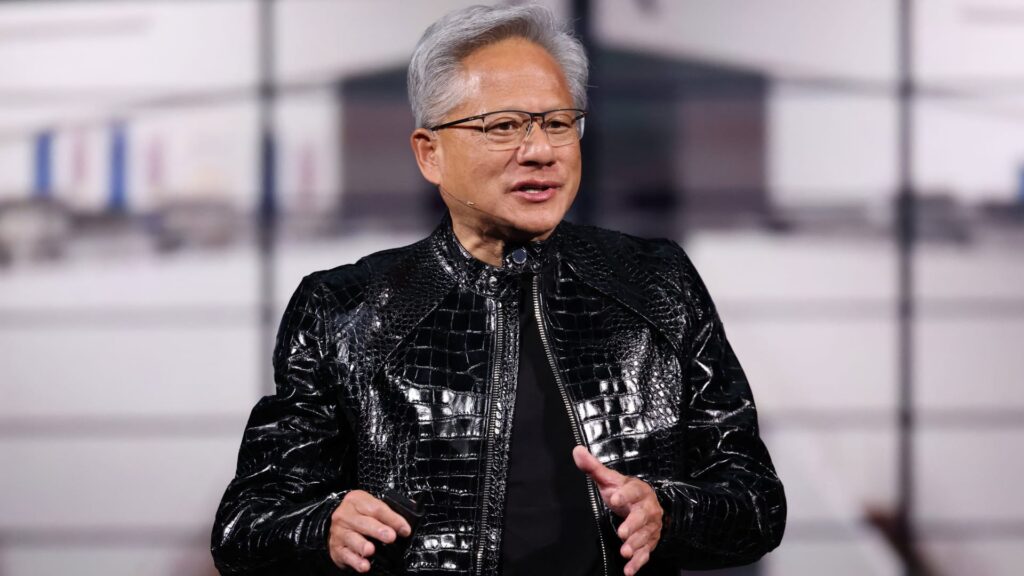
Jensen Huang, chief executive officer of Nvidia Corp., during a news conference at the Nvidia GTC conference in San Jose, California, US, on Tuesday, March 17, 2026.
David Paul Morris | Bloomberg | Getty Images
Nvidia gave strong forward guidance, predicting $91 billion of revenue in its current fiscal second quarter. That’s well above the average quarterly revenue estimate of $86.84 billion, according to LSEG.
Nvidia said it is not assuming any data cetner compute revenue from China in the outlook.
—Katie Tarasov
Nvidia is returning more money to shareholders
Nvidia will return more of its cash to shareholders. The chipmaker’s board has authorized $80 billion for share repurchases. The company is also bumping up its quarterly cash dividend to 25 cents per share from 1 cent previously.
Nvidia generated $48.6 billion in free cash flow in the period, up from $34.9 billion in the prior quarter and $26.1 billion a year ago.
The dividend itself isn’t new, having become available to investors in 2013. In August, Nvidia authorized $60 billion for repurchases.
— Jordan Novet
Nvidia’s profits for the quarter have landed
Nvidia said that net income rose to $42.96 billion, or $1.76 per share, from $18.8 billion, or 76 cents per share, a year earlier.
—Jonathan Vanian
How Nvidia stock is moving after the earnings report


Nvidia one-day stock chart.
Nvidia CEO Jensen Huang on the quarter
Nvidia founder and CEO, Jensen Huang, speaks during the 29th annual Milken Institute Global Conference at the Beverly Hilton in Beverly Hills, California on May 4, 2026.
Patrick T. Fallon | AFP | Getty Images
“The buildout of AI factories — the largest infrastructure expansion in human history — is accelerating at extraordinary speed,” Nvidia CEO Jensen Huang said in a statement. “Agentic AI has arrived, doing productive work, generating real value and scaling rapidly across companies and industries.”
—Jonathan Vanian
Nvidia revenue jumps 85%
Nvidia’s revenue jumped 85% to $81.62 billion from $44.06 billion a year earlier, the company said.
Nvidia’s Vera Rubin AI system: An exclusive first look


Nvidia’s earnings are expected to show booming sales of its current Grace Blackwell rack-scale system. But all eyes are on its next AI system, Vera Rubin, which CNBC got an exclusive first look at in February.
Later this year, top Nvidia competitor Advanced Micro Devices is expected to start shipments of its first rack-scale system, Helios, to compete directly with Vera Rubin.
—Katie Tarasov
Nvidia’s stock is on a post-earnings losing streak
Jensen Huang, chief executive officer of Nvidia Corp., speaks during the 2026 CES event in Las Vegas, Nevada, US, on Tuesday, Jan. 6, 2026.
Bridget Bennett | Bloomberg | Getty Images
Nvidia shares have tumbled after the chip giant’s three most recent financial results. Despite huge demand for its AI chips, analyst expectations may have hit unattainable highs.
Nvidia beat expectations in 18 of the last 20 quarters, yet its stock fell 5% after reporting fiscal fourth quarter results in February. It was down 3% and 0.8% following the previous two reports.
The last time Nvidia saw a double-digit stock move in reaction to earnings was more than two years ago, in early 2024.
Nvidia’s last miss on earnings per share and revenue came in 2022.
—Katie Tarasov
Nvidia options moves ahead of earnings

Investors are positioning ahead of Nvidia’s earnings drop, and there are some unusual moves in the options market.
Options are implying a 5% to 7% move, with a lot of the action leaning bullish.
—Chris Eudaily
Memory price hikes could prove a headwind
SK Hynix Inc. 12-layer HBM3E memory chips, front, and a LPDDR5X CAMM2 memory module arranged at the company’s office in Seongnam, South Korea, on Tuesday, April 22, 2025.
SeongJoon Cho | Bloomberg | Getty Images
Memory prices are up across the board as the global shortage continues, and analysts are watching to see if this could prove a material headwind for Nvidia.
Insatiable demand for AI has largely exhausted supply of what’s known as high-bandwidth memory, or HBM, from leading memory makers Samsung, SK Hynix and Micron.
HBM is made by stacking large amounts of Dynamic Random Access Memory, or DRAM, that enables fast, temporary data storage so chips can run parallel tasks. This is especially crucial for the high-power graphics processing units that make up the majority of Nvidia’s business.
So far, consumer electronics have borne the brunt of the DRAM shortage, as chipmakers like Nvidia reserve their limited supply for AI chips instead of those used in less powerful devices. Gartner predicts PC prices will rise by 17% this year.
According to data from Counterpoint Research, the DRAM market has recorded 30% quarter-over-quarter growth for two consecutive periods, driving memory stocks to be some of the market’s top performers this year.
—Katie Tarasov
Margins show pricing power

Nvidia’s revenue explosion in recent years has been mirrored by an expanding profit margin, underscoring the company’s pricing power, supply chain efficiency and an increase of software in the mix.
From a gross margin in the mid-60s five years ago, Nvidia has lifted that number into the mid-70s today, and it’s one that investors watch closely, particularly with the whole tech industry facing soaring memory costs from a worldwide shortage.
Analysts expect Nvidia to record a gross margin, or the profit left after accounting for the cost of goods sold, of 75% in the latest quarter. That would be in-line with the fiscal fourth quarter and up from an adjusted number of 71.3% a year ago.
Cantor analysts said in a report last week that they’re expecting to see gross margin come in at 75.1%, “based on better volumes of rack-scale solutions and continued Blackwell cost improvements.”
—Ari Levy
As data center dominates, gaming wanes

In the years before the generative AI craze, Nvidia was primarily known for its gaming chips. In fiscal 2020, over half its revenue came from gaming, while just 27% came from the data center.
Fast forward to the present, and Nvidia is almost exclusively a data center company. That part of the business made up 90% of revenue last fiscal year, and there seems to be no stopping it.
Nvidia’s Grace Blackwell rack-scale systems have long been sold out, and Wall Street is now watching for the ramping up shipments of its next system, Vera Rubin.
Meanwhile, gaming is now less than 8% of Nvidia’s business. And as CNBC reported last month, Nvidia’s relentless focus on data center clients has left gamers feeling betrayed, a reality that’s become even more apparent of late due to a global memory shortage that’s led Nvidia to prioritize Blackwell and Rubin over GeForce gaming GPUs.
—Katie Tarasov
Uncertainty swirls around chip sales to China, despite Huang’s Beijing trip
Nvidia founder and CEO Jensen Huang waves after a welcome ceremony for US President Donald Trump at the Great Hall of the People in Beijing on May 14, 2026.
Brendan Smialowski | Afp | Getty Images
One big area of uncertainty is China, specifically pertaining to Nvidia’s older Hopper GPU, known as H200. Huang was a last-minute addition to President Donald Trump’s China summit last week, but the visit did little to clear up whether H200 sales will be permitted in the country.
Huang said at Nvidia’s GTC conference in March that Nvidia had received H200 orders from China.
“We’re in the process of restarting our manufacturing,” Huang told reporters at the event in San Jose, California.
Reuters reported last week that a handful of Chinese companies have been approved by the U.S. Commerce Department to purchase H200s, including Alibaba, Tencent, ByteDance and JD.com.
But one U.S. trade representative said chip export controls were not discussed in the China talks last week, suggesting a major breakthrough on H200 sales may not be close.
China once accounted for at least one-fifth of Nvidia’s data center revenue, but the company has been shut out of the country since being told by the Trump administration in April that it would require a license to export chips there and to a handful of other countries.
—Katie Tarasov
Cerebras’ blockbuster IPO signals new chip competition

Cerebras Systems’ monster Nasdaq debut last week was a clear signal that tech giants are hungry for alternatives to Nvidia’s costly (and sold out) GPUs. The company’s market cap swelled to almost $100 billion on its first day of trading.
Cerebras makes a different type of chip, known as a custom ASIC — application-specific integrated circuit — that’s been gaining ground as agentic AI shifts compute needs toward inference. While GPUs excel at the parallel math necessary for training large models, inference can happen on less powerful chips programmed for more specific tasks.
It’s an increasingly crowded space, with in-house ASICs now made by the likes of Google, Amazon, Meta and Microsoft. Cerebras operates its dinner-plate-sized chips inside its own data centers, pitting it against cloud providers Google, Microsoft, Oracle and CoreWeave.
Nvida also makes custom ASICs in-house after spending $20 billion to acquire Groq’s technology in December, and then announcing custom Groq Language Processing Units at GTC in March.
—Katie Tarasov
Nvidia hit $5 trillion in October. How long until $6 trillion?

Nvidia’s stock is up roughly 20% so far this year, underperforming many of its semiconductor peers but still enough of a gain to support the biggest market cap in the world.
Nvidia became the first $5 trillion company in October, and inched closer to reaching the $6 trillion record last week, though after a bit of a pullback the number now sits at $5.5 trillion.
The company’s record-breaking run comes as chip companies not named Nvidia hit historic highs. Intel had its best month ever in April, as agentic AI spins up a major renaissance for the central processing unit. Memory makers like Micron, meanwhile, have seen shares surge amid a shortage for the key type of chip needed to support AI.
Alphabet briefly surpassed Nvidia to become the world’s most valuable company in after-hours trading earlier this month, but for now that appears to be a momentary blip. Google’s parent is currently worth about $4.6 trillion.
—Katie Tarasov
Nvidia’s data center business is booming as tech giants ramp up AI spending
Nvidia has been a leading beneficiary of the AI boon due to its graphics processing units, or GPUs, that are used to train and run powerful foundation models.
Data center revenue for Nvidia’s fiscal first quarter is expected show an 87% increase from a year earlier to $73.1 billion, representing even faster expansion than the 75% year-over-year jump in the prior quarter and 73% growth rate in the same period a year ago.
The persistent growth reflects the exploding capital expenditures from hyperscalers, which are snapping up GPUs for their data center computing infrastructure that underpins their AI initiatives.
On the same day last month, Alphabet, Amazon, Meta and Microsoft all reported quarterly results, giving investors an updated glimpse into their capex forecasts for the year. Financial firms like Evercore and Bank of America are projecting the group will spend over $1 trillion on AI-related capex in 2027, which ultimately benefits Nvidia.
John Belton, portfolio manager at Gabelli Funds, said in an email on Tuesday that he’s “looking for whether the company is broadening its customer base as that remains a major risk,” adding that five names account for roughly half of Nvidia’s business.
“I’m questioning things such as how durable the growth within that segment of the business is as well as if they’re expanding the customer base and broadening the product set,” Belton said.