


Nearly five years after an atmospheric river devastated large sections of southern British Columbia, communities along the historic Kettle Valley Rail (KVR) Trail are still waiting to learn whether the popular route will be rebuilt or permanently altered.


The KVR washed out right out side Coalmont BC.
Cohan Sassaman
The 2021 flooding washed out bridges, trail beds and infrastructure along the route, leaving major gaps in what was once a continuous corridor connecting communities throughout Canada.
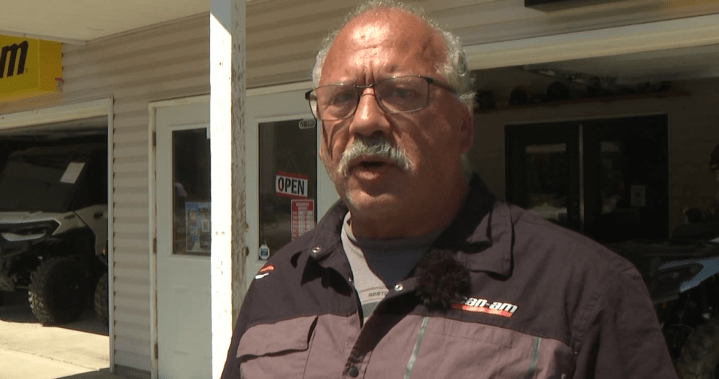
Standing near one of the damaged sections, Tulameen resident and business owner Tom Reichert pointed to where the trail once ran.
Tom Reichert, Reichert Sales & Service Ltd explaing how the decision to not repair the trail full will impact his buisness,.
Cohan Sassaman / Global News
“It is totally washed away, going into private property,” Reichert said. “The residents did their own riprap to save what they could.”


Get daily National news
Get daily Canada news delivered to your inbox so you’ll never miss the day’s top stories.
The trail’s closure has had a lasting impact on local tourism and businesses that relied on a steady stream of cyclists, hikers, horseback riders and outdoor enthusiasts. Before the flood, Reichert said, trail users were a constant presence in the area.
“It seemed like every minute you looked out there were horseback riders or pedal bikers,” he said. “Now, since the flood, not so much.”
Parts of the KVR that was not close to the water did survive.
Cohan Sassaman
A recent study found it would cost approximately $20 million to decommission the damaged sections of the trail, compared with an estimated $50 million to rebuild them. Federal approval is still required before any restoration work can move ahead.
Now the federal government is considering a third option where parts of the trail is rebuilt to attract users on popular sections.
“If Ottawa does approve it, we will have two sections rebuilt, but it won’t be a continuous trail,” said the mayor of Princeton, Spencer Coyne.
Coyne said the loss of the trail has been felt beyond tourism.
“It is a major transportation network for tourism,” he said. “People arrive in Princeton or Tulameen looking to continue that stretch, but they can’t. They get back in their cars and go somewhere else. That’s costing us economically.”
He added that the closure has also affected residents who used the trail daily and serves as a reminder of the destruction caused by the floods.
For Reichert, the trail is also an important emergency access route. As a volunteer firefighter, he said crews have used the corridor to reach injured people.
“It would be a shame not to have that access,” he said.
While communities continue to advocate for repairs, Ottawa has not provided a timeline for when a final decision on the trail’s future will be made. Until then, users of the coast-to-coast trail network will have to navigate around the impassable sections.
Some parts of the KVR did not survice.
Cohan Sassaman
© 2026 Global News, a division of Corus Entertainment Inc.