


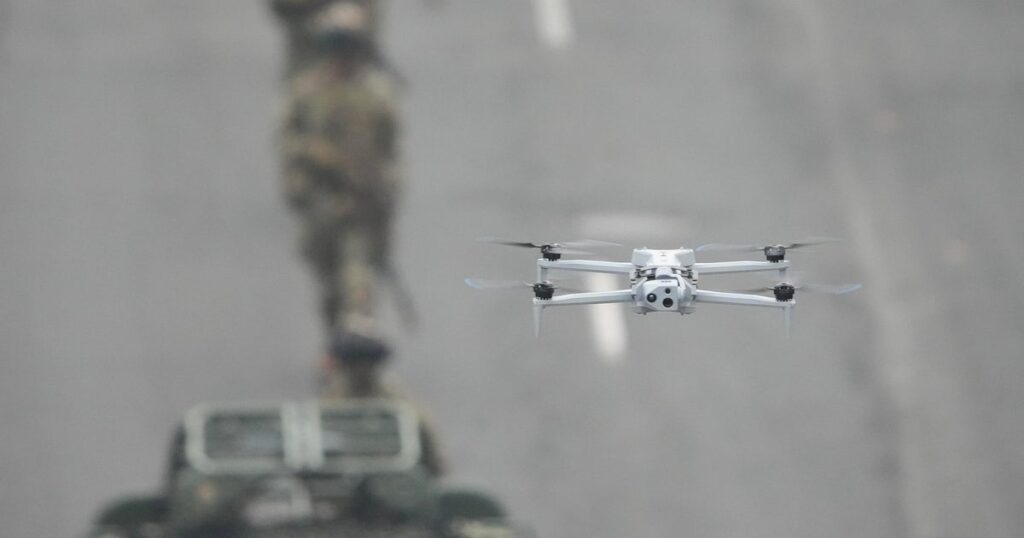
Washington — As the U.S. military races to adapt low-cost, expendable drones for battlefield use, an Army explosive safety specialist warned that the Defense Department’s rush to innovate may be outpacing basic explosive safeguards, raising the risk of accidents.
The assessment was tucked inside a memo obtained by CBS News detailing how a mini-drone had detonated, causing injuries to an Army Special Forces soldier.
In a March memorandum, a civilian U.S. Army employee — with more than 20 years of experience in uniform and as a civilian employee evaluating and monitoring safety experience in the service — cautioned that while U.S. Army Special Forces units are adept at improvising solutions in the field, the broader drive to counter unmanned aerial threats has imposed pressures that could undermine long-established safety standards.
“We fully understand [Special Forces]’s ability to innovate and create tactical solutions to accomplish a mission set [or] task,” the memo states, but it goes on to say that the safety specialist believes that the Defense Department “is in such a rush to solve future and enduring threats related to [unmanned aerial systems]” that “basic explosive safety principles are being ignored,” and “will ultimately lead to a greater risk associated with mishaps [or] accidents.”
Drones have been used for decades by the U.S. military, particularly during the wars in Iraq and Afghanistan. But the Russia-Ukraine conflict has dramatically expanded the battlefront for drone warfare, and what has emerged is the understanding that the U.S. military will need to find a way to quickly and cheaply scale up its production of lethal drones.
Earlier this year, Defense Secretary Pete Hegseth created Joint Interagency Task Force 401 to help accelerate the Pentagon’s drone production capabilities. Late last year, the Pentagon requested information from the defense industry to gauge its “willingness and ability” to make roughly 300,000 drones, following President Trump’s executive order calling for more unmanned aircraft systems to be produced.
The March assessment was written by an explosive safety specialist with the command safety office at Fort Polk in Louisiana, where the Army’s Joint Readiness Training Center is located.
The memorandum was sent by the specialist to the director of safety at U.S. Army Special Operations Command at Fort Bragg in North Carolina.
The warning appeared in a letter detailing an incident in which a small explosive device attached to a drone detonated inside a building at the Army’s Joint Readiness Training Center.
Army Col. Allie Scott of the U.S. Army Special Operations Command told CBS News that the comments from the safety investigator in the memorandum appear to be his opinion and not based in fact.
Scott confirmed the authenticity of the memo and research of the safety report and said the soldier involved in the blast returned to duty shortly after sustaining the injuries from the blast.
CBS News reached out to the explosive safety specialist and the office he works for at Fort Polk but no reply was returned. CBS News also contacted the U.S. Army’s Combat Readiness Center at Fort Novosel, Alabama, which serves as the central authority for safety, risk management and accident prevention.
A spokesperson for the center told CBS News it did not receive a request to investigate the incident, explaining that for an incident to be investigated by Army center, it must “meet the threshold in regard to a dollar value of damages to equipment and/or a permanent injury or death.”
The blast occurred when a Special Forces soldier assigned to the Army’s 3rd Special Forces Group attempted to disconnect the device during troubleshooting, resulting in minor injuries, including lacerations to the arm and face and a concussion. Photographs included in the memo, taken inside a cluttered workspace, show a damaged drone and scattered equipment on a table, underscoring how close the incident came to causing more serious harm.
The investigator believes the detonation may have been triggered either by static electric charge or hazards of electromagnetic radiation to ordnance, possibly caused by an improperly secured relay switch that allowed current to pass through the drone’s carbon fiber frame.
The device involved, an XM183″MiniBlast” pyrotechnic cartridge, was made by Houston-based PR Tactical Corporation, which specializes in producing pyrotechnic explosives for U.S. military training exercises.
Contacted by CBS News, Fred Laughlin of PR Tactical Corporation said the company would not comment before seeing the full report.
The XM183 “MiniBlast” cartridge is designed to replicate the sights and sounds of combat on the modern battlefield. Used during unit exercise, the round is part of a broader system of battlefield effects simulators intended to immerse soldiers in realistic conditions without the use of live munitions.
The memorandum noted that the XM183 “MiniBlast” cartridge has been assessed as having a medium-level hazard risk because it can produce dangerous fragments or shrapnel and can accidentally ignite or detonate.
It also noted that the U.S. Army’s Combat Capabilities Development Command had not provided a “full material release” for the XM183 “MiniBlast.”
Under Army regulations, a “full material release” is the formal determination that a material is safe for use, capable of meeting its operational requirements and sustainable through the Army’s logistical system when it’s employed under approved conditions.