


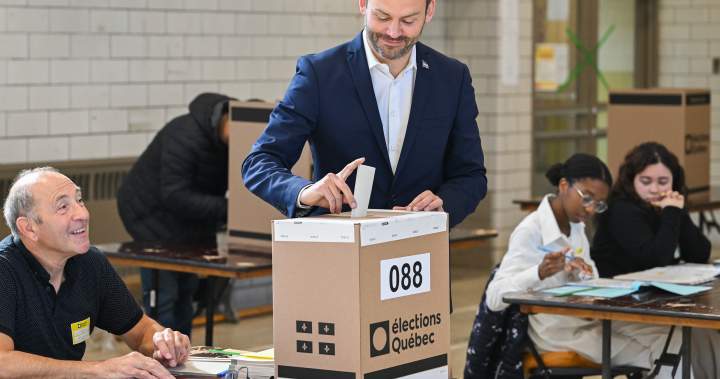
Quebec’s new minority government made several promises to its English-speaking community, but anglophones say they’re approaching the new government with both optimism and skepticism.


The Parti Québécois (PQ) was elected to a minority government in Monday’s provincial election, just five seats shy of a majority, meaning it will have to work with opposition parties to pass legislation.
During the campaign, premier-designate Paul St-Pierre Plamondon stressed the importance of the anglophone community, defending their right to election documents in both official languages and suggesting changes to the province’s language law, Bill 96.
But Sylvia Martin-Laforge, director general of TALQ, which advocates for the province’s English-language communities, said they will be watching to see what actions Plamondon takes.
This includes whether will reverse a challenge by the government on whether English-speaking Quebecers can receive voter information in English and French.
“He had questioned the vallue of challenging bilingual voter information during the campaign, noting that was a fundamental right,” she said. “So that would be an important first message to the English-speaking community if he recognizes that voter information should be in both languages.”
Yet, she also said his stance on applying the Charter of the French Language to CEGEPs is “not good news.”
Martin-Laforge told Global News that education is important for the “vitality” of anglophones, and would like to hear more information on how the new government wants to handle education and if any restrictions could be in place for attending English-language schools.


Get daily National news
Get daily Canada news delivered to your inbox so you’ll never miss the day’s top stories.
Daniel Béland, the director of the McGill Institute for the Study of Canada, said Tuesday that the PQ won’t want to be “at war” with anglophones especially as many did not vote for them.
Statistics on how many anglophones voted for each party are not yet available, but several electoral districts with strong English-speaking communities primarily voted Liberal.
On the Island of Montreal, the Quebec Liberals (PLQ) took 19 of 27 seats with just two PQ MNAs elected.
“In a minority context, with two parties that are explicitly willing to defend the anglophone minority, and I will even add Quebec Solidaire to the Conservatives and the Liberals in a sense, I think that he (Plamondon) will have to be careful the way we move forward in terms of policies that will affect anglophones directly,” Béland said.
He added the PQ doesn’t want to appear “mean” to English-speaking communities just because the party supports independence, an issue many anglophones are against.
Early in the campaign, Plamondon promised to hold a referendum on Quebec independence – something he had promised even before the election began. But he said he wouldn’t hold one until after U.S. President Donald Trump leaves office in January 2029.
With a minority government, getting that referendum to a voting day would likely require additional support from at least one other party.
The Quebec Liberals and Conservatives (PCQ) have been staunch on their opposition to a referendum, but at least one party could lend support.
“There’s another party that’s been elected to the legislature that also supports a referendum and separation and that’s Quebec Solidaire,” said Nelson Wiseman, professor emeritus of political science at the University of Toronto. “So between the two of them, they have a majority. So, forgetting Donald Trump, they could act on it sooner, or if they want they can act on it later.”
He added being a minority government, there is the risk it could fall to a confidence vote before 2029 setting the stage for an election before a referendum is ever held.
A referendum question in Quebec can’t head to the public for a vote without moving through the National Assembly. The PQ won 59 seats in Monday’s vote, while the PLQ and PCQ received 40 and 19 respectively totaling 59 together. Quebec Solidaire won nine seats, meaning they could join with the PQ to support the referendum.
“The timing is problematic and also there is the Trump problem or issue,” Beland said. “So the PQ will have to break its promise and organize a referendum that’s already really unpopular among Quebecers before the deadline they had set for themselves.”
© 2026 Global News, a division of Corus Entertainment Inc.