


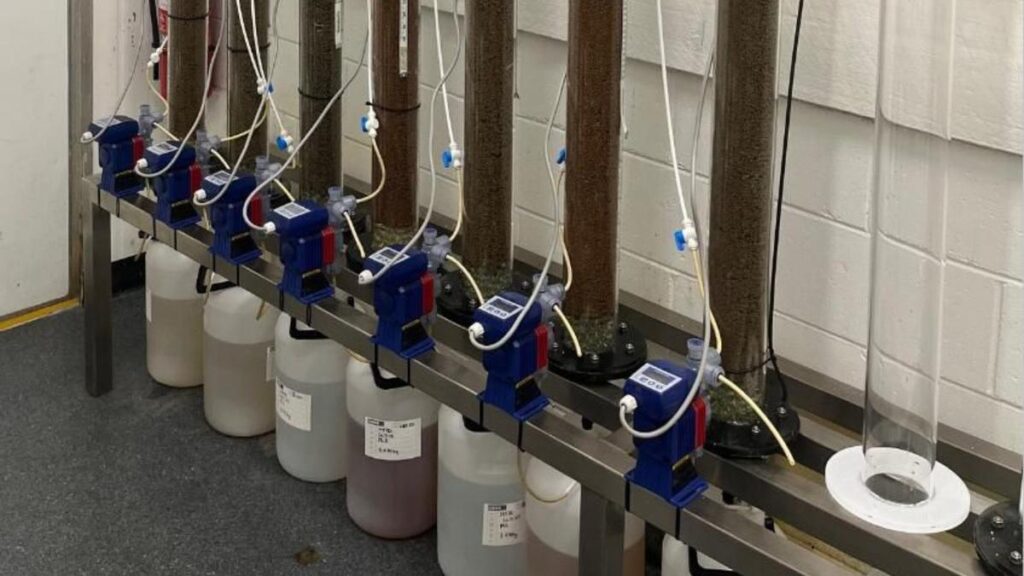
Red Metal has moved a big step closer to proving a low-cost processing route for its monster Sybella rare earths project in Queensland, with definitive column leach tests delivering stellar recoveries from coarse-crushed ore using weak sulphuric acid at ambient temperature.
The company says large column leach tests on representative samples from the Kary Zone have validated its view that the mineralisation can be mined, crushed, stacked and leached in a broadly similar style to large soluble copper heap leach operations.
Tests on both minus 10 millimetre and minus 20mm fractions of saprock and transitional mineralisation produced high rare earth extractions, low impurity levels in the pregnant leach solutions and modest acid consumption. The coarser minus 20mm results are particularly useful because they point to possible savings in crushing, pad size and overall operating costs.
Standout recoveries included neodymium extractions of 71 per cent from minus 10mm saprock and 70 per cent from minus 20mm saprock, while transitional ore returned 76 per cent and 75 per cent, respectively. Praseodymium recoveries were similarly strong, running from 71 per cent to 78 per cent across the same ore types and crush sizes.
The heavy rare earths also performed solidly, with dysprosium extractions between 39 per cent and 41 per cent alongside terbium, which ranged from 43 per cent to 44 per cent. Red Metal says between 35 per cent and 55 per cent of total rare earth extraction occurred in the first 30 days, suggesting scope for early metal recovery once each new heap or heap lift is commissioned.
The tests were run on composite diamond core samples collected from several holes across the northern part of the Kary Zone, providing the company with a more representative view of how the mineralisation may perform in a bulk mining setting compared with smaller-scale test work.
The similarity in response between the saprock, transitional and blended ore types is another important tick, as it suggests the zones could be co-processed in a bulk mining operation without the need for overly complicated grade control between the weathering domains.
Our column leach tests on the Kary Zone ores have conclusively shown that we can efficiently extract light and heavy rare earths from the mineralised granite by coarsely crushing it, stacking it and then leaching it with weak sulphuric acid at ambient temperature.
At a 300 parts per million (ppm) neodymium-praseodymium cut-off, Red Metal says the Kary Zone hosts 936 million tonnes (Mt) at 334ppm combined neodymium-praseodymium and 31.7ppm combined dysprosium-terbium to 100 metres depth. That resource comprises 182Mt of saprock from surface, 157Mt of transitional ore and 598Mt of fresh granite, which was still leaching at the time of reporting.
The Sybella project lies 20 kilometres south-west of Mount Isa and is built around a granite-hosted rare earth system that starts at surface. It has a zero strip ratio in the early weathered material and is being assessed as a potentially simple heap leach development.
The company will now push ahead with prefeasibility work, including further column tests on a minus 30mm fraction, taller 6m columns, ion-exchange purification studies using the leach liquors and geotechnical work to help determine heap stack heights.
Red Metal’s broader exploration book gives it plenty of other levers to work with, too. Its March quarterly flagged follow-up gold work at Pardoo in WA, copper-gold targets at Pulkarrimarra in WA and Pernatty Lagoon and Callabonna in SA, along with government co-funded drilling across priority targets in Queensland and WA.
For now, though, Sybella is the clear headline act. If Red Metal can keep converting its lab work into practical engineering numbers, its Mount Isa rare earths push may have just taken a meaningful stride from clever concept towards a much stronger development case.
Is your ASX-listed company doing something interesting? Contact: matt.birney@wanews.com.au