


Scott Young has come across brown bullhead catfish with dark spots for much of his four-decade fishing career across New Brunswick’s lakes and rivers.


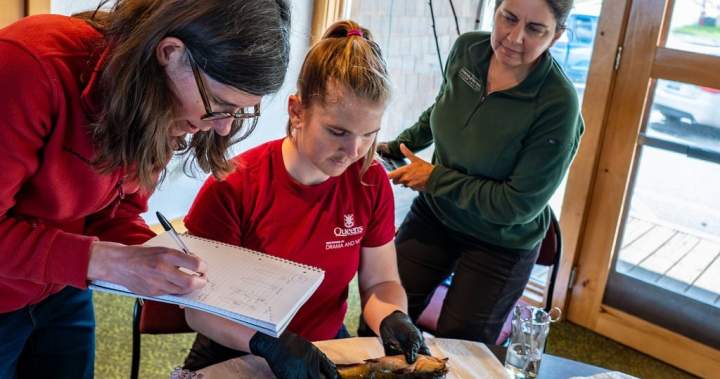
In May, Young took University of Cambridge researcher Zoe Clarke on his boat to collect the spotted fish to confirm her theory that the lesions may be a form of contagious cancer first identified hundreds of kilometres away.
Clarke says she believes results from a DNA sequencing lab that are expected in the next few weeks will show the spotted catfish Young has seen for years have the same transmissible cancer discovered in a lake along the Quebec-Vermont border.
“How the heck did this happen? Why is it here?” said Clarke, a postdoctoral researcher working with the British-based University of Cambridge’s Transmissible Cancer Group.
“That’s the kind of thing that we’re going to be devoting a lot of our energy to over the next few years.”
In studies conducted between 2014 and 2018, scientists determined that raised black growths seen as early as 2012 on brown bullhead catfish in Lake Memphremagog, which straddles the border between Canada and the U.S., were skin cancer.
Then, a study published last month by a team of scientists out of the University of Vermont reported the melanoma found in the catfish was transmissible, the first for any fish or freshwater ecosystem.
In a paper in Nature, the researchers called the contagious cancer “a puzzling biological phenomenon” and warned of its “potential to devastate host populations.”


Get daily National news
Get daily Canada news delivered to your inbox so you’ll never miss the day’s top stories.
The catfish melanoma is only the fourth known distinct lineage of naturally-occurring transmissible cancer in the animal kingdom, following those found in dogs, Tasmanian devils, and an assortment of shelled aquatic creatures, including clams and mussels.
Dr. Julie Dragon, co-lead on the study and an associate professor of microbiology and molecular genetics at the University of Vermont, said genome sequencing revealed the tumours were clone copies of one another as opposed to separate mutations.
In typical cancers, tumours are nearly identical to the host’s DNA with just a few mutated genes.
But analysis of the catfish found evidence the tumours were genetically distinct from their hosts, stemming instead from one parasitic cell line that originated from a single catfish in the past and is physically spreading from fish to fish.
And now the scientists out of Vermont and researchers in England are trying to figure out where the cancer originated, Dragon said.
“We don’t think it started in Lake Memphremagog, and we have already confirmed that it does exist in lakes in New Hampshire and Maine,” she told The Canadian Press.
After Clarke began placing call outs to see if the melanoma had spread to other areas of eastern Canada, she received a response last October from a doctoral student who had seen the lesions on catfish while spending time on a fishing boat in New Brunswick.
She booked her trip to New Brunswick soon after and is now waiting on the sample results from the Hubbard Center for Genome Studies in New Hampshire.
If the DNA from Clarke’s New Brunswick samples are a match, it will help the researchers as they try to solve the mystery of when and where it originated.
“It gives us a great idea of where we can go next to try and keep putting this puzzle together as to where, how, and why is this happening because that’s exactly what we’re trying to figure out,” she said.
Clarke said she’s planning to return to New Brunswick next year to sample fish up and down the Saint John River’s less populated areas.
“We might even rent a little camper van.”
The researchers are asking anyone who comes across the fish with lesions to send photos and location data to Dragon by email, and freeze whole specimens for testing.
Dragon, in Vermont, says studying the diseased catfish could give researchers a chance to study how melanoma starts and grows. While humans get skin cancer largely by exposure to ultraviolet light that damages skin cell DNA, the catfish live in the mud and feed at night.
“That is unusual and we are looking into, why melanoma? But it also is an opportunity because we think these fish could provide a model for studying melanoma,” she said.
As for humans who may be worried about catching cancer from catfish, Dragon says it’s not a concern.
“There is no evidence that it could spread to a human,” she said.
Still, Dragon says the U.S. Fish and Wildlife Service doesn’t recommend eating fish with obvious lesions or growth.
© 2026 The Canadian Press