


Belfast, Northern Ireland – When violence broke out in east Belfast near Zeinab’s home, as a mother of three from Sudan, she felt terrified.
Anti-immigrant rioters have carried out a wave of racist attacks in the Northern Irish capital after a knife attack on Wednesday.
Recommended Stories
list of 4 itemsend of list
The alleged assailant, a 30-year-old Sudanese national who entered Northern Ireland through Ireland, has been charged with attempted murder. The victim, 44-year-old Stephen Ogilvie, remains in hospital with life-changing injuries to his face and back, having reportedly lost an eye.
“We strongly condemn and reject what happened,” said Zeinab, who requested to withhold her surname. “Unfortunately, it turned out that (the suspect) is of Sudanese nationality. But this is the opposite of what is known about our Sudanese people. They are kind people, known for their generosity, their morals, and the way they treat others.”
As agitators burned homes and businesses they believed to be owned by ethnic minorities, Zeinab asked an NGO, the Anaka Women’s Collective, to evacuate her family.
Like other people of colour, she was welcomed by an Irish family and is now taking shelter outside Belfast.
“May God reward them with all goodness. We cannot describe what they have done for us,” she said. “We feel that not everyone here is unaccepting of foreigners. There is goodness, there are people who love us, people who shared their homes with us, shared our worries, shared our moments of weakness, and took us in.”


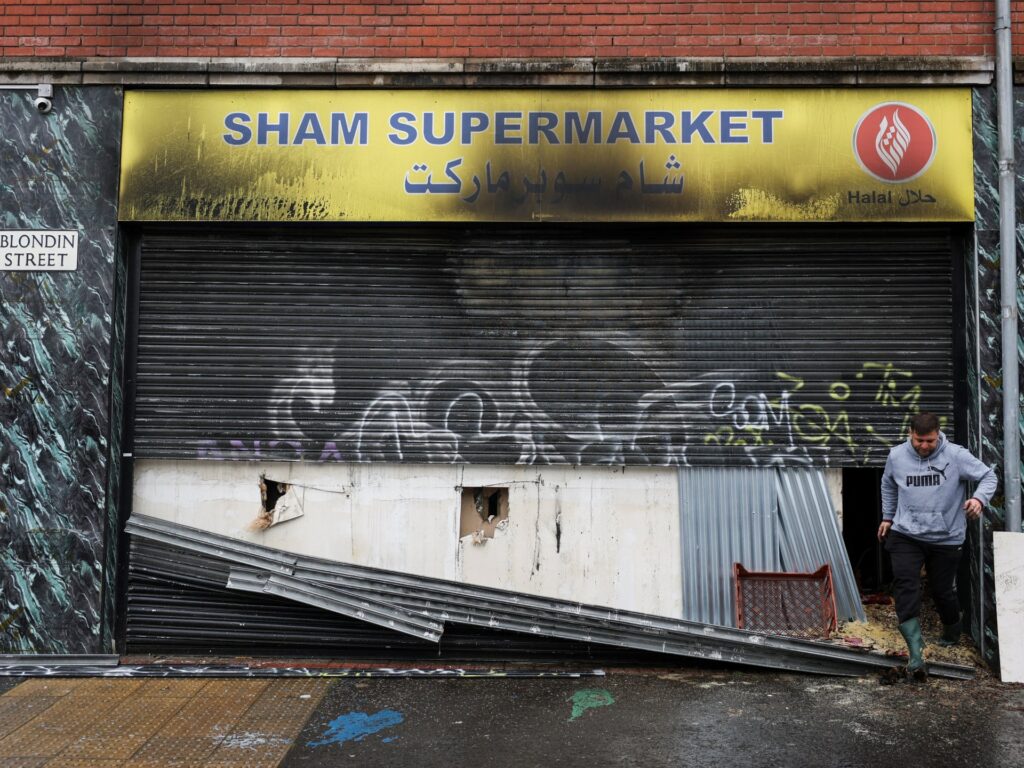
On Tuesday evening, an eerie silence took hold of the city as panicked local traders hurriedly pulled up their shutters, locking up early after threats issued on social media earlier that day.
A list created by AI, shared by prominent figures such as Tommy Robinson and Elon Musk, warned “All Bunnesses” shut up shop by 5.30pm. It included names of streets in the Northern Irish capital. A second list showed some 70 locations in the United Kingdom, also shared about the same time.
“The whole of the United Kingdom is hitting the streets tonight at 7pm following yet another invader attack on our people,” far-right agitator Robinson said.
Hundreds heeded the call.
Young boys, some of whom looked no older than 13, marched determinedly in the direction of east Belfast’s Lower Newtownards Road.
Within an hour, several loud bangs were heard as a bus and other vehicles were set alight, sending plumes of smoke into the drizzly June evening. Some perpetrators were understood to have been as young as 10.
On the street, the words “F*** Islam” were graffitied on the shutters of a halal butcher shop.
Anti-Islam sentiment appears to be a “more prominent feature” in these riots, Amnesty International’s Northern Ireland Director Patrick Corrigan told Al Jazeera, compared with other episodes of unrest.


As video footage showed, crowds would go on to smash windows, kick down doors and attempt to intimidate or burn out residents from nearby houses where they believed migrants were living. A large group of adults watched as the young rioters kicked up mayhem, terrorising Belfast’s relatively small but growing ethnic minority communities and claiming the night – and this part of town – as theirs.
Only 3.4 percent of Northern Ireland’s population, just over 65,000 people, were found to be from an ethnic minority background in the 2022 census. In a country of 1.9 million, just 2,379 are seeking asylum. But as Corrigan has noted, this is the “third consecutive summer in which Northern Ireland has experienced organised racist violence, with each outbreak more serious than the last”.
The scenes echo coordinated attacks in England over recent years, as a familiar pattern plays out: Riots in the wake of a crime, alleged or proven, if the accused or guilty party is not white.
As in the recent case of the killing of Henry Nowak, a teenager murdered in southern England, the victim’s family in Belfast has said the street disorder is “not welcome”, condemning attempts to “divide people or fuel hostility”.

Belfast closed down ‘because of fear’
For Northern Ireland’s victims of crime commissioner, Geraldine Hanna, the ability of distant and faceless digital actors to rapidly cripple the region’s largest city represents a power she believes the devolved government at Stormont does not have.
“Basically, on the back of a GIF on social media, Belfast closes down,” she said. “Schools close, public transport closes, businesses close. Because of the fear.”
Hanna said one protest planned for Wednesday did not go ahead in the end.
“But [nevertheless] some faceless online actor was able to close down Belfast.”
She told Al Jazeera the attacks should be treated as “domestic terrorism” and questioned why the government was not addressing them as such, leaving civil society actors such as charities to plug gaps in immediate response, mutual aid and formulating counter-strategies.
Other demonstrations in larger urban centres across Northern Ireland were joined by crowds dressed in black and covering their faces. Some masked men set up informal checkpoints, asking drivers passing by if any passengers were the “foreigners” they boasted about hunting.
Stretched police officers have also come under attack. In north Belfast, bricks and masonry were thrown at officers in riot gear.
About 200 families have been evacuated, according to the Participation and Practice of Rights charity.
Northern Ireland’s Housing Executive said it has assisted 29 households since the beginning of the “civil unrest”, adding that it was still assessing damage to homes.
A “hit list” of properties believed to be Houses in Multiple Occupation, or HMOs, in south Belfast has circulated on Facebook. The addresses appear to have been scraped from public HMO data, spanning social housing and student accommodation in leafy streets. Ethnic minority community support groups believe the intent was to intimidate vulnerable people.
At the political level, responses from North Belfast MP John Finucane and Northern Ireland’s First Minister Michelle O’Neill – both of the all-island Republican Sinn Fein party – were considered effective in calming tensions.
The new Ulster Unionist Party leader, Jon Burrows, said he was “threatened” by a “baying mob” at Lower Newtownards Road, a site where journalists were intimidated and agitators warned people against filming them.
Meanwhile, Democratic Unionist Party (DUP) politicians defended the protests over “legitimate immigration concerns”, while party leader Gavin Robinson went further, calling for the closure of the “open and porous border” with Ireland.