


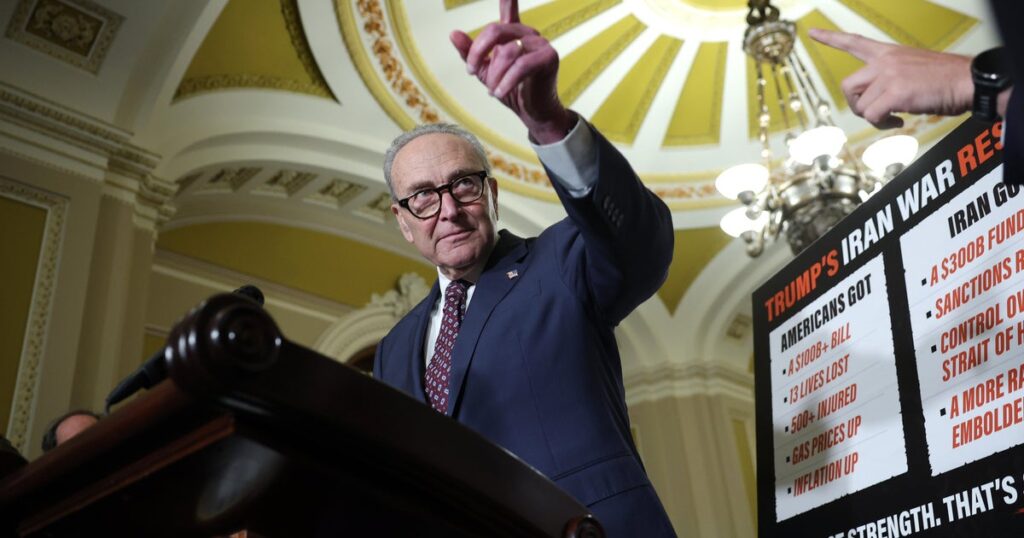
Washington — Senate Democrats blocked a must-pass annual defense policy bill from moving forward on Tuesday as they voiced opposition to the Trump administration’s handling of the war with Iran.
“The NDAA, in my view, has become a referendum on the Iran war,” Democratic Sen. Richard Blumenthal of Connecticut told reporters Tuesday.
In a 50 to 46 vote, the Senate opposed an initial procedural vote to advance the National Defense Authorization Act. Senate Majority Leader John Thune voted against it a move that allows him to bring up the bill again.
Democrats have harshly criticized how the Trump administration has moved ahead in the Iran conflict without approval from Congress. The 1973 War Powers Resolution dictates that the president must report to Congress within 48 hours of deploying forces if lawmakers haven’t authorized a declaration of war, and caps any unauthorized engagement at 60 days. But the Trump administration has maintained that hostilities “terminated” in April, until they began again in recent days.
Senate Minority Leader Chuck Schumer criticized the timing of the vote to proceed to the NDAA, noting that the White House formally notified Congress on Monday that hostilities have resumed in Iran.
“Yet Republicans want the Senate to take up the NDAA, the defense bill, as though none of this is happening?” Schumer said ahead of the vote. “As though Congress can debate the nation’s central national security bill while ignoring the nation’s most urgent national security crisis? We cannot. I will be voting no.”
The New York Democrat railed against President Trump for “waging an unauthorized war, defying bipartisan majorities in Congress, refusing to level with the American people about the cost, the mission, or the end game.”
“The NDAA cannot become a permission slip for that recklessness that we see occurring in Iran,” he added. “Donald Trump does not get to drag the American people deeper into a war he cannot explain and does not know how to end, and then demand Congress look the other way.”
The NDAA sets lawmakers’ defense priorities and usually passes with broad bipartisan support. Thune urged Democrats to support the bill Tuesday morning, saying he was hopeful that the Senate could pass the bill soon and begin working with House and White House counterparts to get it over the finish line.
“Republicans are ready to go,” Thune said. “The question is, how will Democrats vote today?”
Thune said he saw “no reason” for Democrats to oppose, but he argued that “Democrats have allowed the politics of obstruction to determine so many of their actions for the last year and a half.”
“I certainly hope that Democrats won’t now put politics ahead of support for our men and women in uniform,” he said. “But that’s up to them.”
Thune praised the legislation for putting a “heavy emphasis on unmanned systems, especially drones and counterdrone measures,” along with continuing shipbuilding efforts “to strengthen our Naval fleet.” In terms of air power, Thune touted how it would “help ensure we maintain a force of at least 1,800 fighters,” while supporting the new B-21 long-range strategic bomber.
The South Dakota Republican highlighted in particular how the bill builds on efforts in last year’s NDAA to reform defense acquisition, including by allowing multi-year procurement contracts. He also touted the bill’s 3.6% pay raise for troops, along with other investments in education, housing, health care and childcare.
“Our colleagues on the Armed Services Committee have put forward a strong bill — a strong bill for our national security and for the men and women who defend our nation,” Thune said.