


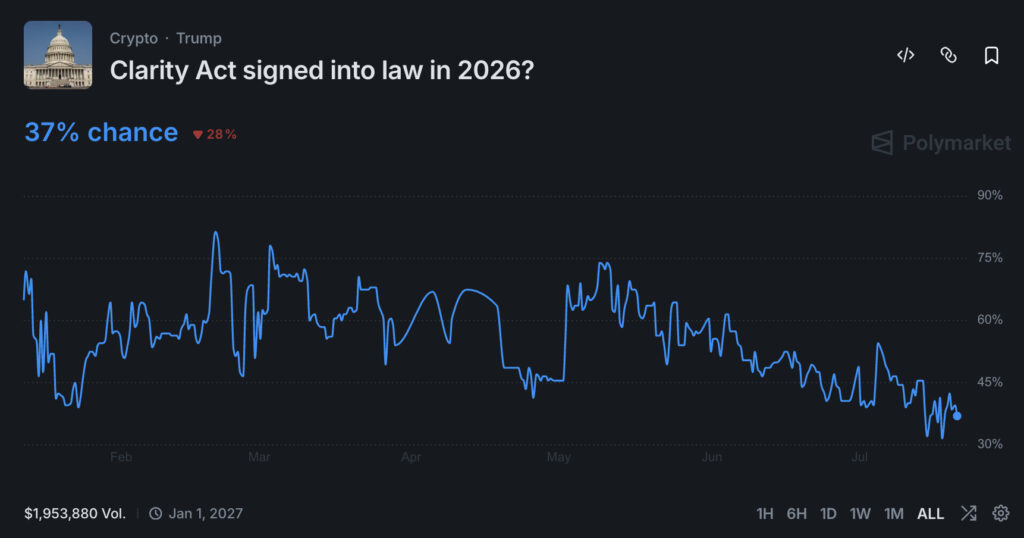
Polymarket traders have cut the odds of the CLARITY Act becoming law in 2026 to 37% today. The prediction market has turned more cautious as Senate negotiations remain deadlocked over ethics provisions tied to President Donald Trump’s crypto business interests. Although the House has passed the bill and the Senate Banking Committee approved it, the legislation has yet to receive a Senate floor vote.
The delay has fueled concerns that the bill could miss its best opportunity before lawmakers leave Washington for the August recess. Every week without progress leaves fewer legislative days on the calendar. As a result, traders have become increasingly skeptical that the legislation can clear the Senate this year.

The biggest obstacle is no longer the bill’s market structure framework. Instead, negotiations have centered on an ethics amendment. Senate Democrats, led by Elizabeth Warren, want enforceable restrictions preventing senior government officials, including the president, from financially benefiting from the digital asset industry they oversee.
Discover: The Best Crypto to Diversify Your Portfolio
CLARITY Act Stalls as Ethics Dispute Deepens
Republicans have resisted language aimed specifically at the president’s crypto interests. They argue such provisions could undermine bipartisan support for the broader legislation. Without a compromise, Democrats have shown little willingness to provide the votes Republicans need to advance the bill.
The debate intensified after Trump’s latest annual financial disclosure revealed roughly $1.4 billion in crypto-related income. The filing included about $594 million connected to World Liberty Financial. It also reported approximately $635 million tied to the TRUMP meme coin venture.


Democrats argue that those financial interests create an obvious conflict if the president signs legislation affecting the same industry. They contend that ethics protections should accompany any market structure reforms. The disclosure has therefore become the central issue in Senate negotiations rather than a secondary political dispute.
The Senate math leaves little room for error. Most legislation requires 60 votes to overcome a filibuster, meaning Republicans cannot pass the CLARITY Act on their own. They must secure support from several Democrats to move the bill forward.
Several Democrats who previously appeared open to supporting the legislation now insist on enforceable ethics safeguards before committing their votes. Until bipartisan negotiators bridge that gap, the bill is expected to remain in procedural limbo despite continued backing from much of the crypto industry.
Discover: The Best Token Presales
Senate Calendar Leaves Little Room for Delay
Time has also become a growing concern. Senate leaders have only a limited number of legislative days before the August recess. Appropriations bills, nominations, and other priorities continue competing for valuable floor time.
If the CLARITY Act misses that window, its path could become even more difficult later this year. Congress will soon shift its focus toward government funding deadlines and other legislative priorities. Supporters acknowledge that every delay increases the political challenge.
For now, Polymarket traders appear to be pricing in uncertainty rather than outright failure. The odds could improve if lawmakers reach a bipartisan agreement on ethics language or if Senate leaders schedule a floor vote. Until then, the CLARITY Act remains stalled, and its path to becoming law remains uncertain.
Trade Ethereum on Bybit and Get a Chance to Win Our $1,000 USDT Airdrop
The post Senate Ethics Deadlock Drags CLARITY Act Odds Under 40% on Polymarket appeared first on Cryptonews.