


Every day across Australia, hundreds of camels, mules and goats are working diligently to help keep the country moving.
Donkeys are rounding up cattle and defending land against predators, pigs are sniffing out truffles and horses are on the ground removing logs from forests.
Their bravery and intrinsic behaviour has been valuable for hundreds of years, helping reduce devastation across the country and saving the economy millions.
However, more than a third of Aussies are unaware of how animals help our everyday life.


A new Working Animals International study found that more than a third of Australians believed animals working alongside people was a “thing of the past”.
In reality, these animals are some of the most important figures keeping the country moving.
“Working animals such as horses, donkeys, mules, oxen and camels play a vital role in the lives of millions of people,” chief executive Linda Edwards said.
“They help families earn an income, transport goods to market and ensure that children get to school, yet too often, their welfare is overlooked.”
Donkeys, for example, are often used to help round up cattle and, in Australia, to protect farms against predators, such as foxes, wild dogs and dingoes, and reduce the threat of bushfires.
Yet, 87 per cent of Australians are completely unaware of how they keep the country moving.
“For over a century, we have worked alongside animal owners to improve access to skills, advice and veterinary care so that working animals can live healthy lives and be properly valued,” Ms Edwards said.


Brooke Purvis, who lives in the NSW Hunter Valley with her husband, was once a horse competitor.
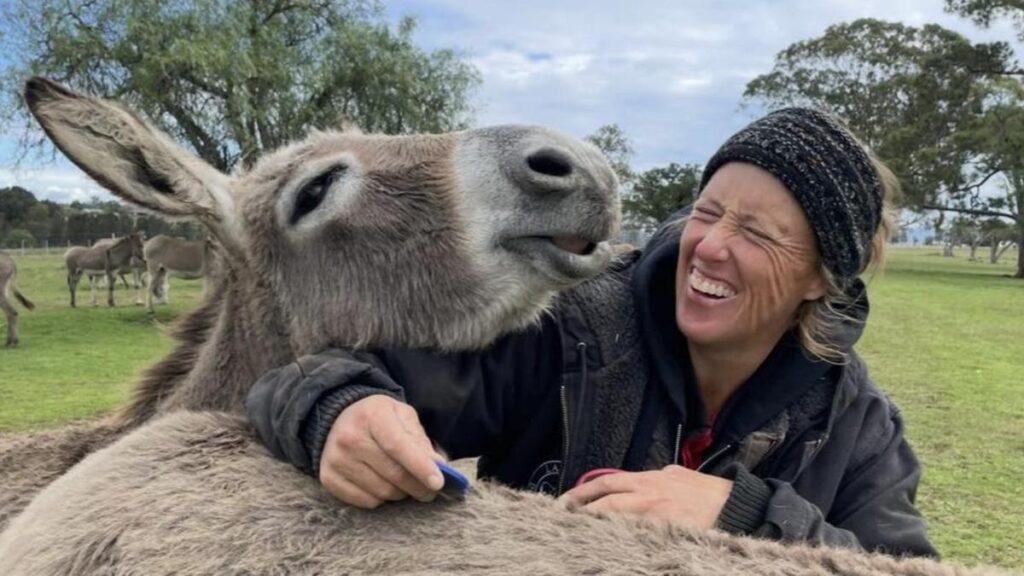
But since 2021, she’s been training feral donkeys from the Northern Territory to work as guardian against predators threatening the land.
Donkeys are considered pests in the Northern Territory and are often shot to control the population.
“They shoot feral donkeys in the NT and we thought ‘how can we repurpose them over here?’” Ms Purvis said.
“Donkeys are far more than ‘just feral’ – they’re intelligent, practical working animals with a key role in Australia’s agricultural future.”


The donkeys are sent from the Top End to NSW in October before the wet season arrives, coming interstate by truck.
“I never know which donkeys I’m getting; whether they’re pregnant, their ages, males to females ratio – it’s a bit of a hit and miss,” Ms Purvis told NewsWire.
After spending a fortnight in quarantine, the donkeys are given time to adjust to their new surroundings before they begin training.
“You’d be silly to try and work with them straight away,” she said.
Ms Purvis said training a donkey to work as guardians wasn’t easy but worth every second.
“Donkeys are a long-term investment if you do right by them,” she said.
Ms Purvis said it took about 12 months to train one to become a guardian – but not every donkey had the chops to make it.
Generally speaking, “stand-offish” donkeys work best as guardians, while “personable human-oriented” are better suited as pets.
“It’s a process of trust,” she said.
“They get to ‘be’ a donkey, follow the others in, come through the yard, and adjust quite well – it’s more about training the people than the donkeys.”


The couple have more than 100 donkeys on their farm, of which half are being trained to help protect the land against predators and bushfires.
Contrary to popular belief, donkeys are not stupid – they’re highly intelligent and offer resilience and strength in spades.
“Donkeys are little silent assassins,” Ms Purvis said.
“They’re paddock territorial, so (they) patrol their paddock and friends.
“If something comes in that’s not meant to be there, they will go and investigate, snaking over as quietly as can be, and when they get close enough, they strike.”
Farmers are some of the donkeys’ biggest fans.
“The farmers down here need donkeys – they’ve got a strong role in Australia’s agricultural future,” Ms Purvis said.
”They’re not a pest to them.”

They’re also skilled in reducing the spread of bushfires.
“They get in the country where the cattle can’t and eat the flammable scrub like weeds and thistles, which stops the need for spraying weeds and thistles,” Ms Purvis said.
The loving and intelligent animals also create large dirt patches wherever they go, allowing water to become trapped in puddles.
This forms a type of semi-break, helping reduce the spread of bushfires.

Donkeys, like people, need interactions with others, so they’re usually put together in pairs.
“They require pairing for their wellbeing and mental health,” Ms Purvis said.
“They’ve got to be in twos, it’s like putting two kids in a room – you need a valuable interaction.”
Ms Purvis said one of the biggest highlights of her job was seeing donkeys interact with other people.
“We also do a bit of respite for teachers with kids who just need a break from the classroom,” she said.
“The donkeys go through the schoolyard, and then if the kids are having a hard day, they get sent down to the donkeys and love it.
“They’re like therapy animals.”