


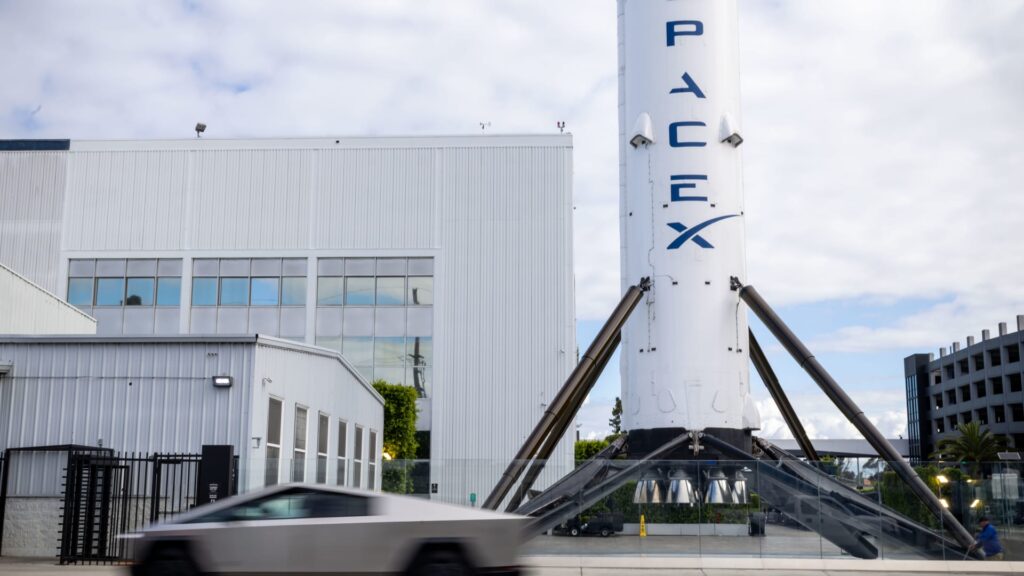
A Tesla Cybertruck drives past SpaceX facilities in Hawthorne, California, US, on Monday, April 13, 2026.
Ethan Swope | Bloomberg | Getty Images
SpaceX launched its massive Starship rocket on Friday after a first try was scrubbed due to technical issues a day earlier.
A 90-minute launch window opened at 6:30 p.m. ET, and the flight took off at that time from SpaceX’s facility in Starbase, Texas.
The test flight of Starship V3, with all its revised systems, was a key event for SpaceX ahead of a public market debut after the company publicly disclosed its IPO prospectus earlier this week. Elon Musk’s aerospace and defense company is expected to raise around $75 billion in an IPO next month, after being valued at $1.25 billion in February, when it merged with xAI, Musk’s artificial intelligence startup.
NASA administrator Jared Isaacman flew to Starbase before the launch, and appeared in a flight suit with SpaceX employees on a livestream video to tout the achievements.
Before leading the space agency, Isaacman paid to lead two private SpaceX flights, in 2021 and 2024, commanding crews on multiday trips around the Earth, forging a close relationship with Musk.
During the test flight on Friday, SpaceX successfully deployed dummy satellites into orbit, and beamed live video of its rockets’ operations from space. However, the company didn’t achieve some of its Starship goals. The company missed propulsion targets it must hit in order to know its revamped rocket and engines are ready to conduct safe flights to orbit and back.
The Superheavy first stage that powers the initial ascent of Starship failed immediately after its separation. Anomalies then occurred during an engine relight sequence, destroying a significant part of the Superheavy aft and resulting in a loss of control.
After flying at a speed of Mach 7, Starship lit two of its engines before splashing down vertically in the Indian Ocean. It then tipped over and exploded after the nose of the rocket hit the water, an expected outcome.
SpaceX said in its IPO filing on Wednesday that Starship “is designed to deliver 100 metric tons to Earth’s orbit in a fully reusable configuration while enabling rapid turnaround times akin to commercial aviation.” It’s the 12th test flight for Starship.
The largest rocket ever built or flown, Starship is also key to SpaceX’s ability to bolster its Starlink wireless internet service business. The company said it plans to launch more satellites into orbit to add to its constellation, and provide stronger wireless internet to customers even in dense urban areas.
Last year, SpaceX launched over 3,000 satellites on 122 Falcon 9 rocket missions. The Starship was designed to carry and release more satellites per trip than the smaller Falcon 9.
The system is comprised of the Starship upper stage vehicle, Super Heavy booster and Raptor engines. The upper stage is meant to be fully reusable, and NASA is relying on SpaceX’s Starship to land astronauts back on the moon in 2028.
Friday’s test flight is SpaceX’s first for Starship in seven months, following a string of explosions and other setbacks in early 2025 that disrupted air travel due to falling debris. The company carried and successfully deployed mock Starlink satellites during the test flight on Friday, but no people or customer cargo.
WATCH: Betting on Musk’s space ambitions

