


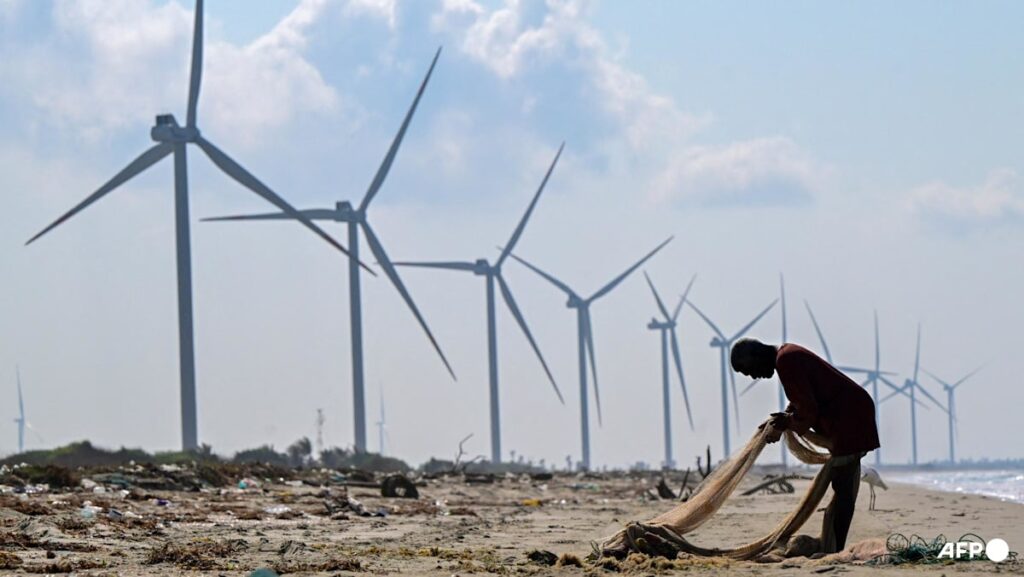
“When the fans rotate, the shadow falls on the water,” he said. “So the fish don’t swim up to the shallows.”
His colleagues agree, also blaming the turbines – as well as competition from Indian trawlers.
“TOILETS OVERFLOW”
“We are not opposed to renewable energy in principle,” said Lesley Jesurajan, a leading figure in the local civil society group OPEnE. “But not here. There are plenty of other places to install wind turbines.”
Owned by state utility Ceylon Electricity Board (CEB), the turbines line a narrow strip of sand exposed to winds sweeping across the gulf between Sri Lanka and India.
The first phase – 30 turbines with a combined capacity of 104 megawatts – joined the grid in 2020, and construction on another 14 has begun.
A third phase of 52 turbines had been awarded to Indian conglomerate Adani, but the government cancelled the contract in 2025 after a dispute over the price per kilowatt-hour.
Even the first phase has fuelled anger.
Benedict Mary Vijiliya’s village, around 100m from the coast, is surrounded by wind turbines.
She claims concrete foundations and trenches for access roads have prevented rainwater from draining towards the sea.
“During the monsoon rains, the water comes up to our waists and the toilets overflow,” complains Vijiliya, president of the Women’s Rural Development Society (WRDS), showing photographs on her phone of her home submerged under about a metre of water.