


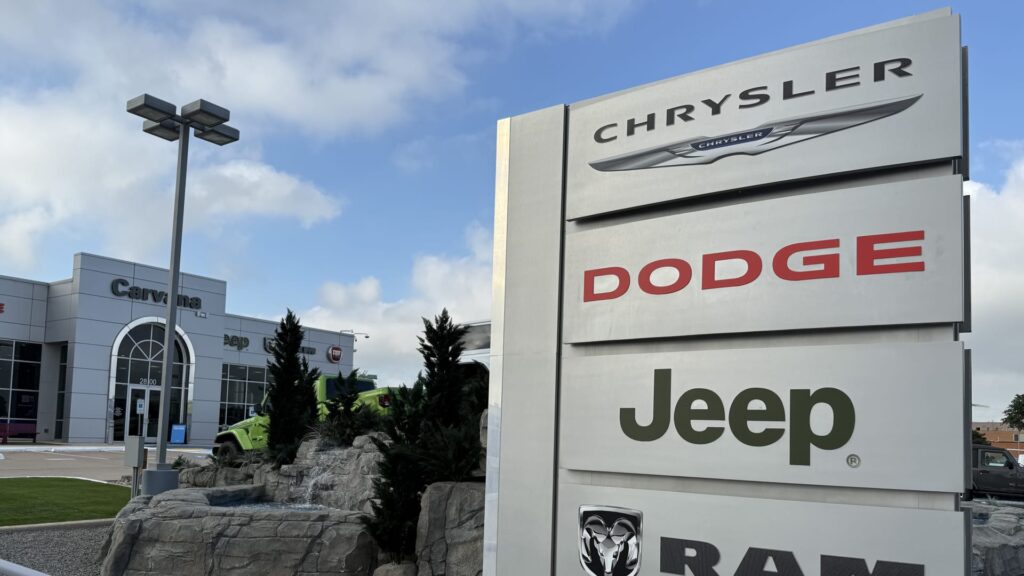
Exterior of Carvana’s new franchised vehicle location in Dallas, Texas.
Michael Wayland / CNBC
European car giant Stellantis reported a 4 billion euro ($4.5 billion) cash shortfall in the third quarter as it ploughed ahead with a $70 billion turnaround strategy to restore profitability.
Third-quarter revenues rose 1% to 37.6 billion euros from a year ago, the Chrysler and Jeep owner said on Wednesday, while adjusted operating income rose 184% to 256 million euros from 90 million euros a year earlier.
As the company made progress on its turnaround plan, its industrial free cash flow improved to negative 4 billion euros, up from negative 4.3 billion the year prior.
“During the quarter, we continued to make progress in the early execution of our FaSTLAne 2030 plan, launching new products, accelerating partnerships as planned, and delivering meaningful improvements in manufacturing and quality,” Stellantis CEO Antonio Filosa said in a press release.
Wall Street reacted positively to the results as well as the company’s ability to maintain its 2026 guidance as other European automakers struggle. Stellantis shares Wednesday were up roughly 6% in Milan as well as premarket trading in New York, but remain sharply down since the beginning of the year.
Stellantis also reconfirmed its target to achieve positive free cash flow next year, which is a main focus for investors.


Stellantis stock since the beginning of the year.
“Q3 was soft, but consensus expectations were far lower. Key here is that ’26 Guidance was maintained while other auto OEMs and suppliers are cutting on elevated costs,” RBC Capital Markets analyst Tom Narayan said Wednesday in an investor note.
Stellantis’ 2026 guidance includes a mid-single-digit percentage increase in net revenue and a low-single-digit adjusted operating margin.
The third-quarter results came as the transatlantic company continues to implement a 60 billion euro turnaround strategy after years of sales declines, especially in North America.
The plan includes investing 36 billion euros in its portfolio of automotive brands, with 60% of the cash to go towards its struggling North America sector. It also plans to introduce new vehicles, refresh models, and incorporate new technologies in its products.
China competition
European carmakers, including Stellantis, have been struggling in China as domestic brands like Xiaomi, BYD and Geely gain ground and intensify competition.
Just this week, German luxury carmaker Porsche said it would reduce its exposure to China as car sales decline in the region. Meanwhile, Mercedes-Benz said its third-quarter car sales slumped due to a “challenging market environment,” in the country.


Earlier this month, Filosa told CNBC that European regulators need to do more to incentivize carmakers to manufacture vehicles in the region to fend off Chinese rivals.
Filosa called for regulation that “incentivizes, rewards, and protects the ones that are able to demonstrate that they design cars, engineer cars.”