


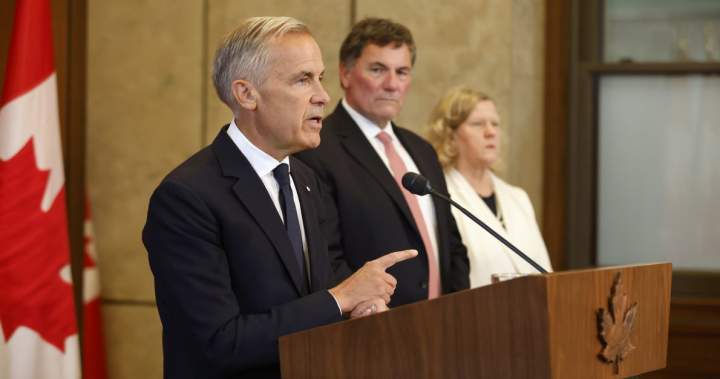
Strong majorities of Canadians support the federal government walking away from U.S. trade talks and hitting back with retaliatory tariffs, a new poll suggests, which is translating to persistent support for Prime Minister Mark Carney and the Liberals.


However, the Ipsos polling conducted exclusively for Global News and released Saturday also shows that support varies by age, with fewer Generation Z and Millennial adults backing the Liberals and their approach to the growing U.S. trade war.
“These people are living in what we like to call ‘the endurance economy’: they’re just getting by from day to day, and they’re enduring economic life right now,” said Darrell Bricker, chairman of Ipsos Canada.
“I think one of the takeaways here is that while Canadians are generally supportive of the idea of pushing back hard on the United States … if any of those things could bring a personal risk, if you’re somebody who’s living in that endurance economy, you’re less likely to support it.”
The poll found 63 per cent of Canadians surveyed feel Canada was right to stand firm in the trade negotiations, “even if it meant higher costs and job losses,” while just 18 per cent said Canada should have made additional sacrifices to get a deal.
An even larger majority, 73 per cent, said they back Ottawa’s “dollar for dollar” counter-tariffs on $28 billion worth of U.S. goods, matching the up to 50 per cent tariffs imposed by U.S. President Donald Trump last week after trade talks collapsed.
But those numbers fall to 48 per cent of Gen Z adults and 57 per cent of Millennials who support Canada standing firm, and 59 per cent of Millennials who were happy to see Canada’s retaliatory tariffs. By comparison, about 80 per cent of elderly boomers supported both of those positions.
Bricker said the disparity points to economic realities for those different age groups.
“The people who were the ‘elbows up’ crowd in the last election campaign, who voted for the Liberals and continue to vote for the Liberals, they’re older, they’re more economically established, they tend to have higher degrees of education, they tend be more affluent,” Bricker said.
“So as a result of that, there’s less risk for them. So they can be all ‘elbows up,’ but it doesn’t cost them as much as it’s going to cost the other people they’re asking to have their elbows up.”
Liberal lead remains virtually unchanged
The age gap also extends to who Canadians said they would vote for if an election were to be held tomorrow.


Get breaking National news
Get breaking Canada news delivered to your inbox as it happens so you won’t miss a trending story.
While the Liberals maintain a healthy lead of 44 per cent support overall among those surveyed, compared to 33 per cent for the Conservatives, 40 per cent of Millennials chose the Conservatives over the Liberals, who see just 30 per cent support in that age group.
The Liberals’ support is down by just one point since April, while the Conservatives saw no change. The NDP at 10 per cent and the Bloc Quebecois at eight per cent nationally are each up one point since April.
“I have not in my consciousness recalled as tumultuous a week, or couple of weeks, or couple of months, in Canadian politics since probably 1995, when we went through the sovereignty referendum,” Bricker said.
“You would expect that you would see a lot of change in terms of political support, and we’re seeing virtually none (since the federal election). … I would say a lot of what’s going on right now is basically baked in, in terms of how it relates to federal politics.
Bricker added Canadians are likely not anticipating another election anytime soon, meaning they’re not thinking hard about their vote intentions right now.
Asked if they felt Conservative Leader Pierre Poilievre and his party would have done a better job handling the trade issues with the U.S. than Carney, 37 per cent overall said yes, with 67 per cent of Conservative voters agreeing.
A sizeable 62 per cent of respondents said they would like to see Parliament recalled before it’s due to reconvene in late September in order to debate and vote on Canada’s response to the U.S., which Bricker said could pose a vulnerability to an otherwise politically strong Carney.
“Canadians know their institutions actually matter to them,” he said. “Not recalling Parliament and not having a conversation through our political institutions is something that does represent a little bit of a vulnerability … (but) I would say, at this stage of the day, a mere crack.”
Backing for government supports and retaliation
The poll also found strong support for a slew of other retaliatory measures that Canada could take against U.S. trade actions, from imposing tariffs on critical minerals and energy (both 73 per cent) to limiting those exports south of the border (71 per cent for critical minerals and 69 per cent for crude oil, natural gas and electricity).
Two-thirds said they would like to see an “aggressive” tax on U.S. tech giants operating in Canada, while 64 per cent were supportive of logistically slowing down U.S. imports by tightening border inspections on incoming goods.
The least popular option presented — letting the Canadian dollar weaken naturally to make Canadian exports more globally competitive — saw 45 per cent support.
On “Buy American,” 80 per cent said they supported government purchasing and infrastructure projected prioritizing Canadian materials and contracts, with 60 per cent saying they will make an effort to prioritize Canadian products, services and companies themselves.
Between two-thirds and 80 per cent of respondents were supportive of other possible government support measures in the trade war, such as helping businesses expand to markets outside the U.S., providing job training and retraining programs for affected workers, and offering loans, emergency aid, extended Employment Insurance, or financial incentives to businesses.
Sixty-seven per cent of Canadians said they would like to see a major COVID-era subsidy program put in place to support Canadian workers affected by tariffs by both countries in the trade war, up eight points since last July.
And while 52 per cent overall said they are personally willing to undergo some “significant” economic pain to help Canada weather the storm, that number once again was lower among Generation Z (41 per cent) and higher among boomers (67 per cent).
“I thought the numbers would be stronger,” Bricker said.
“As you start going down the list and people start considering things that might be a little bit more onerous, or things that they’re really not that certain what it means, you start to see things get a little bit more wobbly. On the side of support right now, but definitely not as baked in and strong.”
These are some of the findings of an Ipsos poll conducted between August 26 and 27, 2026, on behalf of Global News. For this survey, a sample of 1,001 Canadians aged 18+ was interviewed online. Quotas and weighting were employed to ensure that the sample’s composition reflects that of the Canadian population according to census parameters. The precision of Ipsos online polls is measured using a credibility interval. In this case, the poll is accurate to within ± 3.8 percentage points, 19 times out of 20, had all Canadians aged 18+ been polled. The credibility interval will be wider among subsets of the population. All sample surveys and polls may be subject to other sources of error, including, but not limited to coverage error, and measurement error.