


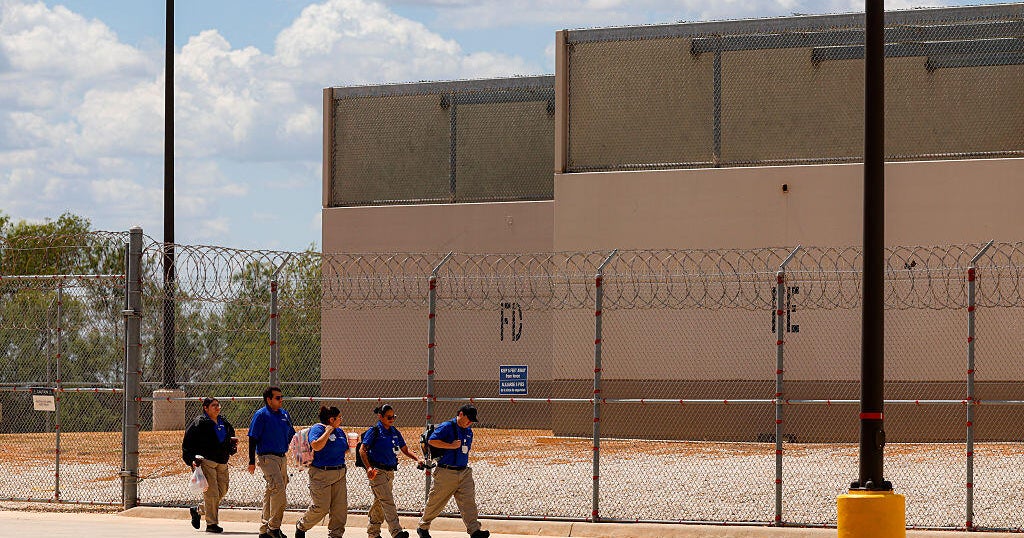
Washington — The Supreme Court on Thursday said it will consider whether the Trump administration can detain tens of thousands of immigrants during their removal proceedings without access to bond hearings.
At the center of the case, known as Rhoney v. Barbosa da Cunha, is the administration’s mandatory detention policy, which targets all immigrants in the United States illegally, including those who have lived in the country for years. The question of whether the policy is lawful has divided federal appeals courts, though hundreds of district judges have rejected it. Two U.S. appeals courts have allowed noncitizens to be subject to mandatory detention without bond, but nine others have ruled the Trump administration must provide certain immigrants with bond hearings and eligibility for release for the duration of their deportation proceedings.
In the past, immigrants who had lived in the U.S. illegally for many years were eligible for bond hearings, where they could try to convince an immigration judge that they were not flight risks and could remain freed during their deportation cases. But last year, Immigration and Customs Enforcement tightened its detention rules and said detainees at risk of deportation were not eligible to be released on bond if they were in the U.S. illegally. Immigration authorities can, however, release them on parole for humanitarian or public-interest reasons.
The agency previously said only certain immigrants, such as those convicted of certain crimes or who had more recently crossed into the U.S. illegally, were not eligible for bond hearings.
As a result of the Trump administration’s mandatory detention policy, scores of people who entered the U.S. illegally years ago, including those without criminal records, have been held by immigration authorities indefinitely.
Thousands of cases challenging those mandatory detentions have been brought in courts across the country, straining federal prosecutors who have had to shift their attention away from criminal and other civil cases. Lower court decisions have broad impacts on those challenges.
The mandatory detention policy is part of President Trump’s broader crackdown on immigration. In the president’s second administration, immigration authorities have arrested thousands of immigrants without criminal records and who only face civil immigration violations.
In July, ICE detained more than 46,000 people for removal because of alleged immigration offenses, surpassing the 43,000 detentions by immigration authorities in June.
ICE has launched operations in major cities targeting people who are in the country illegally, sometimes leading to violent and deadly clashes between immigration authorities and protesters.
Arguments in the case be heard in the Supreme Court’s new term, which begins Monday.
The legal battle involves a Brazilian citizen, Ricardo Aparecido Barbosa da Cunha, who came to the U.S. illegally more than 20 years ago. Barbosa da Cunha has never been convicted of a crime, according to court papers. He applied for asylum in 2016 and was granted a valid work permit.
But last year, during a traffic stop in Massachusetts, Barbosa da Cunha was taken into custody by ICE officers, and the Department of Homeland Security initiated removal proceedings against him.
Barbosa da Cunha requested a bond hearing, but an immigration judge denied the request on the grounds that he was subject to mandatory detention without the possibility of bond under a provision of federal immigration law.
The Brazilian man then filed a petition in federal court alleging that his detention without access to a bond hearing was illegal and a violation of the Constitution’s Due Process Clause.
A federal judge in New York, where Barbosa da Cunha was being held in a detention facility, ruled in his favor. The judge ordered the government to hold a bond hearing within 10 days, and Barbosa da Cunha was released on bond in late October 2025.
The Trump administration appealed that decision, and in April, the U.S. Court of Appeals for the 2nd Circuit rejected the mandatory detention policy.
In its ruling, the appeals court called the policy the “broadest mass-detention-without-bond mandate in our nation’s history for millions of noncitizens.”
The administration’s interpretation of the law, the 2nd Circuit panel said, would “send a seismic shock through our immigration detention system and society, straining our already overcrowded detention infrastructure, incarcerating millions, separating families, and disrupting communities.”
The Justice Department asked the Supreme Court to review the 2nd Circuit’s decision, though a ruling from the nation’s highest court will impact thousands of cases brought by immigrants challenging their detentions without the opportunity for a bond hearing.