


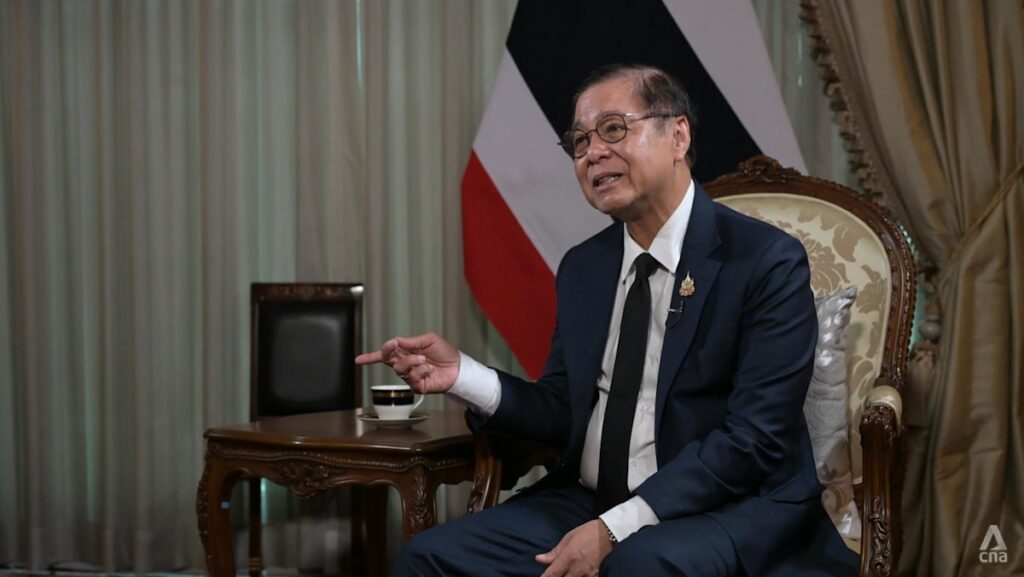
Sihasak said Thailand has consistently urged Myanmar’s authorities to pursue dialogue with ethnic armed groups and seek political reconciliation.
“We are prepared to facilitate these talks if it’s the wish of the Myanmar government and the ethnic groups … so that there would be a reduction of violence along the border,” he added.
However, he warned that any conflict crossing into Thailand would not be tolerated.
“We have told the Myanmar government that any encroachment or any deliberate firing onto the Thai side causing any fatality is totally unacceptable.”
MARITIME BOUNDARY DISPUTE WITH CAMBODIA
Sihasak also spoke about a long-running maritime boundary dispute between Thailand and Cambodia.
On Tuesday, Cambodia said it had launched a compulsory conciliation process under the United Nations Convention on the Law of the Sea (UNCLOS), following Bangkok’s decision last month to unilaterally terminate a 2001 bilateral agreement that provided a framework for talks over a disputed maritime belt.
For more than 25 years, both nations have laid claim to about 26,000 sq km of sea in the Gulf of Thailand, an area estimated to hold nearly 12 trillion cubic feet of natural gas and large quantities of oil, together valued at about US$300 billion.
Sihasak told CNA that he had sensed a possibility that Cambodia would launch the UN-backed process, and expressed Thailand’s reservations about the move despite agreeing to take part in it.
“(Cambodia) said we closed all doors because of (the termination of the 2001 agreement). We say, that’s not our intention. We made it clear to them that we’re trying to start the talks anew,” he said.
“If we proceed with the process of compulsory conciliation, we would want the scope limited only to maritime limitations. Any discussions, the joint development, is another matter that requires another mandate and requires further discussions between two countries.”
Thailand and Cambodia will each appoint two conciliators, who will then decide on a fifth independent conciliator. The whole process will take at least a year, said Sihasak.
Phnom Penh has rejected suggestions that its decision to initiate the conciliation process reflects a breakdown in bilateral relations, saying diplomatic engagement between the two sides remains ongoing.