


Tokenized stocks could give crypto-native investors access to equity exposure through crypto platforms, but a token that tracks a share price is not automatically a share. The diversification case rests on whether holders receive genuine legal rights, whether assets sit within regulated custody arrangements, and whether markets maintain reliable liquidity.
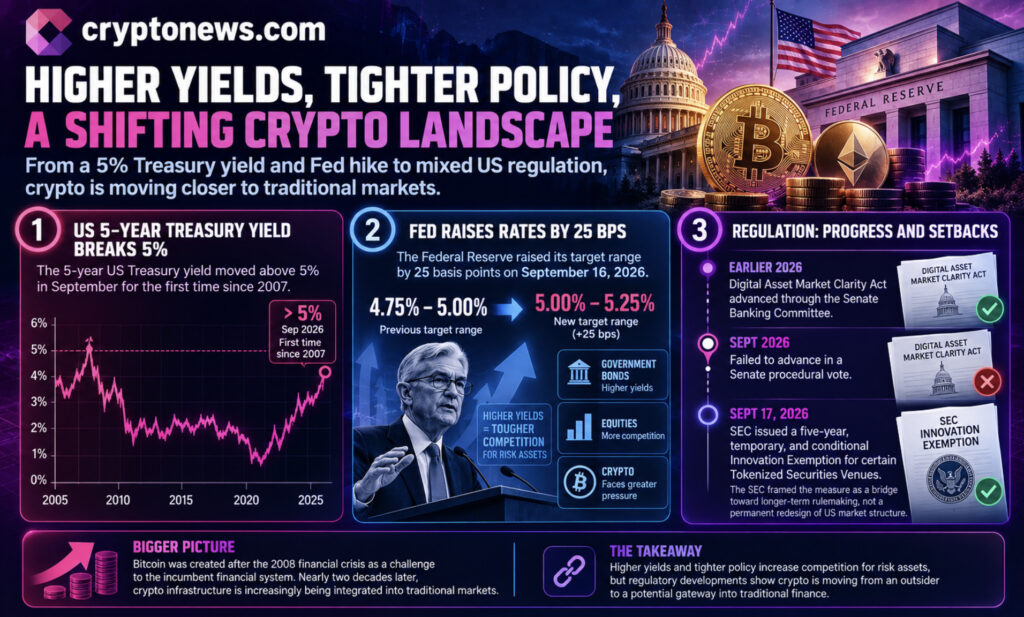
The market backdrop has shifted. The five-year US Treasury yield moved above 5% in September for the first time since 2007, and the Federal Reserve raised its target range by 25 basis points on September 16. Higher yields give investors a more competitive alternative to risk assets, sharpening comparisons between equities, crypto, and government debt.


At the same time, the industry is moving beyond crypto’s original outsider posture. Bitcoin emerged after the 2008 financial crisis as a challenge to parts of the incumbent financial system; nearly two decades later, crypto infrastructure is increasingly being considered as a route into traditional markets.
The Digital Asset Market Clarity Act advanced through the Senate Banking Committee earlier in 2026 but failed to advance in a September procedural vote. One day later, on September 17, the SEC issued a five-year, temporary, and conditional Innovation Exemption for certain Tokenized Securities Venues. The agency framed the measure as a bridge toward longer-term rulemaking, not a permanent redesign of US market structure.
The shift has portfolio implications. Crypto benchmarks can remain heavily concentrated in bitcoin and ether, leaving many digital-asset portfolios exposed to overlapping crypto-market drivers even when they hold multiple tokens.
Earn $50 and Enter $300K Prize Draw on EdgeX
Diversification Depends on What Each Tokenized Stocks Represent
For investors concentrated in Bitcoin, Ethereum, stablecoins, and DeFi assets, tokenized US equities could add exposure to companies and sectors beyond crypto. Crypto platforms could also become distribution and trading infrastructure for assets that originated in traditional finance, bringing stock exposure into a familiar digital-asset environment.
Tokenized stocks may still respond to broad risk-off moves, and access to another asset class does not guarantee that a portfolio is balanced. The useful measure is the exposure the product actually delivers, including its legal claim and its market behavior, not the fact that it trades on-chain.
The SEC exemption makes the ownership question explicit: tokenized shares traded under the framework must provide holders the same rights as the equivalent traditional shares. A venue must also give an issuer notice and an opportunity to object before listing a tokenized share created by an unaffiliated third party.
There is also a potential efficiency argument. Blockchain-based settlement and programmable infrastructure may reduce some friction in issuing, transferring, and trading financial assets, but those benefits remain a possibility rather than a proven outcome of this exemption. Tokenization does not remove the underlying investment’s market risk or the need for disclosure, governance, and market safeguards.
Trade Crypto on Bybit and Get a Chance to Win Our $1,000 USDT Airdrop
The SEC Pilot Tests Access
The Innovation Exemption gives qualifying Tokenized Securities Venues temporary relief from being treated as exchanges under the usual definition when they facilitate limited trading of genuine National Market System stocks through permissioned automated market makers and liquidity pools.
Certain liquidity providers also receive temporary, conditional relief from dealer-registration requirements. The structure creates a bounded environment for market participants and regulators to observe how tokenized equities operate. It does not settle the rules for every crypto platform, nor does it establish that on-chain trading will offer deep markets.
Custody presents a parallel test. Tokenized equities may connect on-chain trading to regulated financial infrastructure, but investors still need to understand how assets are held and how the custody model operates during disruption or insolvency. Custody and execution controls remain important considerations in that infrastructure.
Tokenized stocks may make portfolio diversification more accessible to crypto-native investors, but the investment case is only as strong as the rights attached to the token, the custody behind it, and the liquidity available when a position needs to be unwound.
The SEC experiment is best read as a test of coexistence between crypto and Wall Street, not as evidence that one system has displaced the other.
Discover: The Best Token Presales
The post Tokenized Stocks, Investor Rights, and Their Crypto Role appeared first on Cryptonews.