


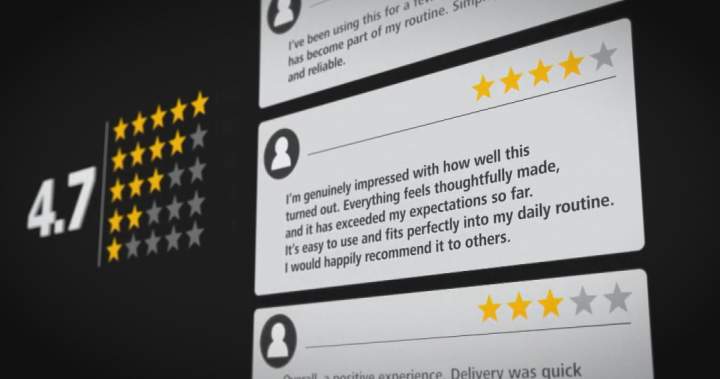
Online reviews can help people decide what to buy, but business owners and consumer watchdogs say some are confusing customers because they’re not actually real.


For Charlotte Ashley, owner of Trident Booksellers and Cafe in Halifax, fake reviews have led customers to request items the business doesn’t even carry.
“Maybe they want menu items that we don’t serve,” said Ashley. “People are disappointed and that’s not the kind of visit that we want them to have at our business.”
Ashley pointed to one such review posted on Google that gave the business five stars but also said the supposed customer got a mushroom quesadilla that the cafe doesn’t serve.
She’s unsure what has caused the fake reviews to pop up on her business’s page or the motive behind them.
But fake reviews are far from new, with a report by the Canadian Anti-monopoly Project showing there’s a market for them on Google and Amazon.
The report says fake reviews harm three groups: consumers because they “obscure” the true quality of the service or product; honest sellers because the reviews put them “at a clear disadvantage”; and platforms if consumers lose trust in them.


Get breaking National news
Get breaking Canada news delivered to your inbox as it happens so you won’t miss a trending story.
“There is a substantial market for fake reviews operating kind of in plain sight and it affects customers who are looking at reviews on all sorts of platforms,” said Emily Osborne, a fellow at the project and policy researcher at the Canada Shield Institute.
Osborne said fake reviewers can be recruited in various ways, including through social media groups.
She said a third-party seller could ask reviewers to post a five-star review potentially in exchange for a free product.
Companies such as Amazon have acted to take down fake reviews, Osborne noted.
Osborne told Global News the Canadian government needs could do more to hold the platforms more accountable.
“I think there’s some space for Canadian policymakers to require better enforcement against fraud on platforms,” she said.
There are posts that exist on social media by “professional review providers,” with a list of prices provided with some offering 100 reviews for $180.
Kay Dean, a U.S.-based consumer watchdog, says the marketplace for fake reviews is “immense.”
“It’s just shocking how immense the problem is, I believe it distorts the whole small business economy globally,” said Dean, who started Fake Review Watch, a website and YouTube channel where she posts her investigations and research. Dean is a former federal prosecutor.
She said her investigations have found businesses bartering and trading reviews with each other on social media. She’s also found marketers and search engine optimization companies with “networks of profiles” that post negative reviews.
“So there’s just a variety of ways to procure fake reviews, it’s very, very easy and inexpensive,” she said.
The exact number of fake reviews online is difficult to determine. But a 2023 report by the U.K. government found 11 to 15 per cent of all reviews on e-commerce platforms for three common product categories were likely fake. Product categories typically included consumer electronics, home and kitchen, and sports and outdoors.
It also found well-written fake reviews can distort consumer decision making, with buyers 3.1 per cent more likely to purchase a product.
There are things people can do to take precautions when shopping, including using caution when “flawless” ratings are given. Experts say the best advice comes through word-of-mouth.
© 2026 Global News, a division of Corus Entertainment Inc.