


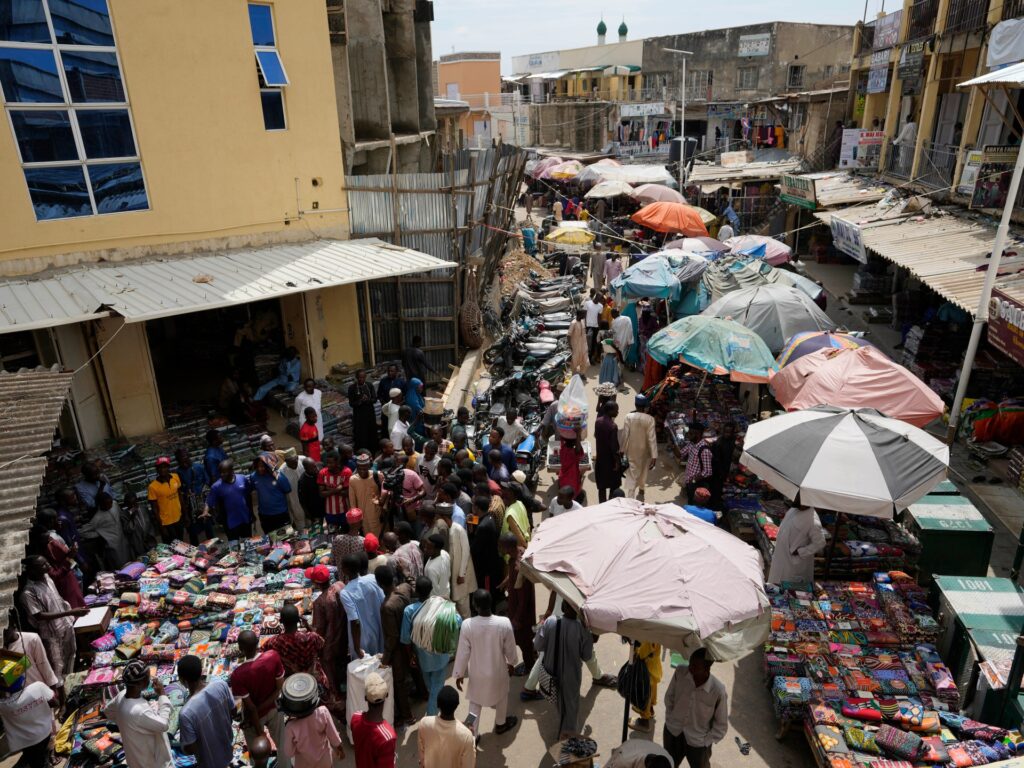
Kano, Nigeria – On a bustling day in northern Nigeria, Marian Shammah made her way to the Sabon Gari Market, one of the largest electronics hubs in Kano state.
The 34-year-old cleaner was in need of a refrigerator, but with rising costs and a meagre income, she saw the second-hand appliances sold at the market as a lifeline.
Recommended Stories
list of 3 itemsend of list
After locating the one she wanted, she paid the vendor 50,000 naira ($36) and took it home. But just a month later, the freezer collapsed.
“Only the top half of the refrigerator was working, and the freezer wasn’t working,” said Shammah.
Her food spoiled, her savings disappeared, and she was soon back in the market searching for another appliance.
Although Shammah could have bought a new local appliance for just over 30,000 naira ($30) more, she – like millions of Nigerians – believes second-hand products from America and Europe “last longer” than new products sold in Nigeria.
Observers say this trend is part of a larger crisis. Nigeria has become a major destination for the developed world’s discarded electronics – items often near the end of life, sometimes completely dead, and frequently toxic because they contain hazardous materials. When they break down, they add to landfills, worsening an already dire e-waste crisis on the African continent.
Around 60,000 tonnes of used electronics enter Nigeria through key ports each year, with at least 15,700 tonnes already damaged upon arrival, according to the United Nations.
The trade in used electronic goods is powered largely by foreign exporters. A UN tracking study between 2015 and 2016 showed that more than 85 percent of used electronics imported into Nigeria originated from Germany, the United Kingdom, Belgium, the Netherlands, Spain, China, the United States, and the Republic of Ireland.
Many of these imports violate international restrictions, like the Basel Convention, an environmental treaty regulating the transboundary movement and disposal of hazardous electronic waste to developing countries with weaker environmental laws.
Across West Africa, the Basel Convention’s “E-Waste Africa Programme”, a project focused on strengthening e-waste management systems across the continent, estimates that Benin, Ivory Coast, Ghana, Liberia, and Nigeria collectively generate between 650,000 and 1,000,000 tonnes of e-waste annually – much of it the result of short-lifespan second-hand imports.


Health risks
The United Nations describes e-waste as any discarded device that uses a battery or plug and contains hazardous substances – like mercury – that can endanger both human health and the environment. Several of the toxic components commonly found in e-waste are included on the list of 10 chemicals of major public health concern maintained by the World Health Organization (WHO).
According to the WHO, used electrical and electronic equipment (EEE) presents a growing public health and environmental threat across Africa, with Nigeria at the centre of the trade.
“Much of the equipment shipped as used electronics is close to becoming waste,” said Rita Idehai, founder of Ecobarter, a Lagos-based environmental NGO, warning that devices imported and sold as affordable second-hand goods often fail shortly after arrival and quickly enter the waste stream.
The consequences are far-reaching. Many imported fridges and air conditioners, for instance, still contain CFC-based and HCFC-based refrigerants such as R-12 and R-22 – chemicals banned in Europe and the US for causing ozone depletion or being linked to cancer, miscarriages, neurological disorders, and long-term soil contamination. These gases live for 12 to 100 years, meaning leaking equipment adds to a multi-generational environmental burden.
After these imported items stop working or fall apart, informal recyclers then dismantle the electronics with their bare hands, Al Jazeera observed. In Kano, the recyclers inhale poisonous fumes and manage the heavy metals without protection. Their work earns them a meagre 3,500–14,000 naira ($2.50-$10) per week, they said, and the after-effects linger – including persistent coughing, chest pain, headaches, eye irritation, and breathing difficulties after long hours of burning cables and dismantling electronic devices.
The health crisis extends into Kano’s communities.
Among casual recyclers and residents who live close to e-waste dumps, many report symptoms that range from chronic headaches and skin irritation to breathing issues, miscarriages and neurological concerns, according to health surveys done by the International Journal of Environmental Research and Public Health. These ailments are consistent with longtime toxic exposure, the researchers said.
Recent field assessments conducted by Nigeria’s Federal University Dutse also stressed that in and around Kano state, where the Sabon Gari Market is located, there are rising levels of heavy metals in soil and drainage channels.
Dr Ushakuma Michael Anenga, a gynaecologist at the Benue State Teaching Hospital and second vice president of the Nigerian Medical Association, warned that toxic exposure from informal e-waste recycling poses grave health risks to communities in Kano.
“Exposure to heavy metals and refrigerant gases in e-waste causes extreme brief and long-term health issues, generally affecting the breathing and renal organs,” he told Al Jazeera.
“Common casual practices like exposed burning and dismantling result in direct, high-level exposure for workers and nearby residents. Children and pregnant girls are particularly inclined due to the fact that those toxicants can disrupt development or even skip from mother to unborn baby, [while] recyclers who work without defensive equipment face repeated, frequently irreversible damage.”

Profits over protection
In Sabon Gari Market, second-hand electronics are advertised as less costly lifelines for households and poor business owners burdened by inflation.
Many customers say foreign-used home equipment appears sturdier and seems like better value for money than new imports from the developing world. Meanwhile, others are just looking for cheap options in difficult economic times.
“I usually go for second-hand or foreign-used electronics because brand-new ones are too expensive for me,” Umar Hussaini, who sells used electronics at the market, told Al Jazeera.
“Sometimes you can get them for half the price of new ones, and they look almost the same, so it feels like a good deal at the time.”
But the last refrigerator he bought stopped cooling after just three months. With no warranty or guarantee, the seller refused responsibility.
“For weeks, we couldn’t store food properly at home, and we ended up buying food daily, which was more expensive,” he said. “However, I have to buy another one again.”
For small business owners like Salisu Saidu, the losses can be even more devastating. He bought a used freezer for his shop, believing it had been serviced. Within weeks, it failed.
“I lost a lot of frozen food, which meant I lost money and customers,” he told Al Jazeera.
Around his neighbourhood, broken electronics are often dumped out in the street, sometimes emitting smoke or sparks.
“There’s also a lot of electronic waste piling up around,” he said, calling for tighter import controls, proper certification, and mandatory warranties to protect buyers from being sold what he described as “damaged goods disguised as fairly used”.


Bought as bargains, sold as burdens
At Sabon Gari Market, another vendor, Umar Abdullahi, is surrounded by imported refrigerators, air conditioners and washing machines stacked tightly together.
The products in his shop are advertised as “London use” or “Direct Belgium”, while he negotiates the sale of a double-door fridge for 120,000 naira ($87).
Abdullahi’s store is where Shammah returned after the refrigerator she bought failed. But he admits that much of what he sells to customers arrives unchecked.
“We buy them untested from suppliers in Europe, and we also sell them untested so we can make our profit,” he told Al Jazeera.
This despite the fact that international rules under the Basel Convention, as well as Nigerian environmental regulations, prohibit the shipment of material considered e-waste – with penalties including fines and jail terms.
Nwamaka Ejiofor, a spokesperson for Nigeria’s National Environmental Standards and Regulations Enforcement Agency (NESREA), said the country does not permit the import of e-waste. However, the entry of used electronics is allowed under regulated conditions.
“The importation of used electrical and electronic equipment is regulated and may be allowed only where such equipment meets prescribed conditions, including functionality and compliance requirements,” she told Al Jazeera.
“Nigeria applies a combination of regulatory, administrative and enforcement measures to ensure that imported used electronics comply with national law and the country’s international obligations,” she added, listing out measures including environmental regulations, cargo inspection and verifying that imported equipment is “functional”.
However, despite this, some traders find loopholes in the system, including declaring cargo they plan to sell as personal belongings or second-hand household goods to avoid scrutiny.
Although NESREA says enforcement has improved, critics say the steady flow of mediocre goods continues largely unchecked. Even dealers at Sabon Gari Market acknowledge that most appliances are sold “as is”, without certification or guarantees.


‘Loopholes’
Behind the second-hand electronics trade is a network of collectors and exporters who source discarded appliances across Europe.
Baban Ladan Issa, who ships used electronics from Ireland to Nigeria, said items are gathered from weekend markets, private homes that are replacing old gadgets, and contractors clearing out equipment from offices, hotels and hospitals.
“Some suppliers mix working and damaged goods together,” he told Al Jazeera, noting that while he tries to avoid faulty items, not all buyers do the same.
Once assembled, shipments worth millions of naira are sent to Lagos through ships then down to sellers in the market in Kano state, sometimes packed in containers or hidden inside vehicles to reduce inspection risks.
Shipping records seen by Al Jazeera showed consignments labelled as “personal effects”, a classification that can limit detailed checks at ports.
Chinwe Okafor, an environmental policy analyst based in Abuja, said the problem is systemic.
“Exporting nations regularly take advantage of loopholes by means of labelling nonfunctional e-waste as ‘second-hand goods’ or ‘for repair,’” she told Al Jazeera. “In some instances, research estimates that over 75 percent of what arrives in developing countries is truly junk.”
“This permits wealthy countries to keep away from highly-priced recycling at home while pushing unsafe materials into nations with weaker safeguards.”
Ibrahim Adamu, a programme officer with the NGO Ecobarter, added that mislabelling, poor inspection technology and corruption at ports make enforcement difficult.
“The highest profits are captured by exporters and brokers who arbitrage the gap between disposal costs in Europe or Asia and the strong demand for ‘tokunbo’ goods in Nigeria,” he said, using the local name for used imported electronics.
To forestall this, he said Nigeria “must reinforce border inspections” and implement a policy whereby producers and manufacturers bear financial responsibility. At the same time, “the international network has to adopt binding bans that [hold] manufacturers and exporters responsible”, Adamu said.

Little oversight, mounting risks
Although Nigeria has regulations governing the import of electrical and electronic equipment, enforcement gaps keep exposing markets like Kano’s Sabon Gari to ageing and near-end-of-life appliances, locals say.
Ibrahim Bello, a used electronics importer with a decade in the business, said many shipments that arrive from Europe are in less-than-ideal condition.
“Around 20 to 30 percent of the items we receive have issues when they arrive,” he told Al Jazeera. “Some are already damaged, while others stop working after a short time because they are old.
“That’s just part of the business.”
Retailer Chinedu Peter gave similar estimates. “From what I’ve experienced, maybe 40 percent of the electronics have some fault as they come,” he said, adding that environmental and protection checks don’t happen as they are meant to.
“Such a lot of items enter without special checks.”
Both men feel that clearer rules and certified testing systems will improve trust. But until then, thousands of ageing, unsuitable products will continue to flood Nigeria.
Shammah, back at Sabon Gari Market just weeks after her refrigerator broke, was once again searching through rows of stacked appliances, hoping her next purchase might last longer than the last.
“I don’t really trust these fairly used appliances again, but I still have to buy something because we need it at home,” she told Al Jazeera.
“This time I’m thinking … I can buy a new one from a proper shop, even if it takes longer, because I don’t want to lose my money again.”