


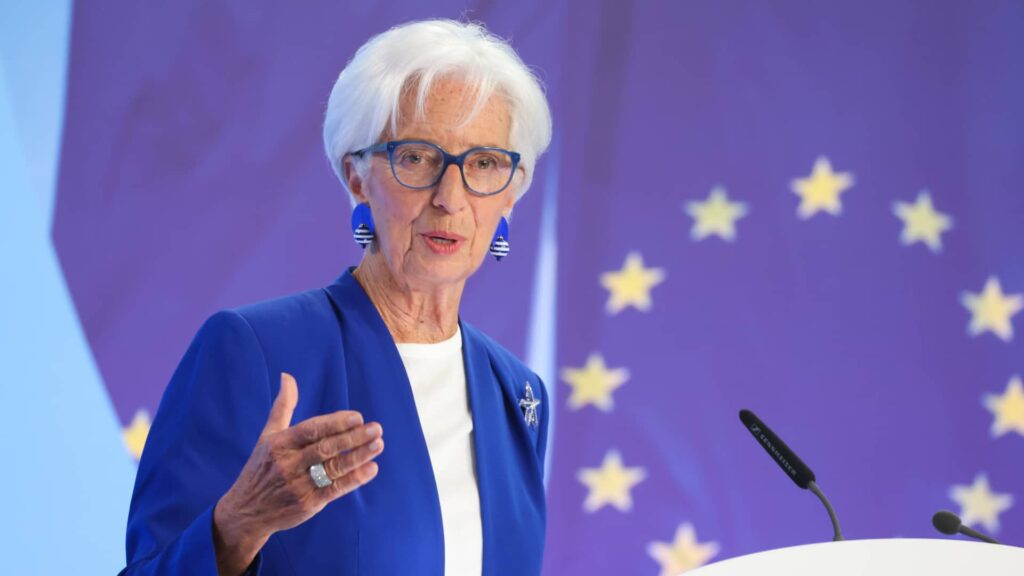
Christine Lagarde, president of the European Central Bank (ECB), during a rates decision news conference in Frankfurt, Germany, on Thursday, June 11, 2026.
Alex Kraus | Bloomberg | Getty Images
Europe is facing an erosion of the conditions that historically drove the continent’s growth, its top central banker warned Wednesday, as she called on leaders not to repeat mistakes made during the dotcom boom in the age of AI.
Speaking at the World Economic Forum’s International Business Council in Geneva, Switzerland, on Wednesday, European Central Bank President Christine Lagarde warned that the continent’s post-war growth model is “eroding” and “unlikely to return to the form we once knew.”
This economic growth, Lagarde told an audience, rested on three pillars: expanding global trade, manufacturing supported by access to cheap energy, and “a stable, rules-based global order, underpinned by a U.S. security umbrella.”
All three of those pillars are weakening today, Lagarde said.
Last year alone, she said, more than 2,500 trade restrictions were implemented globally.
Shortly after his return to the White House, President Donald Trump unveiled a raft of targeted tariffs, including a 20% baseline levy on goods imported to the U.S. from the European Union. That tariff rate was later reduced to 15% when the two sides agreed on a trade deal, but uncertainty remains about the stability of that agreement and how imports of certain European goods, such as steel, will be taxed by Washington.
U.S. retreat from the post-war world order
More broadly, Lagarde said in Wednesday’s speech, America’s pullback from leading Western security was adding further pressures to the European economy.
“That [past] environment allowed European supply chains to deepen, and enabled firms to organize investment around efficiency rather than resilience,” she said.
“Today, that global order is under pressure. Geopolitical tensions are bringing critical dependencies and chokepoints into sharper focus, while Europe faces growing security threats on its doorstep.”
Trump has long rebuked America’s European allies for not spending enough on defense, with his administration issuing threats to withdraw from the military alliance and even bring NATO territory under Washington’s control by force. Meanwhile, Russian aircraft have increasingly encroached on European airspace, and the U.S.-Iran war has weighed on the continent’s economy and raised new security threats for the region.
As the world has become less secure, Lagarde said on Wednesday, capital flows into Europe have been put at risk.
“When economic dependencies can be weaponized or when perceptions of deterrence weaken, concerns about resilience enter economic decisions directly. Firms invest less when capital is seen as less safe, weighing on output and consumption,” she said.
“Taken together, these shifts suggest that Europe’s post-war growth model is eroding. And it is unlikely to return to the form we once knew.”


AI warning
Looking ahead, Lagarde said Europe still has “substantial strengths to build on,” including the world’s largest network of trade agreements, world-class manufacturing capabilities and the EU’s massive single market.
However, she issued a warning to the region not to repeat dotcom-era mistakes when it comes to the AI revolution.
“Europe largely missed out on the first digital revolution, as the commercial gains from the spread of information and communication technologies were captured disproportionately elsewhere. We cannot afford to repeat that experience with artificial intelligence, the second digital revolution,” Lagarde said.
Europe’s tech sector has long been dwarfed by that of the U.S. Europe’s 34 most valuable listed tech companies have a combined market capitalization of about €1.37 trillion ($1.59 trillion), while the United States’ so-called Magnificent Seven stocks have a combined market value of more than $23 trillion.
While Lagarde told the WEF’s council Wednesday there were already “encouraging signs” that European firms are investing in AI, she said questions remain as to “whether Europe can create the conditions for that investment to spread and scale.”
“One prominent proposal is ‘EU Inc.’ — an optional EU-wide corporate legal form that would allow companies to incorporate once and then operate under a single set of rules across the EU,” she said, while noting that capital market reforms were being devised to help European companies scale across the continent.
“We already have many of the ingredients for stronger long-term growth,” she said. “Turning European size into European scale would help innovative firms grow at home, allow new technologies to spread faster and boost productivity. In doing so, it would help make domestic demand a more lasting engine of growth.”
Marco Forgione, director general of The Chartered Institute of Export and International Trade, told CNBC’s “Squawk Box Europe” on Wednesday that Europe was also guilty of protectionism when it comes to trade.
“The internal market within Europe is free, but trading into Europe is very far from free, and it’s a very protectionist environment. And I think the issue for Europe is how it’s going to play the role it’s going to play in a new world order,” he said. “Competition from China and the likes, who have moved way up the value chain with regards to manufacturing, is a real challenge.”
“Fundamental changes, both political and economic, are required if Europe is going to break free from the sort of stasis that it’s been in for decades and really start to see growth in its economy,” he added.