


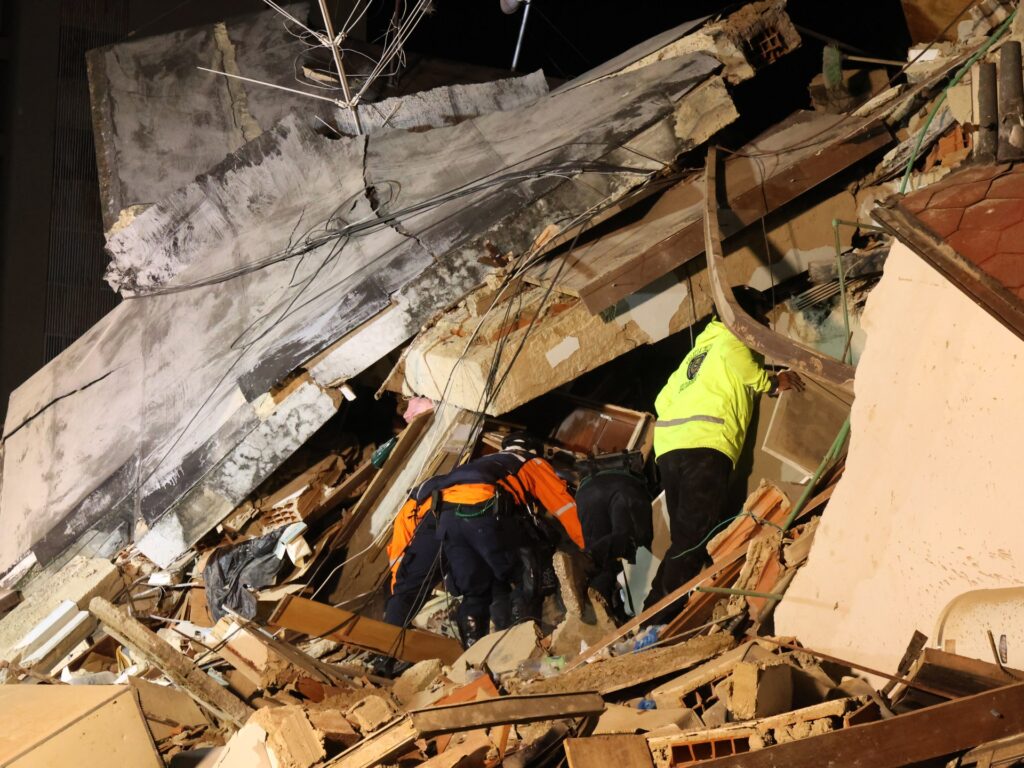
Venezuela has declared a state of emergency after two back-to-back earthquakes of magnitudes 7.2 and 7.5 struck, killing at least 32 people.
A major search and rescue operation is under way after Wednesday’s quakes caused widespread damage, especially in the capital, Caracas.
Recommended Stories
list of 1 itemend of list
Emergency crews are searching through the rubble of collapsed buildings while authorities closed the country’s main airport in Caracas, suspended classes and mobilised health workers to respond to the disaster.
The United States Geological Survey (USGS) warned that “high casualties and extensive damage are probable”, and US President Donald Trump said the quakes – some of the strongest in more than a century – caused “a devastating number of deaths”.
Here is what we know:
What happened in Venezuela?
Venezuela was struck by the quakes about 6:04pm (22:04 GMT) on Wednesday as it was marking a national holiday commemorating the 1821 Battle of Carabobo.
The government declared a state of emergency as emergency crews responded to widespread damage. In a televised address, acting President Delcy Rodriguez urged doctors, nurses and other healthcare workers to report immediately to hospitals and clinics to help treat the injured.
Reporting from Bogota in neighbouring Colombia, Al Jazeera’s Teresa Bo said the worst damage was reported in Caracas, particularly in the Altamira district, where emergency crews rescued survivors from the rubble of a 22-storey building as relatives searched for missing loved ones. Authorities said the full extent of the damage is still being assessed.
What do we know about the victims and the death toll?
Rodriguez said at least 32 people have been killed and about 700 injured in the quakes, which were followed by nearly two dozen aftershocks.
Authorities have not yet released a breakdown of the victims by age, gender or location, and officials said the figures are expected to rise as search and rescue operations continue.
The Altamira and El Paraiso neighbourhoods of Caracas are the worst affected. Damage has also been reported in La Guaira and other parts of central Venezuela.
The USGS warned that the death toll could rise significantly because many buildings in the affected region are made from unreinforced brick masonry and adobe, which are particularly vulnerable during strong earthquakes.
Its latest assessment gave a 39 percent probability that fatalities could reach between 1,000 and 10,000 and a 37 percent probability of 10,000 to 100,000 deaths. These are statistical estimates designed to support emergency planning and are not confirmed casualty figures.
Where were the epicentres?
The twin earthquakes originated in Yaracuy state, west of Caracas, according to the USGS. The first, a magnitude 7.2 quake, struck at a depth of 22km (14 miles), followed less than a minute later by an even larger magnitude 7.5 quake at a depth of about 10km (6 miles).
Although the epicentres were outside the capital, the shaking was felt across Caracas and much of central and western Venezuela, including the states of Carabobo, Miranda, La Guaira and Trujillo. Tremors were also reported in neighbouring Colombia and as far away as Brazil’s Amazon region, more than 1,700km (1,050 miles) from Caracas.
What has been the impact?
The earthquakes caused widespread damage across Venezuela, collapsing buildings, damaging infrastructure and sending residents into the streets in panic.
The government closed Simon Bolivar International Airport in Caracas because of damage, suspended classes for several days and urged people to remain calm.
Search and rescue operations remained under way across the worst hit areas as authorities continued to assess the scale of the destruction. Experts also warned that strong aftershocks remain possible in the coming days.
How has the international community reacted?
Governments across the Americas expressed solidarity with Venezuela and began mobilising humanitarian assistance.
United States: Trump said on his Truth Social platform that the US “stands ready, willing, and able to help! I have instructed all agencies of our government to get ready to move quickly. We will be there for our new and great friends.”
Earlier, officials from the Trump administration said Washington will send search and rescue teams, medical supplies and other humanitarian assistance.
El Salvador: President Nayib Bukele said the country is preparing to send 300 paramedics and other rescue workers along with 50 tonnes of medical supplies and emergency equipment.
Ecuador and Panama: Both governments announced humanitarian assistance with Ecuadoran President Daniel Noboa saying humanitarian concerns should take precedence despite political differences.
Mexico and Brazil: The two countries expressed solidarity with Venezuela and said they were closely monitoring the situation, adding that there were no immediate reports of their citizens being affected.