


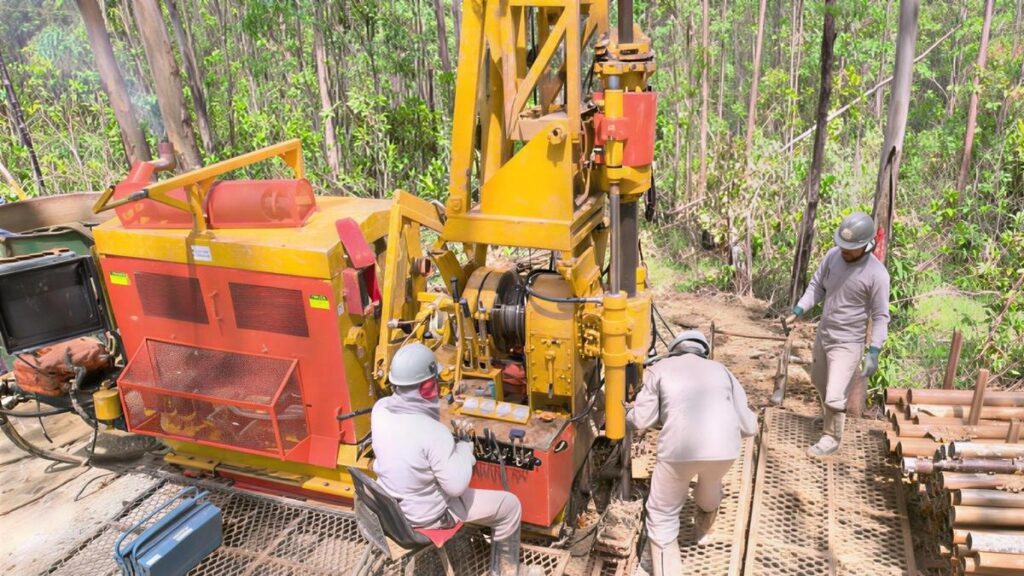
Viridis Mining and Minerals has hailed a major milestone at its flagship Colossus rare earths project in Brazil, completing a targeted infill drilling campaign that will lift resource confidence, support a resource upgrade, and clear a path towards project financing.
The infill drilling focused on areas planned for the company’s initial mine pits at Colossus, increasing drill hole density to 75m by 75m as it works to upgrade indicated and inferred resources into the higher confidence measured resource category.
The results will feed directly into Viridis’ next updated mineral resource estimate, an ore reserve update and a definitive feasibility study (DFS) for the project.
Results from the campaign have further underlined the shallow, laterally continuous nature of mineralisation, cementing Colossus’s status as the biggest ionic adsorption clay (IAC) rare earths reserve outside China.
The latest standout drill intercepts included a best hit of 8m assaying 7076 parts per million (ppm) total rare earth oxides (TREO), which included 4m at 9546ppm TREO.
The second-best result handed down 16m going 7434ppm TREO, including 6m at 10,426 ppm TREO. That was supported by a third-best hit of 12m at 6754ppm TREO, featuring 6m at 8843ppm TREO.
The latest drilling results continue to reflect strong enrichment in high-value magnet rare earth oxides such as dysprosium, terbium, neodymium and praseodymium.
The latest infill results continue to confirm the exceptional grade, continuity and shallow nature of the Colossus mineralisation, including strong concentrations of high-value magnetic rare earths such as Dysprosium and Terbium. Importantly, drilling focused on the planned initial mining areas is significantly increasing resource confidence ahead of Final Investment Decision targeted for Q3 2026.
Remarkably, the magnet rare earth oxides component consistently made up a hefty 56.9 per cent, 53.2 per cent and 43.4 per cent, respectively, of the total rare earth oxides in the three standout holes, with dysprosium and terbium values also running strongly between 100ppm and 188ppm.
Those magnet rare earths are critical to permanent magnets used in electric vehicles, wind turbines and advanced electronics, which gives Colossus a potentially valuable product mix as it edges towards development.
Viridis says it’s also pushing forward with parallel workstreams across geotechnical studies, density, hydrogeology, permitting and process optimisation, all in support of a definitive feasibility study (DFS) slated for the end of June.
To that end, a demonstration plant is scheduled to begin operation this month, with financing, offtake and strategic partner discussions ongoing.
Viridis’ broader funding backdrop is also moving ahead. In March, Colossus was selected for Brazil’s Climate and Ecological Transformation Investment Platform, a government-backed initiative that aims to connect priority transition projects with global capital.
More recently, in April, Viridis appointed rare earths veteran Geoff Bedford to its board as an independent non-executive director, following the retirement of non-executive director Tim Harrison from the board.
Bedford has brought hands-on experience across the full rare earth value chain, from upstream mining through to downstream magnetics and advanced materials. His appointment has come at a pivotal moment for Viridis as it advances Colossus through commercial negotiations and execution planning.
With drilling complete and confidence in the resource still building, Viridis appears to be swinging Colossus onto a significant course change, from standout discovery to bankable development story.
If the next resource and reserve updates land as hoped, the company could find itself with good following winds at just the right time.
Is your ASX-listed company doing something interesting? Contact:
matt.birney@wanews.com.au