


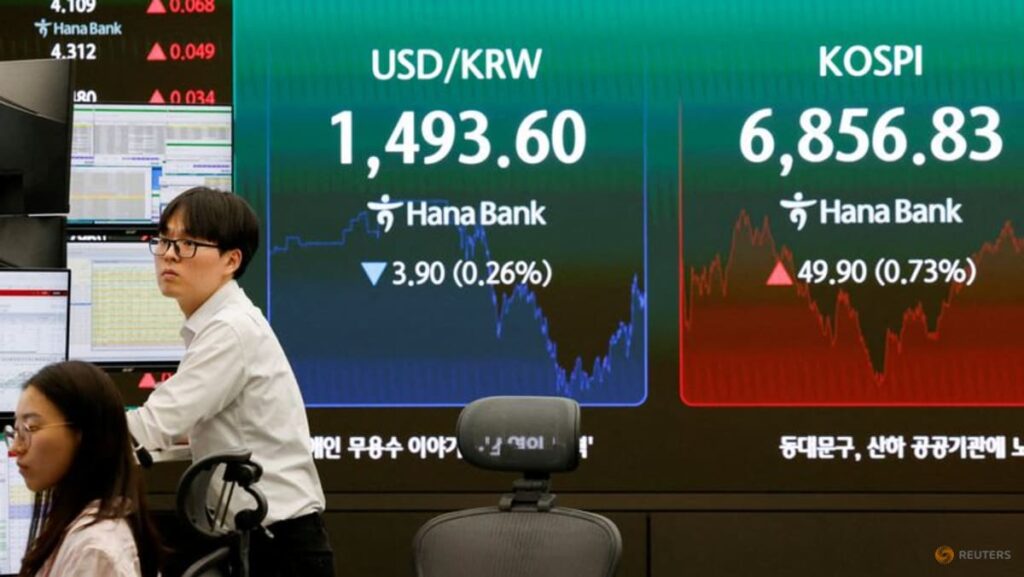
SINGAPORE: South Korean shares soared 16 per cent in early trade on Friday (Jul 31) off the back of a fresh surge of investment into global semiconductor stocks, the latest swing in a market being tossed back and forth by leveraged bets.
The benchmark KOSPI jumped 919.07 points, or 16.43 per cent, to 6,512.63 by 1.15am GMT, rebounding after three consecutive sessions of losses that took the index to its lowest level since Apr 7.
Samsung Electronics shares rose as much as 26.3 per cent, and SK Hynix stock gained as much as 29.7 per cent, with both chipmakers set to post record daily gains. The two chipmakers account for more than half of the KOSPI by market capitalisation.
The stunning turnaround came after the Philadelphia Semiconductor Index surged 8 per cent in the US on Thursday, with chipmaker Micron Technology up 18 per cent.
Tech giant Microsoft leapt 15 per cent, for its biggest gain in 18 years, after reporting stellar earnings that injected fresh market confidence into the outlook for AI investments.
In broader Asian markets, other tech-heavy market gauges also increased sharply. Japan’s Nikkei rose more than 5 per cent and Taiwanese shares jumped 7 per cent.
In South Korea, foreigners were net buyers on Friday of shares worth 5.8 trillion won (US$4.04 billion).
If the current gains stick, the KOSPI will post its biggest daily percentage rise on record. The index, however, remains fragile and down more than 30 per cent from a peak late in June.
Earlier this week, South Korea announced new measures to rein in the leveraged products wreaking havoc in the stock market, but analysts said they might not go far enough to quell skyrocketing volatility, as pain and public anger mount over sharp losses this month.
“It is a concern that there is investor sentiment of trying to recover losses from the recent market slump through leveraged bets,” said Han Ji-young, an analyst at Kiwoom Securities.
The KOSPI is on track for a monthly fall of nearly 25 per cent, its largest since the Asian financial crisis in 1997.