


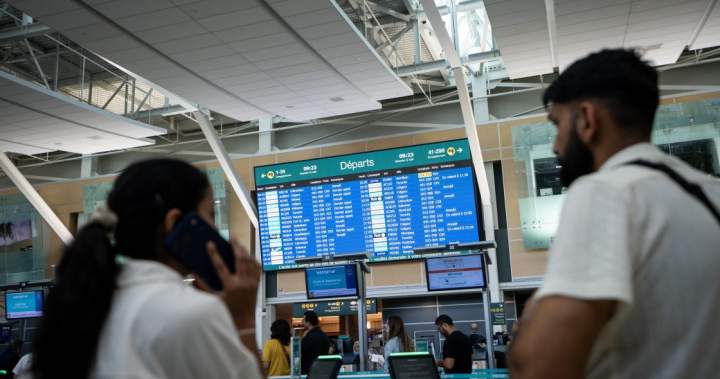
WestJet says its guests are still being impacted by a one-day flight attendants’ strike, which ended after a tentative agreement between the airline and the union was reached.


Some passengers may be feeling the effects for several days, according to experts.
Multiple WestJet flights were cancelled, delayed or rescheduled in the days leading up to the labour action and during the strike itself, and the airline put an unknown number of its 737 aircraft into storage ahead of the job action.
Now that the strike has ended, WestJet says it’s working to normalize its operations, but that passengers should still check their flight status leading up to their departures.
“WestJet is resuming operations and entering the recovery phase following a labour disruption,” WestJet said Tuesday morning in a statement sent to Global News.
“Flights have begun to operate; however, the impacts of the disruption continue as the airline works to restore its network. Guests are encouraged to continue checking the status of their flights before heading to the airport.”
WestJet would not confirm to Global News how long it expects those strike-related impacts to last.
The union representing WestJet’s flight attendants, CUPE 8125, said in a statement Monday that workers are “returning to work,” and a response to a Global News request for an update sent Tuesday referred back to the same statement.
“WestJet Mainline flight attendants have reached a tentative agreement after strike action helped bring the parties to a resolution. With the strike now over, flight attendants will be returning to work,” CUPE said in a statement on Monday.
Although the strike lasted for one day, experts say the impacts are significant and will be felt for a while longer.
“WestJet’s reluctance to put a timeline on recovery tells the real story: restarting an airline is nothing like flipping a switch,” says John Gradek, lecturer and expert in aviation management at McGill University.


Get breaking National news
Get breaking Canada news delivered to your inbox as it happens so you won’t miss a trending story.
“To ride out the strike, aircraft and crews were repositioned across the country and overseas, and getting them back where the schedule needs them takes days, not hours.
“Realistically, we’re looking at Friday or Saturday before the network resembles normal, and a week to 10 days to fully clear the backlog — because this is peak summer, the flights still operating are already full, and there’s almost no room to reaccommodate people.”
Related Videos
What passengers need to know
With WestJet warning that passengers may still have their travel plans impacted — even after the strike ended — there still may be times when sudden changes to flight schedules will throw a wrench in things.
WestJet extended its flexible cancellation policy to include flights scheduled to leave up to and including Aug. 6, 2026. The temporary policy includes the ability for guests to make a one-time change or cancellation to their bookings with no fee.
“If you are scheduled to travel on or before Aug. 6, 2026, to provide greater flexibility and peace of mind, eligible WestJet, WestJet Vacations, Sunwing and Vacances WestJet Québec guests may make a one-time change or cancellation at no additional cost,” WestJet said in an online travel advisory.
“Changes must be made at least two hours prior to your original scheduled departure time. Additionally, if your flight has been disrupted and you no longer wish to travel, you can cancel your flight at any time.”
But if a passenger makes their own changes to air travel plans, they waive their rights according to government regulations — even if the air carrier cancels or changes their original flight.
Air Passenger Protection Regulations (APPR), set by the government of Canada and administered by the Canadian Transportation Agency, ensure travellers are given alternative travel arrangements or compensation where applicable, but the specifics depend on who is making the changes and when.
Under the terms of the rules, if WestJet makes a cancellation or schedule change as the result of a labour disruption, that is considered to be outside of the carrier’s control and triggers a specific set of rights that must be met for passengers depending on the circumstances.
If a flight is cancelled or delayed by three hours or more because of a strike, WestJet must provide clear information in a timely manner and passengers must be offered alternative travel arrangements. Those arrangements may also require the air carrier to provide meal vouchers and accommodations.
The APPR requires passengers be provided alternative travel arrangements within 48 hours of their original departure time — even with a competing airline if it’s more than nine hours. Nearby airports may also be required for rebooking if beyond the 48-hour window, and that’s all on top of potential compensation for inconvenience where applicable.
WestJet said last week if strike action leads to flight delays or cancellations, “impacted guests will be refunded or reaccommodated, as applicable.”
As required by the air passenger rights legislation, passengers “may be eligible for compensation if a cancellation results in a delay which causes you to arrive three or more hours late at your final destination.”
When the strike initially began, WestJet said in a statement that 250,000 guests over the August long weekend had their travel plans cancelled “with further flights to follow, depending on the duration of the work stoppage.”
Gradek estimates that the disruptions will have affected more than 300,000 travellers, including those impacted by pre-strike cancellations and “the days of recovery still ahead.”
“The airline has a 48-hour obligation to get those passengers to their destination, including by buying them seats on competitors,” he said.
“My advice to anyone caught in it: don’t cancel and rebook yourself, or you may forfeit that protection — wait for WestJet’s rebooking notice, but keep every receipt.”
© 2026 Global News, a division of Corus Entertainment Inc.