


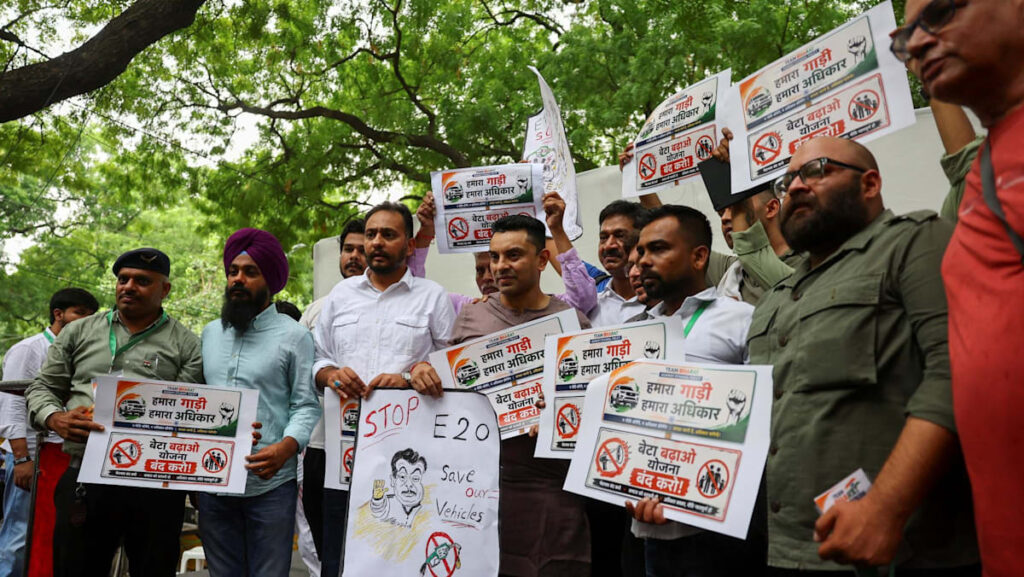
SO WHY IS THE BACKLASH GROWING?
Timing may partly explain the backlash.
Within months of the E20 rollout mandate, motorists began posting videos alleging fuel-related problems, just as the June monsoon increased the risk of water entering poorly maintained underground storage tanks in petrol stations.
Deshpande, the mechanic, said some bottled fuel samples that circulated on social media appear to contain far more liquid in the lower layer than could be accounted for by a 20-per-cent ethanol content. The samples could have been contaminated by water, he said.
“Many petrol stations have not converted to non-metal storage tanks and still have metal tanks underground. Ethanol is a kind of alcohol and attracts water. When there is metal around it, condensation can occur and draw moisture from outside into the tank,” Deshpande explained.
“What is happening right now has more to do with contamination of fuel than E20,” automobile expert Sorabjee agreed.
“Most of the complaints are coming from the north (of India). They are not coming from the west or the south, which suggests there is a contamination issue in the north. If E20 itself were the problem, cars across the country should be breaking down,” Sorabjee said.
Since ethanol tends to absorb moisture, stringent storage and handling methods are essential, experts said.
Ethanol also acts as a detergent, which can dislodge accumulated dirt in poorly maintained vehicle fuel tanks and send it into filters or fuel injectors, Sorabjee said. “Ethanol punishes bad practices.”
Social media has magnified isolated incidents, with some creators presenting speculation as technical evidence, Sorabjee added.
That said, E20 has established drawbacks. Ethanol contains less energy per litre than petrol, which translates into lower mileage, experts said.
Motorists and mechanics told CNA they had seen a 15 to 20 per cent drop in vehicle mileage.
“If my mileage was around 14 km per litre in peak traffic, it may have dropped to about 12 or 12.5 km per litre,” said motorist Dmello.
The motorist from Pune said he had seen a larger mileage drop of 30 per cent since switching to E20 fuel. “Earlier, on the highway, I used to get 24 to 25 km per litre. Now it has drastically reduced to 18 to 19 km per litre,” he said.
Autocar’s tests found losses ranging from 3.8 per cent to 12.6 per cent, depending on the vehicle and its engine calibration. Sorabjee said the decline could be higher in some older vehicles.
However, the IIT Kanpur study put the mileage loss caused by E20 fuel at less than 5 per cent.
Fuel economy also depends on traffic, tyre pressure, maintenance, driving style and vehicle age, making it difficult to attribute an individual motorist’s entire mileage decline to ethanol, experts said.
But a major point of contention is that the drop in mileage has not translated to lower fuel prices at the pump, experts and motorists said.
“Consumers are feeling the pinch, and at the end of the day the motorist is feeling shortchanged,” Sorabjee said. “They should have given a good price reduction on the E20 fuel.”