


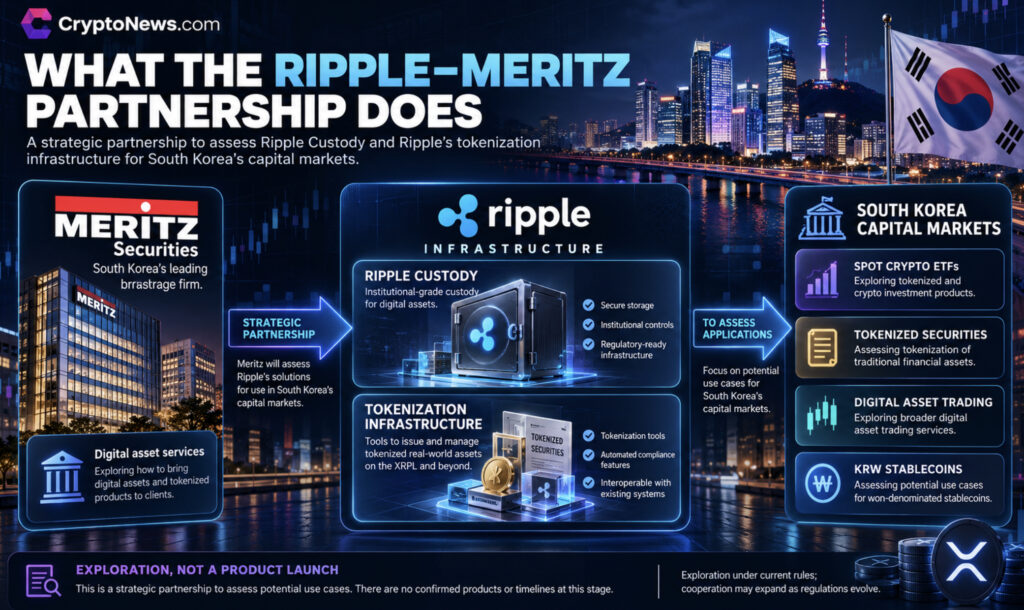
Ripple and South Korean brokerage Meritz Securities have signed a strategic partnership to assess Ripple Custody and Ripple’s tokenization infrastructure for the country’s capital markets. The review comes as digital assets move toward formal regulatory recognition in South Korea, while the XRP price slips below $1.50.
The companies plan to begin cooperation within the limits of existing securities-business rules and regulations, then consider expanding it in stages as South Korea’s digital-asset framework develops.
Meritz Securities said it is examining possible business lines that could become relevant as digital assets enter the regulated financial system.
This list helps explain why the Ripple tie-up may matter beyond custody: Meritz is assessing how several kinds of digital-asset services could fit its capital-markets business as rules change. But the company has not tied those potential activities to Ripple, nor said that any of them will proceed.
Tokenized securities can represent financial assets on a blockchain, but issuance and investor rights depend on the product and its legal structure; tokenization’s relationship to ownership and liquidity is therefore central to assessing any future offering.
Earn $50 and Enter $300K Prize Draw on EdgeX
What Does the Ripple Infrastructure Review Cover?
Ripple Custody is described as Ripple’s institutional digital-asset custody solution, while the company’s tokenization infrastructure is intended for use by financial institutions. Both are currently offered to global financial institutions, and Meritz and Ripple will jointly review how they could be brought to the Korean capital market.
The announcement specifies no blockchain network, custody volume, asset-issuance process, customer group, transaction mechanics, or operating model.
For financial institutions, custody and tokenization are related but distinct pieces of infrastructure: custody concerns safeguarding and managing digital assets, while tokenization concerns representing assets in digital form. The partnership does not spell out how those functions would connect in a Korean service.


Institutional custody also involves operational controls and execution requirements beyond simply holding assets, as discussed in the evolution of institutional custody and execution.
Meritz said the arrangement is intended to combine Ripple’s global digital-asset infrastructure with the brokerage’s capital-markets capabilities, and that it plans to prepare digital-asset financial services in stages as domestic rules change.
Ripple Asia-Pacific Managing Director Fiona Murray said the company would explore how digital-asset infrastructure could support the continued development of Korea’s capital markets. Neither statement sets out a delivery milestone or commits either firm to a commercial launch.
Trade XRP on Bybit and Get a Chance to Win Our $1,000 USDT Airdrop
XRP Price Eyes A Bullish Catalyst


XRP is trading around $1.45, down 4.3% over the past 24 hours and 3.9% over the last seven days, according to CoinGecko. The token has also slipped from around $1.52 during the latest 24-hour range, suggesting sellers still have the upper hand in the near term.
The setup remains cautious, with XRP struggling to hold recent gains despite Ripple’s latest expansion into South Korea’s capital markets. Our prediction-market data puts the $1.40 area as a key downside level, while $1.60 represents the more notable upside target for October. CoinGecko
A sustained move above $1.60 could therefore shift the XRP price outlook toward a stronger recovery, while losing $1.40 could expose the token to deeper downside. For now, XRP appears to be caught between those levels, making the Ripple-Meritz partnership a potential catalyst rather than an immediate price trigger.
Discover: The Best Token Presales
The post XRP Price Eyes New Catalyst as Ripple Partners With South Korea’s Meritz appeared first on Cryptonews.