


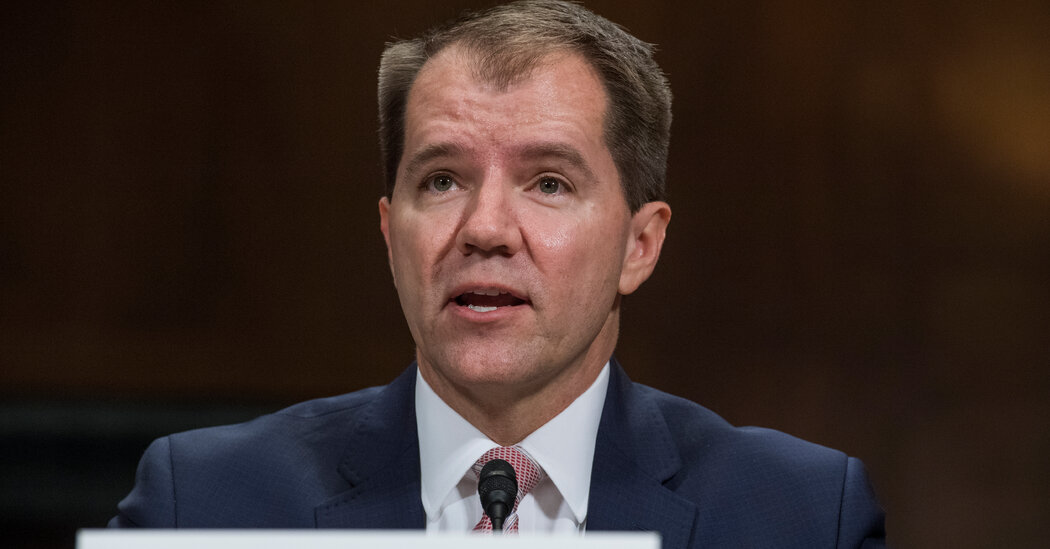
In a routine decision in March, a unanimous three-judge panel of a federal appeals court ruled against a Texas inmate who was injured when the ceiling of the hog barn he was working in collapsed. The court, predictably, said the inmate could not overcome qualified immunity, the much-criticized legal shield that protects government officials from suits for constitutional violations.
The author of the decision, Judge Don R. Willett, then did something unusual. He issued a separate concurring opinion to draw attention to the “game-changing arguments” in a recent law review article, one that seemed to demonstrate that the Supreme Court’s entire qualified immunity jurisprudence was based on a mistake.
“Wait, what?” Judge Willett wrote, incredulous.
In 1871, after the Civil War, Congress enacted a law that allowed suits against state officials for violations of constitutional rights. But the Supreme Court has said that the law, usually called Section 1983, did not displace immunities protecting officials that existed when the law was enacted. The doctrine of qualified immunity is based on that premise.
But the premise is wrong, Alexander A. Reinert, a professor at the Benjamin N. Cardozo School of Law, wrote in the article, “Qualified Immunity’s Flawed Foundation,” published in The California Law Review.
Between 1871, when the law was enacted, and 1874, when a government official produced the first compilation of federal laws, Professor Reinert wrote, 16 words of the original law went missing. Those words, Professor Reinert wrote, showed that Congress had indeed overridden existing immunities.
Judge Willett considered the implications of the finding.
“What if the Reconstruction Congress had explicitly stated — right there in the original statutory text — that it was nullifying all common-law defenses against Section 1983 actions?” Judge Willett asked. “That is, what if Congress’s literal language unequivocally negated the original interpretive premise for qualified immunity?”
The original version of the law, the one that was enacted in 1871, said state officials who subject “any person within the jurisdiction of the United States to the deprivation of any rights, privileges or immunities secured by the Constitution of the United States, shall, any such law, statute, ordinance, regulation, custom or usage of the state to the contrary notwithstanding, be liable to the party injured in any action at law, suit in equity, or other proper proceeding for redress.”
The words in italics, for reasons lost to history, were omitted from the first compilation of federal laws in 1874, which was prepared by a government official called “the reviser of the federal statutes.”
“The reviser’s error, whether one of omission or commission, has never been corrected,” Judge Willett wrote.
The logic of the Supreme Court’s qualified immunity jurisprudence is that Congress would not have displaced existing immunities without saying so. But Professor Reinert argued that Congress did say so, in so many words.
“The omitted language confirms that the Reconstruction Congress in 1871 intended to provide a broad remedy for civil rights violations by state officials,” Professor Reinert said in an interview, noting that the law was enacted soon after the three constitutional amendments ratified after the Civil War: to outlaw slavery, insist on equal protection and guard the right to vote.
“Along with other contemporaneous evidence, including legislative history, it helps to show that Congress meant to fully enforce the Reconstruction Amendments via a powerful new cause of action,” Professor Reinert said.
Judge Willett, who was appointed by President Donald J. Trump, focused on the words of the original statute “in this text-centric judicial era when jurists profess unswerving fidelity to the words Congress chose.”
Qualified immunity, which requires plaintiffs to show that the officials had violated a constitutional right that was clearly established in a previous ruling, has been widely criticized by scholars and judges across the ideological spectrum. Justice Clarence Thomas, for instance, wrote that it does not appear to resemble the immunities available in 1871.
Professor Reinert’s article said that “is only half the story.”
“The real problem,” he wrote, “is that no qualified immunity doctrine at all should apply in Section 1983 actions, if courts stay true to the text adopted by the enacting Congress.”
Joanna Schwartz, a law professor at the University of California, Los Angeles, and the author of “Shielded: How the Police Became Untouchable,” said that “there is general agreement that the qualified immunity doctrine, as it currently operates, looks nothing like any protections that may have existed in 1871.” The new article, she said, identified “additional causes for skepticism.”
She added that “Judge Willett’s concurring opinion has brought much-needed, and well-deserved, attention to Alex Reinert’s insightful article.”
Judge Willett wrote that he and his colleagues are “middle-management circuit judges” who cannot overrule Supreme Court decisions. “Only that court,” he wrote, “can definitively grapple with Section 1983’s enacted text and decide whether it means what it says.”
Lawyers for the injured Texas inmate, Kevion Rogers, said they were weighing their options.
“The scholarship that Judge Willett unearthed in his concurrence is undoubtedly important to the arguments that civil rights litigants can make in the future,” the lawyers, Matthew J. Kita and Damon Mathias, said in a statement.
“Normally,” they added, “you cannot raise a new argument for reversal for the first time on appeal, much less at the Supreme Court of the United States. But one would think that if the Supreme Court acknowledges that it has been reciting and applying the statute incorrectly for nearly a century, there must be some remedy available to litigants whose judgments are not yet final.”

