


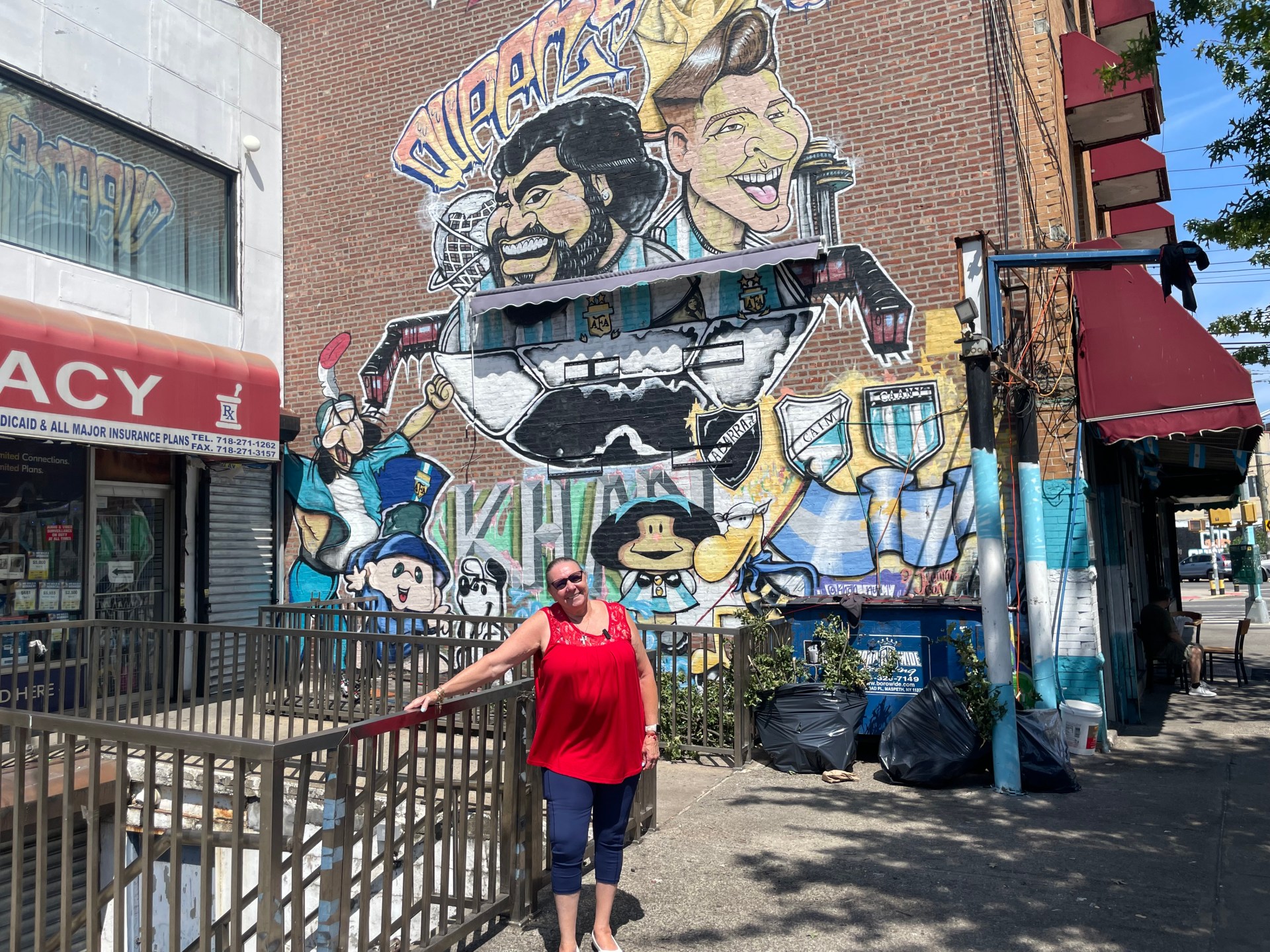
New York City – It’s dubbed “Little Argentina”, but lifelong resident Christian Gimenez says much has changed in the neighbourhood he grew up in.
Once an epicentre of the Argentinian diaspora that settled in New York City, most relocating during the so-called “dirty war” of the 1970s, only a handful of Argentinian restaurants and bakeries remain as a foothold of what once was in the Elmhurst, Queens neighbourhood.
Recommended Stories
list of 3 itemsend of list
But when the FIFA World Cup comes around, the block swells with revellers, clad in white and sky blue. With Argentina heading to the final against Spain on Sunday in East Rutherford, New Jersey, just a few kilometres (miles) away, everything on the block – from the asphalt, to the benches, to the store fronts, and even the fire plugs – bears the iconic colours.
As a child, “everywhere you would go, it was Argentinian,” Gimenez, who owns Rio de la Plata Bakery and is among those who spearheaded the decorations, told Al Jazeera. “So what I do is try to keep it alive.”

To be sure, the 40-year-old is clear that the commitment to Argentina’s national team goes far beyond the monthlong tournament. The World Cup may come only once every four years, but the vaunting mural of Lionel Messi and Diego Maradona on the side of his bakery is a mainstay.
To many, it is a reminder of the generational significance of the country’s football tradition, one that has for decades been a glue for Argentinians in New York City, even as the community has dispersed.
Seventy-four-year-old Beatriz Jaime recounted watching Argentina’s 1978 routing of the Netherlands in a broadcast at Madison Square Garden, and returning to the neighbourhood soon after to find it “loaded with people” celebrating into the night.
“The thing is that the roots are here, and they’re in Argentina,” said Jaime, who grew up in Queens but now lives on Long Island.
“You never forget that. I get goosebumps.”

For Henry Pachaco, 45, who is also from Queens, fandom is a family affair. He stood clad in the national team jersey, his mother wearing a blue shirt with a single phrase, “Hand of God”, a reference to the infamous hand-ball goal scored by Maradona in the 1986 quarterfinal match against England.
Pachaco called the block “the centre” for Argentinian fans in the city, offering a stadium atmosphere on game day – complete with a closed street, music, an outdoor television, and street food – without the price tag.
For Argentina to be in the final, for Messi to possibly be playing in his last national team match, and for all of it to be happening on New York’s doorstep, he said, represents a convergence of worlds.
“It’s like bringing Argentina to New York … wherever you go, anywhere in the world, when Argentinians get together. That that same passion is equal, no matter what.

“You’re always gonna be accepted here and have the best time of your life,” he said.
Gimenez echoed the sentiment, while addressing several racist incidents from Argentinian fans that have tarnished La Albiceleste’s run in this World Cup and the last. He said that was not representative of the fan base.
“Whatever your race or whatever your ethnic background is, we don’t look into that,” he said.
“If you’re supporting us, we love you. Straight up, just like that.”
A new fandom grows in Brooklyn
It is a message that is likely to be well received a borough away, in the Kensington neighbourhood of Brooklyn, home to an rapid-growing Bangladeshi community that has earned the area the title “Little Bangladesh”.
NYC data shows the diaspora population has tripled in the last two decades, one of the fastest-growing groups in an ever-changing city. Last year, the community elected the first-ever Bangladeshi American to the NYC Council.
Shafiqul Alam, 66, who has lived in the neighbourhood for 36 years, said the area has transformed, bringing with it a passionate new base of support for Argentina’s national team.
On match days, large-screen televisions have been set up in pedestrian squares in the neighbourhood. If the weather turns, he said, it is not uncommon for people to crowd inside his shop to watch on his own television.
“Bangladeshi people love Argentina,” he said, “and Argentina loves Bangladesh.”

Many factors have coalesced to fuel support for Argentina within South Asia, and particularly Bangladesh, notably a newfound access to televisions in the 1980s, which aligned with the Maradona-led national team’s 1986 defeat of England.
The match held potent political significance for countries still grappling with the legacy of British colonialism. But for many younger fans, support comes down to one man: Messi.
“Knowing this could be Messi’s last match, everyone will want to watch,” said Sajid Bhuyan, 31, a resident of the neighbourhood.
He had trouble imagining that any less than 90 percent of the local Bangladeshi community in Kensington backed Argentina.

While the origin stories of their fandom may be different, Bhuyan felt the passion from Little Bangladesh to Little Argentina was the same.
He recounted a tournament that has repeatedly seen Argentina come back from the brink of defeat, most recently in a stunning turnaround in the semifinal against England.
“I almost died when Argentina scored the two goals in just minutes,” Bhuyan said. “I couldn’t breathe, I couldn’t talk, I had to take five or six minutes to calm down.
“So if it happens again,” he said, “we will enjoy!”

