


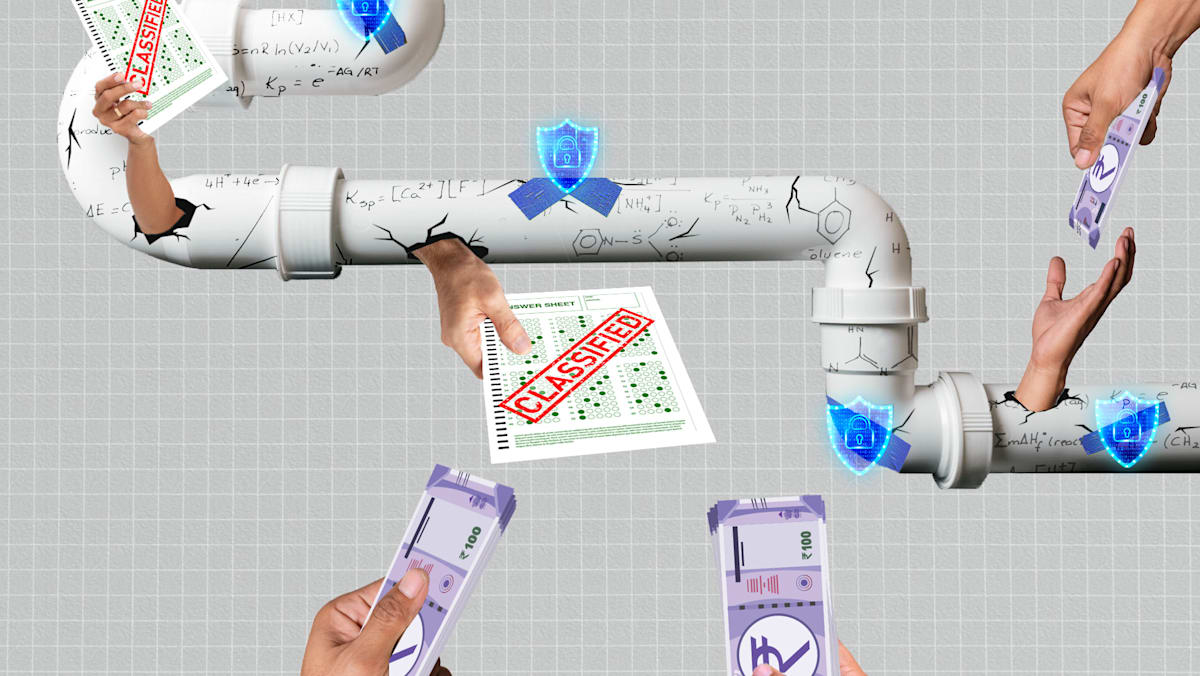
WILL GOING DIGITAL ACTUALLY PLUG INDIA’S LEAKS?
Subrahmanyam, the former Indian education secretary, has proposed a nationwide continuous assessment system built by upgrading existing schools, colleges and polytechnics into a national network of accredited digital assessment centres.
Under his proposal, every senior secondary school would, over time, be equipped with secure computer laboratories that could serve both teaching and assessment.
Rather than replacing paper-based exams overnight, he called for a phased transition over about a decade, allowing schools to gradually build infrastructure, train staff and shift to digital assessments.
This phased approach also reflects the scale of the challenge.
Proposals submitted by India’s Ministry of Education and the NTA to a parliamentary committee in July suggest that moving the NEET exam online in 2027 could require the exam to be spread over five to six days across about 1,000 centres in 500 cities, with roughly 500,000 candidates sitting each day, according to a report by local new publication The Indian Express.
Those numbers underscore the logistical hurdles involved that India would need enough secure computer labs, reliable power and connectivity, trained staff and multiple equivalent test versions to ensure fairness across sessions, said experts.
Although the NTA already conducts several major exams at computer centres, NEET remains paper-based largely because of its size – more than 2.2 million candidates appearing at 5,432 centres in 2026 – they added.
Experts said that with technology India can move away from setting one question paper for all candidates to plug leaks.
“If you can generate different but equivalent question papers for every candidate, there is no longer one paper worth stealing,” said Krishna. But he cautioned that technology only shifts the attack surface, from physical question papers to the computers, exam centres and digital systems used to administer the test.
“Centre operators, invigilators, vendors and the coaching ecosystem need as much design attention as encryption and key management,” he said.
That is also the lesson Dalrymple said ETS has learnt from decades of running high-stakes exams worldwide, in more than 180 countries, including the US, India, Japan, South Korea and across Europe.

