


Some Canadian oil industry and development leaders are suggesting Ottawa should reconsider the plan to sell the Trans Mountain pipeline to the private sector amid a spike in oil prices with no end in sight.

This comes at a time when global oil markets are rattled as a result of the Iran war and, more specifically, the closure of the vital Strait of Hormuz, with the International Energy Agency warning on Wednesday that the conflict is “depleting global oil inventories at a record pace.”
Mark Maki, the president and CEO of Trans Mountain, spoke on Monday at a Canadian Club event and said it’s a “sovereign pipeline” that operates almost entirely within Canada and that it’s an “incredibly strategic asset” to the country.
With demand spiking for Canadian oil to help offset losses from the Middle East, experts say there is a case to be made both for selling the pipeline sooner and for keeping it.
“Is it [the Trans Mountain pipeline] strategic? Yeah. Could you sell it? Yes. But probably there is a decent argument to keeping it, at least until we sort out what are we going to do to try and get West Coast market access improved,” says Richard Masson, the former CEO of the Alberta Petroleum Marketing Commission.

The Trans Mountain pipeline is Canada’s only pipeline currently in operation that transports crude oil and other petroleum products from Alberta to Canada’s West Coast.
More pipeline proposals are being considered, with Prime Minister Mark Carney and Alberta Premier Danielle Smith expected to make a related announcement on Friday.
The leaders of Trans Mountain Corporation and the federal agency that oversees the Crown corporation say it’s possible Ottawa will own the current Alberta-to-B.C. pipeline indefinitely.
On Monday, Maki was joined on stage by Elizabeth Wademan, who heads up the Canada Development Investment Corp.

Get daily National news
Get daily Canada news delivered to your inbox so you’ll never miss the day’s top stories.
Trans Mountain is a subsidiary of the investment corporation and Wademan describes her agency as a “friendly yet challenging shareholder” in the pipeline firm.
Wademan said there’s a case for the federal government to be a long-term holder in the Trans Mountain pipeline and she “personally would love to see it owned by Canadians.”
The pipeline expansion was first proposed in 2012 by Kinder Morgan Canada, which encountered so much environmental and Indigenous opposition that it ultimately threatened to scuttle the project.
The federal government purchased the pipeline for $4.5 billion in 2018 in an effort to get the project over the finish line. Once construction did start, the project ran into numerous delays and budget overruns, with its price tag spiralling over the course of four years to an eye-popping $34 billion.
Ottawa has said it does not plan to be the permanent owner of the pipeline, but would instead sell the asset to the private sector in time while maintaining regulatory oversight.

The Iran war has caused the price of crude oil, which is set globally, to rise to about US$100 as of publication — up from roughly $60 at the start of the year.
When oil and gas prices go up, so too does revenue for oil companies and governments, which may collect taxes and other fees on the sale of those products, though some of those gas taxes have been paused for now to help provide some relief for consumers at the gas pump.
This is why there may be a push to sell the pipeline sooner while the value of oil is spiking.
“The intention all along was to sell it off to a private company, Indigenous groups or a combination of the two. I don’t think that when the price temporarily goes high that you then go back on your word and say, ‘Well, maybe we’re going to rethink this,’” says Moshe Lander, an Alberta-based economics professor at Concordia University.
“That was the objective [and] I don’t think that should change. You can always argue about what the appropriate timing is to sell them off, but I think you’re going be hard-pressed to find a better time than when the oil price is high. That’s when you, in theory, have the most leverage; you’re not going to get a good price for it when it’s 60 bucks a barrel.”
Masson says finding a buyer may be a challenge.
“I don’t think there are many likely buyers around. Certainly, Kinder Morgan is one of the U.S. companies [but] they won’t want to come back. Most of the U.S. companies, I would expect, wouldn’t want to come back,” Masson says.
“Financing it is where international investors come in. They’re typically very passive…. Their mandate, like any other management team, is trying to maximize cash flow for the shareholder, and that can all work, but I don’t think there’s likely any pipeline company who wants to step up and say, ‘I want to take on this big pipeline right now.’”
Trans Mountain is also actively seeking to expand its capacity of nearly 900,000 barrels of crude oil per day by about 25 per cent, including by introducing methods to deliver oil faster through the pipeline over the next few years.
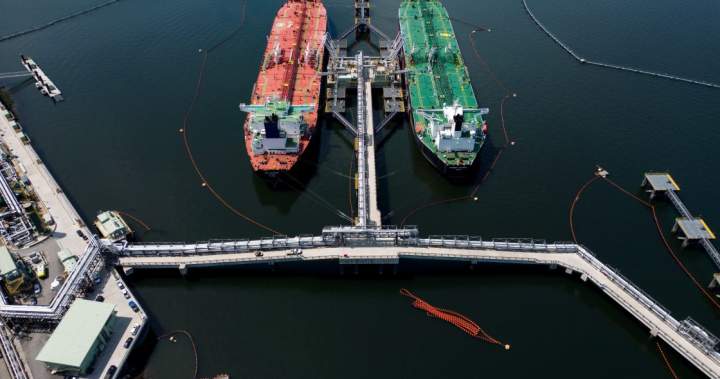
Part of this plan also includes dredging the Port of Vancouver’s Westridge Marine Terminal to allow tanker ships to fill up with more oil at the mouth of the pipeline and take it to international markets like Asia.

Masson says he’d like to see Trans Mountain prioritize maximizing its capacity over the next few years before Ottawa looks to sell it.
“I think given that they found this potential 300,000 barrels [of additional capacity potential] a day by 2028, I would carry through on that,” he says.
“So I wouldn’t try to disrupt the whole apple cart with the sale process in the middle of all that.”
If Ottawa looks to prioritize increasing Trans Mountain’s capacity, it may wind up holding onto the pipeline for a little longer, but Lander says ultimately, it’s in the government’s best interest to eventually find a buyer.
“If the government continues to maintain ownership of the pipeline, the government is responsible then for maintaining that pipeline and everything that comes with it,” he says.
“If we’re purely talking about what are the economics of the pipeline, it doesn’t make sense to stay in government hands.
“There’s no reason that we need to rush and make any of these decisions precipitously.“
— with files from The Canadian Press

