


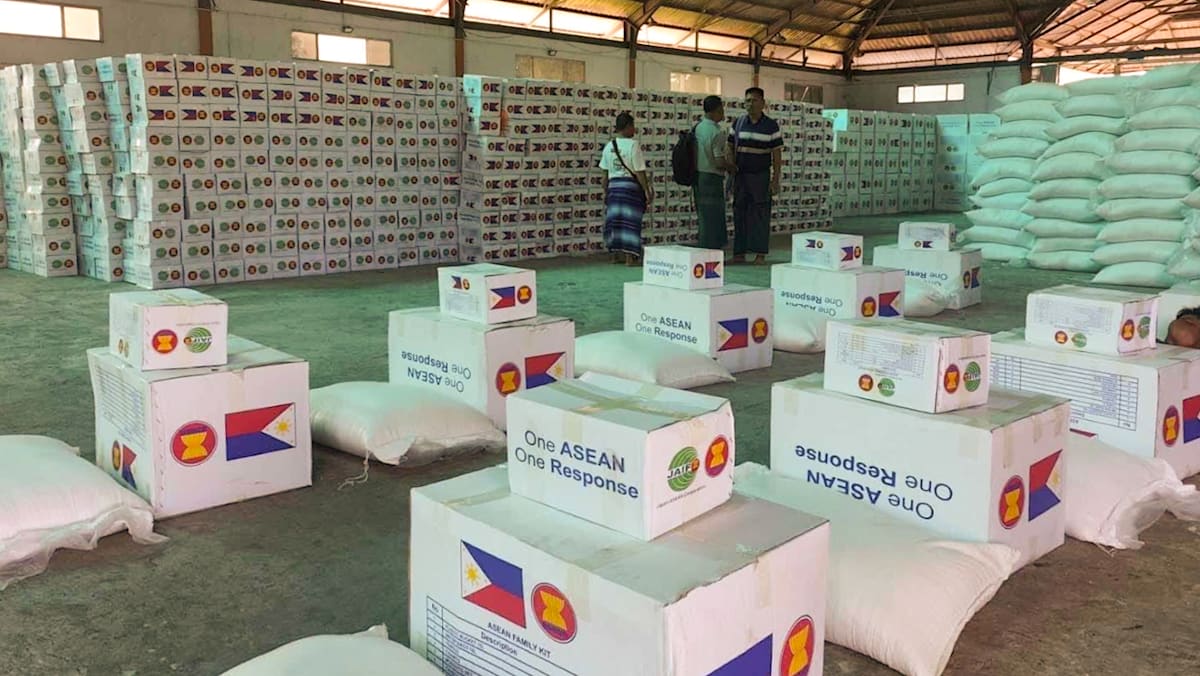
JAKARTA: A recent humanitarian mission to Myanmar by the Association of Southeast Asian Nations (ASEAN) – led by the bloc’s special envoy to the country – has drawn mixed reactions, with some observers highlighting its potential to reach vulnerable communities, while others warn against engaging the country’s military authorities amid a lack of progress on an agreed peace plan.
Special envoy Maria Theresa Lazaro, who is also the Philippine foreign secretary, visited the country from Oct 28 to 29 to launch a month-long operation with the ASEAN Coordinating Centre for Humanitarian Assistance on disaster management (AHA Centre).
It was the third ASEAN aid distribution in Myanmar this year, but the first in which the grouping’s special envoy personally participated, according to Indonesia’s charge d’affaires in Yangon, Novan Saleh.
The mission, which comes ahead of the ASEAN Leaders’ Summit in Manila from Nov 15 to 17, aims to distribute humanitarian assistance, including 50kg bags of rice and personal hygiene kits, to more than 11,000 households affected by Myanmar’s prolonged conflict. Lazaro also met Myanmar’s military-backed leadership during her visit.
Joanne Lin, senior fellow and coordinator of the ASEAN Studies Centre at the ISEAS-Yusof Ishak Institute, said the mission was significant because ASEAN had managed to access areas it previously could not reach.
“What was really significant in this case is the fact that they managed to go into areas that they were not able to access before,” she told CNA.
But Khin Zaw Win, director of Tampadipa Institute, a policy advocacy and capacity-building institute based in Yangon, questioned the scale of the assistance.
“Even 11,000 households is a small number,” he told CNA. “It’s more of a symbolic gesture.”
Gugun Muhammad, a member of the Jakarta-based non-governmental organisation Leaders and Organizers of Community Organization in Asia (LOCOA), also questioned the broader implications of the visit.
“It could normalise and legitimise a government that emerged from a ‘sham’ election, as though ASEAN recognises it,” said Gugun.
He said ASEAN should engage a broader range of stakeholders, rather than focusing primarily on the military-backed administration.
The contrasting views highlight ASEAN’s challenge in balancing humanitarian engagement with political pressure, as Myanmar’s military leadership seeks to regain full participation in the regional bloc despite restrictions imposed following the February 2021 coup.

