


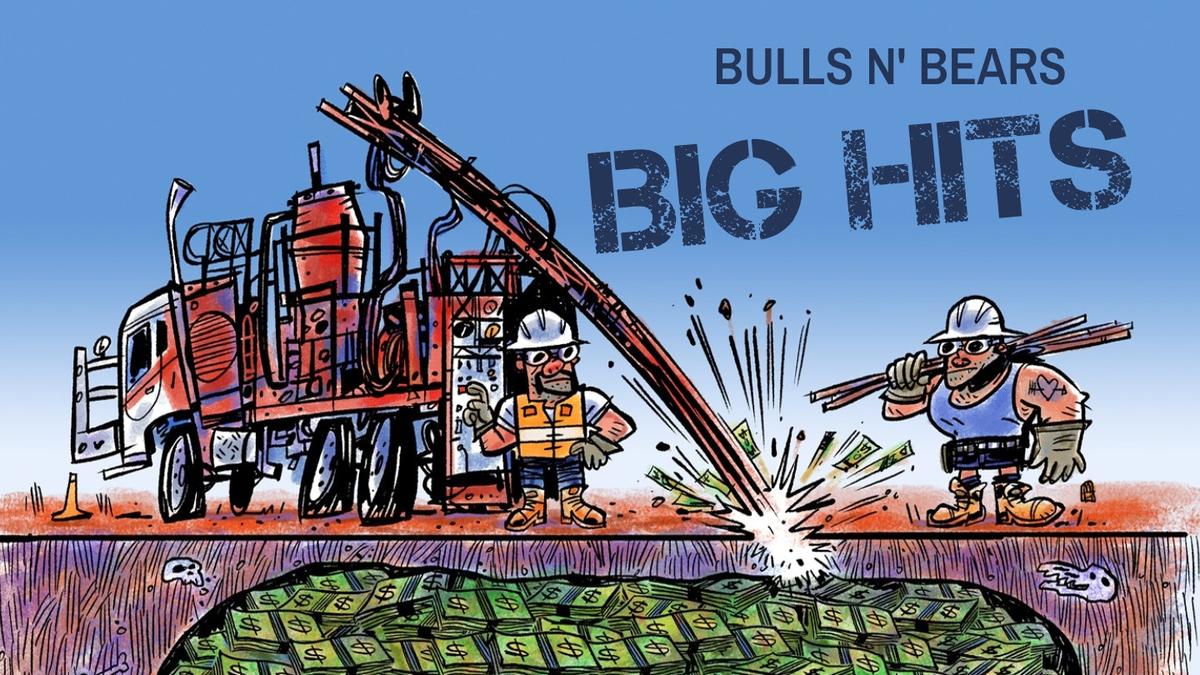
Bulls N’ Bears Big Hits looks at notable drill hits recently reported to the ASX, led by Andean Silver in Chile, Midas Minerals in Namibia and Iltani Resources in Queensland.
From a screened field of 14 contenders in a mixed week for ASX drilling news, three company hits stood out for very different reasons: silver-gold fireworks, copper width and a rare indium twist.
So, let’s dive in.
ANDEAN SILVER (ASX:ASL)
Project: Cerro Bayo silver-gold project, Chile Hit: 2.4m at 15,558g/t silver-equivalent
Andean Silver takes the podium’s top step this week after drilling what it says are the highest grades yet returned from its Cerro Bayo silver-gold project in southern Chile, with a bonanza-grade hit that would have been hard to ignore in any field.
The company’s headline intercept from the Trinidad vein came in at 2.4m, grading 15,558 grams per tonne (g/t) silver-equivalent, made up of 1882g/t silver and 164.8g/t gold. It included 1.4m at a stunning 25,340g/t silver equivalent, comprising grades of 3045g/t silver and 268.6g/t gold. While the intercepts are narrow, the grades are spectacular.
Intriguingly, the hit came from the first drilling at Trinidad in more than 10 years, giving the result a useful sense of rediscovery rather than simply another infill line in a well-chewed part of the mine complex.
Andean says the numbers show strong continuity of mineralisation through the Laguna Verde mine complex at Cerro Bayo, where its accelerated drilling aims to convert inferred resources to measured and indicated categories for future feasibility and restart work.
Beyond the immediate bonanza headline, the Trinidad trend has opened a bigger question. The company says the zone now shows conversion and growth potential across more than 800m of strike, despite historic drilling testing only to about 150m vertically.
That leaves Andean with several obvious follow-up paths. Future drilling is expected to chase mineralisation down-plunge of the Trinidad shoot and test extensions outside the current resource, including mineralisation 400m north of the main Trinidad mine area.
One hole has already shown mineralisation continuing beyond interpreted veins and outside the reported resource, with a separate 2.5-metre hit grading 500g/t silver-equivalent. Historic drilling more than 15 years ago also returned nearby gold-silver intercepts, giving the company more targets to revisit around existing infrastructure.
Across its 330-square-kilometre Cerro Bayo project, Andean says its 12-month strategy is shifting from a mostly exploration-focused approach to a mix of resource growth, resource definition and restart planning. That includes brownfields drilling around the Laguna Verde and Cerro Bayo mine complexes, broader target generation and regional exploration, plus infill drilling to support updated geotechnical and metallurgical studies.
The company also says feasibility-level work is due to begin, with an option to add to the current four-rig fleet to support its planned 2026 and 2027 programs, if required.
The broader Cerro Bayo project already carries a reported resource of 20 million tonnes at 211g/t silver-equivalent for 136 million ounces silver-equivalent. That gives the latest Trinidad hit more context than a one-hole wonder, particularly with resource growth drilling planned across the wider district for the first time in nearly two decades.
From a Big Hits perspective, Andean’s problem is a good one. The intercept was so high grade it almost selected itself, even without the broad width that usually makes comparisons easier. This week, grade won the toss-up.
MIDAS MINERALS (ASX:MM1)
Project: Otavi copper project, Namibia Hit: 52m at 1.19 per cent copper, 8.7g/t silver and 1.93 per cent lead from Spaatzu.
Midas Minerals earns second place with the cleanest broad drill hit of the week, after assays from its Spaatzu prospect in Namibia confirmed a thick copper-silver-lead interval on the northern flank of the Merwe dome.
One hole returned 52m at 1.19 per cent copper, 8.7g/t silver and 1.93 per cent lead from 148m, including 30m at 1.87 per cent copper and 12.7g/t silver from 152m.
Other useful hits included 33m at 0.76 per cent copper, 17.8g/t silver and 1.69 per cent lead from 18m, and 16m at 0.76 per cent copper, 26.8g/t silver and 2.36 per cent lead from 205m.
The hit sits 300m west of the company’s earlier discovery hole at Spaatzu. It extends the copper-silver-lead-manganese mineralised corridor out to at least 800m of strike, with induced-polarisation geophysical targets mapped across an estimated two kilometres.
Midas also re-assayed a historic Nexa diamond hole at Spaatzu, which returned 97.8m at 17.6 per cent manganese from 0.2m, including 16.6m at 35.3 per cent manganese. It is not the main reason this result made the Big Hits selection, but it adds a useful polymetallic layer to the Otavi story.
The broader geological setting also gives the hit more room to run. Spaatzu sits on a 2.5-kilometre copper soil anomaly on the northern flank of the Merwe dome, a structurally complex base-metals setting in Namibia’s Otavi Mountain Land.
Midas says drilling points to copper-silver mineralisation following a west-northwest-trending fault, with higher grades developing where those structures cut favourable rock units. The system appears to carry both structural and stratabound styles, with sharper copper-silver zones sitting alongside broader disseminated copper-lead mineralisation.
The manganese adds another layer. The company says high-grade manganese oxide veining occurs near surface around the crown of the dome, close to the higher-grade copper-silver mineralisation, giving Spaatzu a broader polymetallic footprint than copper alone.
Midas says more drilling is required to define the full extent of the mineralisation and better understand the structural and lithological controls at Spaatzu.
The company has six rigs operating across its Namibian ground, including diamond drilling aimed at improving its understanding of the local structural controls at Spaatzu, with further results pending.
For this week’s field, the appeal is straightforward. Midas has delivered a thick, readable copper hit backed by scale and a busy follow-up program.

ILTANI RESOURCES (ASX: ILT)
Project: Orient West, Queensland
Hit: 1m at 192g/t silver, 925g/t indium, 1.8 per cent lead and 13.9 per cent zinc.
Iltani Resources rounds out the top three with the week’s best critical-minerals colour, built around a narrow but indium-rich silver-base metals hit at its Orient West prospect in North Queensland.
The standout intercept from reverse circulation (RC) drilling delivered 1m at 192g/t silver, 925g/t indium, 1.8 per cent lead and 13.9 per cent zinc for 1390g/t silver-equivalent from 104m.
Supporting hits in two other holes included 1m at 358g/t silver, 213g/t indium, 7.6 per cent lead and 7.3 per cent zinc from 49m, and 1m at 46g/t silver, 811g/t indium and 12.9 per cent zinc from 242m.
Importantly, the one-metre peaks sit within broader mineralised envelopes, including one intercept that returned 17m at 37g/t silver, 88g/t indium, 0.5 per cent lead and 1.5 per cent zinc from 97m.
Across the seven broader intercepts reported, indium grades ranged from 40g/t to 180g/t, giving the overall result more weight than a single shiny vein.
Orient sits within Iltani’s wider Herberton project, where the company holds 370 square kilometres of tenements in a historic mineral field best known for its tin, tungsten, copper and silver-lead-zinc workings.
The Herberton-Mount Garnet region has more than 2400 recorded mines and prospects, giving the project useful district-scale context beyond its latest drill results.
Iltani describes Orient as Australia’s largest known silver-indium deposit and says the latest drilling continues to reinforce the project’s potential as a supplier of indium-rich concentrate. That matters because indium is usually recovered as a by-product of zinc, lead and tin processing, making its supply far less responsive to demand than that of many mainstream metals.
The soft metal with its low melting point is best known for indium tin oxide, the transparent conductive coating used in touchscreens and flat-panel displays. It also has roles in high-speed semiconductors, thin-film solar cells, specialist solders and even some high-performance aircraft engine bearings.
So far, Iltani has completed 65 RC drill holes for 12,297m at Orient West and East from a planned initial 110-hole program. With samples routinely submitted for analysis and results pending, the company says it expects a steady flow of assays in the coming months.
Iltani is continuing infill drilling at Orient West to bring the high-grade core to 50m section spacing, before testing extensions to the northeast and southwest. About 900m of known mineralised strike, based on historic workings and outcrop sampling along the northeast trend, remains to be comprehensively drill-tested.
Two RC rigs are on site, with drilling also underway at Orient East before further tests of other zones and VTEM geophysical targets at Orient West’s southwestern zone. The planned Orient program is expected to run for up to two months.
Iltani’s results reflect an interesting mix of grade, technology relevance, criticality and constrained supply that gave the company the extra lift it needed to make the final Big Hits podium.
Is your ASX-listed company doing something interesting? Contact: matt.birney@wanews.com.au

