


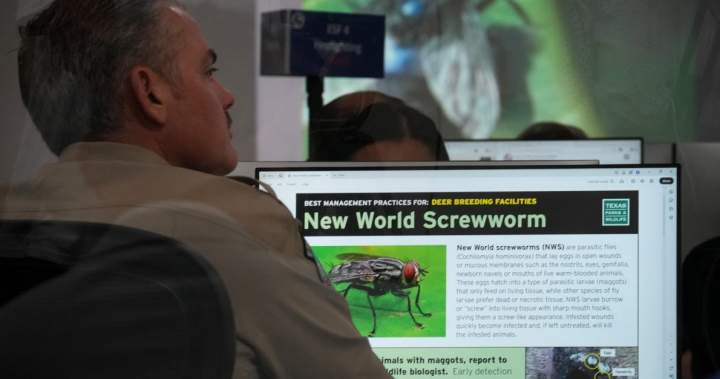
Canada will temporarily limit imports of livestock from Texas after a confirmed case of flesh-eating screwworm was found in the state for the first time since the 1960s, the Canadian Food Inspection Agency said Friday.

A calf at a ranch in La Pryor, Texas, tested positive on Wednesday for the parasite, which left a gaping hole around its umbilical cord, according to the U.S. Department of Agriculture. The discovery has sparked alarm for the U.S. cattle industry and the potential of an outbreak beyond Texas’ borders.
The CFIA said animals, including horses, that originate from or were present in Texas within 21 days prior to arriving at the Canada-U.S. border will not be accepted into Canada.
“The flesh-eating larvae of this parasitic fly threatens the lives of its host animals,” the agency said in a statement.
“While our colder climate is not hospitable for the long-term establishment of the fly in Canada, they can survive shorter periods of time in the summer months. Taking this action now is an appropriate risk mitigation measure to prevent its introduction and protect animal health.”
The CFIA urged animal owners, veterinarians and cattle ranchers to be on the lookout for signs of screwworm infestations of livestock, including worsening wounds, discharge and foul odour coming from the animal.
Canadians travelling to Texas with their pets are encouraged to “remain vigilant and inspect their pets regularly for any signs” of infestation, it said.

Get weekly health news
Receive the latest medical news and health information delivered to you every Sunday.
Global News has reached out to the Canadian Cattle Association and other beef industry associations for comment.
New World screwworm larvae can infest most animals and wildlife, including occasionally birds and even humans in rare cases.
An untreated infestation can be fatal, but there are now a dozen government-approved medications to treat livestock. Federal and state officials have been quick to stress that the fly’s larvae — which feed on living material — do not infest meat or fruit.
The flies prefer hot, humid environments around 25 to 30 degrees Celsius and are endemic to South American and Caribbean countries.
Ranchers in South Texas have been bracing for the arrival of screwworm for more than a year, as the flies progressed from Colombia through Central America, inching closer to the U.S. border.
The CFIA said New World screwworm cases have also been reported in Mexico, prompting the agency to prohibit imports of cattle, bison, sheep, goats, cervids and swine from the country.
“Stringent” import controls are also in place for horses from Mexico “to prevent introduction of animal disease into Canada,” it said Friday.
It noted several U.S. states are taking their own precautionary measures to stop the potential spread of screwworm beyond Texas.
U.S. Agriculture Secretary Brooke Rollins has said her agency is doing all it can to stop a spread of screwworm from threatening Texas’ multibillion-dollar cattle sector.
Texas Gov. Greg Abbott, who declared a state of disaster Friday, pledged Texas will invest its own money and resources if needed to help Rollins’ department accelerate construction of a US$750-million sterile fly breeding facility that can halt the reproduction of the flesh-eating larvae.
The plant, which broke ground in April, was set to be operating by November 2027, but Abbot said it must be completed before next summer. A second U.S.-funded breeding facility in Mexico is expected to start production next month.
At both facilities, sterile male flies will mate with wild female screwworms to produce infertile eggs.
Without greater sterile fly production, Abbott said during a news conference in the state capital of Austin, “We cannot make it through a second summer.”
—With files from the Associated Press and Reuters

© 2026 Global News, a division of Corus Entertainment Inc.

