


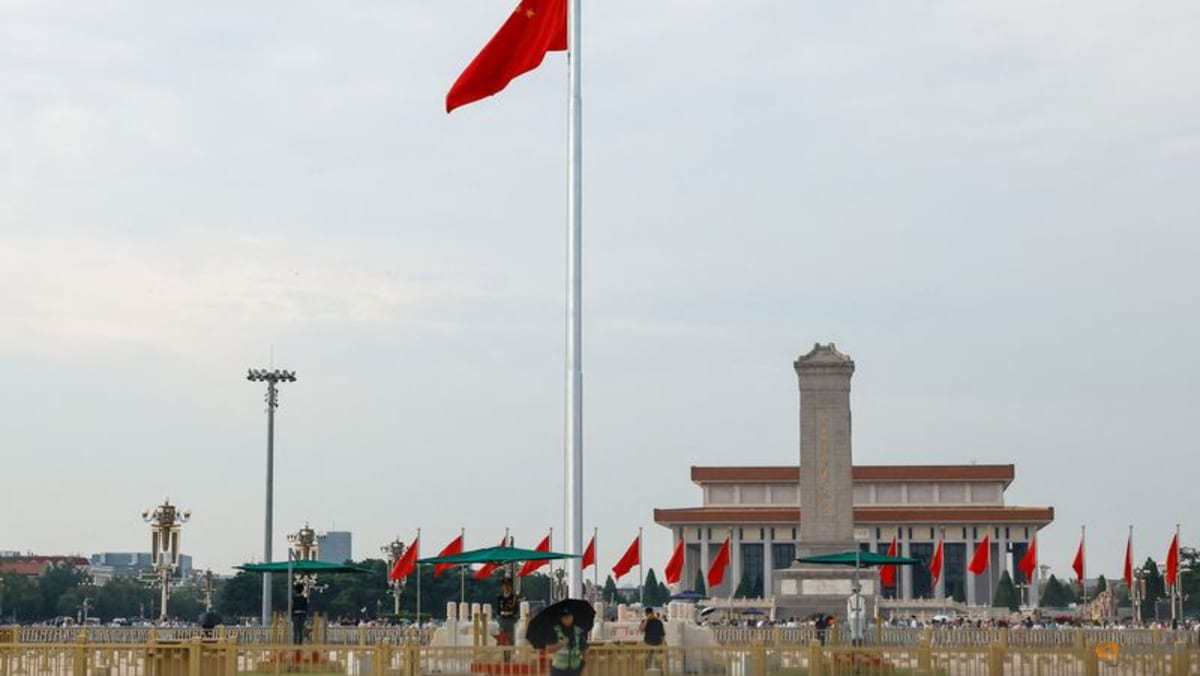
BEIJING: China on Tuesday (Aug 18) lowered national flags at government headquarters to mourn former Premier Zhu Rongji, the no-nonsense reformer who died last week at the age of 97, as the public reminisced about a bygone era while reflecting on his complicated legacy.
Security was tightened across the city, particularly around Tiananmen Square, the centre of China’s political power.
The square lies along the eastbound route to the Babaoshan crematorium, where top leaders are typically cremated.
China’s vice premier from 1991 to 1998 and premier from 1998 to 2003, Zhu helped drive the country’s hard-edged economic overhaul in the 1990s.
He curbed runaway inflation, tightened tax and banking systems, and pushed through a sweeping state-sector shake-up that cost millions of jobs at unprofitable state firms.
His reforms also helped clear the way for China’s accession to the World Trade Organization (WTO) in 2001, deepening its integration into the global economy.
“My defining trait – my guiding principle – is independent thinking,” Zhu told officials in Shanghai in 1988 before he became the city’s mayor.
“I believe I should say what I truly think.”
Zhu had his party membership revoked in the late 1950s, for an incautious three-minute speech, he said. It was not restored for roughly two decades.

