


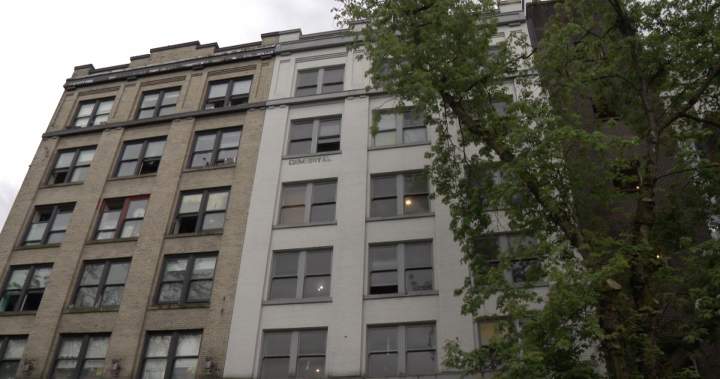
Vancouver’s mayor is calling for change after Global News revealed the operator of a provincially funded SRO received more than half a million dollars in the final months when two tenants remained, while there are renewed questions about how non-profit organizations are spending the millions in taxpayer money funneled into the Downtown Eastside every year.

From at least late March to mid-May, there were only two tenants at the Colonial Hotel at 122 Water Street in Gastown, as the SRO operated by Atira prepared to close.
The non-profit received $325,000 from BC Housing to run the Colonial Hotel in March when occupancy dwindled to two tenants, and an additional $222,100 for April to support the wind-down of operations, according to the province.
“That disgusts me,” Steve Hagger told Global News.
Hagger is currently homeless and said he knew the last tenants of the Colonial Hotel, where he had sometimes stayed as a guest.
“I’ve seen that building go with just three or four tenants for like, four or five months now,” Hagger said in an interview. “The fact that they got that much money makes me really sick, cause it’s disgusting in there.”
“I think it’s unfair to taxpayers absolutely, because they could be putting it to a better use,” added BC Housing tenant John Hodgson.

“It’s completely ridiculous,” said Vancouver mayor Ken Sim.
In an interview Thursday, Sim said it’s disappointing to see the waste and lack of transparency, adding the city is still waiting for 400 mandatory care beds promised by the province.
“That’s a lot of money for two tenants, I did the math and you could rent a place in the nicest hotel in the entire city and still save a bundle of money,” Sim told Global News.
The province confirmed that Atira terminated the lease on the Colonial Hotel property as of April 30.

Get daily National news
Get daily Canada news delivered to your inbox so you’ll never miss the day’s top stories.
Atira has refused to answer questions regarding how much it costs to keep the 140-room building open for two residents and said its agreement to operate it as an SRO ended on April 30.
“I think we have to ask ourselves, why aren’t they being transparent, and when you have hundreds of thousands of dollars per month being spent to house two individuals – maybe that’s the reason why they don’t want to show people where the money’s going,” said Sim.
“The whole thing is just a scam,” said former Colonial Hotel tenant Jessica Klinger. “Rich people getting richer off our, more or less, misery.”
Klinger and her boyfriend, Clayton Quigley, said they were among the SRO’s last tenants and lost many of their belongings when they were kicked out in mid-March.
Quigley questions the $547,100 in provincial funding Atira was given to operate the mostly vacant building over two months.
“There’s no way it cost them that much,” Quigley said in an interview. “It’s just a big money grab, that’s all it is.”
Millions are spent annually with mediocre results in the Downtown Eastside.

Earlier this year, Larry Campbell, the provincially-appointed Downtown Eastside advisor, said it’s been a mixed bag when trying to have a conversation with non-profit organizations about money.
“We don’t know where the money is going,” Campbell told media on March 31. “These are the people running the organization. We don’t know where the money is going. And some of them are resistant.”
“I don’t know what the money’s going to, but it’s sure as hell not going towards our housing or our well-being,” said Klinger. “I’ve been here (at the Colonial Hotel) for eight years. It’s been a hell ride and all I want to do with my life is get my life together, be able to like, maybe get my kids back.”
A 2023 paper published in the peer-reviewed journal, Social Sciences, explored the ‘Nonprofit Industrial Complex’, or NPIC.
Co-authored by SFU doctoral student and registered outreach social worker Tyson Singh Kelsall and 21 others, the research concluded the NPIC “allows governments and politicians, foundations, and wealthy individuals to shirk responsibility by creating a facade of community-led initiatives that are underfunded and given inflexible mandates.”
“Nonprofits in Vancouver seek to increase their own revenue growth, sometimes by producing further harm to and restricting access to resources from the populations from which they already extract revenue, in order to ensure the cycle continues,” it added.
Hagger said government needs to start looking at where all the money is going.
“I don’t think it’s really going to any of people really, maybe a portion or a percentage of it but a lot of it’s going into somebody’s pocket, and a lot of it in the wrong pockets,” Hagger told Global News. “I don’t want anything in my pocket, I just want the money so I can get something, somewhere to live.”
“I feel like they could do a lot more to help us like with you know, resources and everything else,” added BC Housing tenant Jonathan Craig.
Atira said it is currently working toward transferring the Colonial Hotel building back to the owner, but no longer has staff on site.
The province confirmed all Colonial tenants with Atira rental agreements through BC Housing have been relocated to alternative housing options, and the remaining tenant has a lease with the building’s private owner.
Property records show the Colonial Hotel is owned by Colonial Enterprises Ltd. under director Peter Plett.
The building owner, the province said, is disputing the lease termination with Atira.
On May 19, the sole tenant, told Global News he’s not planning to leave.
“This is where I live, so I’m staying here,” said Robert, who did not provide his last name.
The City of Vancouver said there is nothing in its bylaws preventing a resident from occupying the building, as long as life safety conditions are met and minimum light levels are maintained in common areas.

