


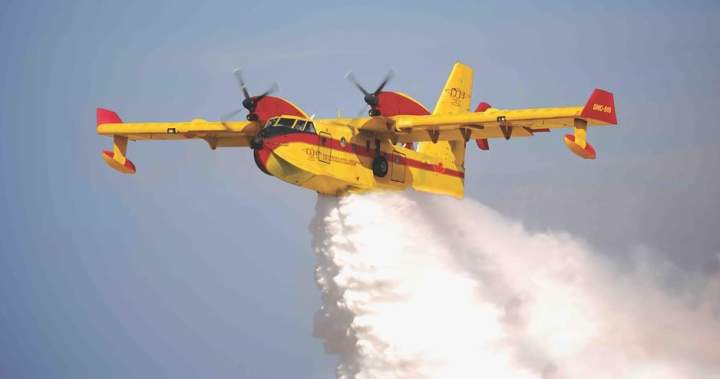
The federal government has pledged up to $2.5 billion in financing for Canadair water bomber maker De Havilland Canada in a bid to ramp up production of the iconic firefighting aircraft.

The money will allow for a second assembly line in Alberta, the federal Department of Finance said. And it will provide the means to double production capacity to an eventual 20 water-scooping planes per year, according to De Havilland.
The manufacturer, whose “super scoopers” can suck up more than 6,000 litres of water in 12 seconds and dump it on wildfires, also says it will put the cash toward new staff and production in Victoria, Calgary and Ontario.
The funding is expected to take the form of loans and loan guarantees, delivered by Export Development Canada, said Finance Department spokesperson Benoit Mayrand.
The interest rates and repayment terms are confidential.

Demand for amphibious firefighting aircraft is on the rise as the scale and intensity of wildfires increases and the need for tools to fend off climate disasters grows more urgent.
The yellow Canadair turboprops serve as the only aircraft of their kind currently in production built from the outset for that purpose, rather than being retrofitted to douse flames.
A De Havilland DH-515 firefighting aircraft is shown in a company handout photo.
Credit: De Havilland Aircraft of Canada
However, competition is hot on their tail fin.
Aerospace companies such as Positive Aviation, Kepplair Evolution and Hynaero of France are all developing water bombers.
Italy’s 19-01 Holding aims to roll out its first prototype, which can scoop roughly twice the water volume of the DHC-515, by 2028.
De Havilland revived production of the Canadian-made planes in 2022 after several European countries placed orders for the program.

Get weekly money news
Get expert insights, Q&A on markets, housing, inflation, and personal finance information delivered to you every Saturday.
The assembly line had halted in 2015, when it was run by Bombardier Inc.
Revving up has been a challenge, and the company has yet to churn out a single aircraft.
The years-long hiatus meant a supply chain that drew on 60,000 parts had evaporated. Procurement hurdles have helped push the projected delivery date for the first Canadair DHC-515 (formerly called the CL-515) to early 2028.
De Havilland Canada’s brand new water bomber, the CL-515, is among the aircraft the company will be building at its new manufacturing plant which is under construction about 30 minutes east of Calgary.
Global News
Until last week it was sold out through 2034, though the fresh financing will now let more planes be assembled simultaneously starting in 2030, the company said in a release.
Even as it struggles to meet demand from other countries, De Havilland has been calling for a national fleet of water bombers at home.
Neil Sweeney, the company’s vice-president of corporate affairs, said in a recent interview that an order for 50 new water bombers from the federal government or the provinces would give it the financial runway — billions of dollars — to launch a second production line at the assembly plant currently under construction 30 minutes east of Calgary in Wheatland County.
An artists rendition of the new aircraft manufacturing plant that De Havilland Canada is building in Wheatland County, about 30 minutes east of Calgary.
Courtesy: De Havilland
Something comparable to that goal seemed on the cusp of fruition in September, when a draft joint statement from the Canada-European Union summit and seen by The Canadian Press pledged an order for 50 De Havilland water bombers.
However, the final joint statement last week stuck with the 24 planes already ordered by European countries, with no fresh batch of orders emerging.
Questions around financial liability and production capacity persist.
“My question is, who carries the risk if there’s an issue with De Havilland being able to build these airplanes at scale,” said John Gradek, who teaches aviation management at McGill University.
“De Havilland’s never built one of these airplanes.”

Industry insiders have also highlighted the pace of production for the water bombers, which will be riveted by hand and roll off the line at a projected rate of 10 per year — 20 eventually — partly due to a lack of automation.
“De Havilland is building this airplane the way Canadair built it in the 1960s,” Gradek said, referring to the Montreal-based company that was nationalized in the 1970s before its purchase by Bombardier in 1986.
Decades later, automation typically plays a much greater role aircraft production, he noted.
“I want to know where this money is going, and I want to make sure that … they’re not just replicating a hand-built or a hand-assembled airplane.
“That’s not the way we build airplanes in 2026.”
De Havilland did not respond to a request for comment.

However, CEO Brian Chafe has framed the facility now under construction as a “world-class aerospace hub” and a “state-of-the-art campus.”
“De Havilland Canada will use this financing to hire new staff and invest in additional production capacity across its Canadian sites in Victoria, Calgary, Toronto, Kitchener and Fort Erie with supply chain jobs being created from Newfoundland to British Columbia,” it said in a release Friday.
The Finance Department did not lay out any potential reporting requirements.
“Specific commercial terms and conditions, including applicable interest rates and repayment terms, are subject to commercial confidentiality,” Mayrand said.
There are about 160 water bombers currently in service across the globe, mainly in Canada, the United States and Europe.
The 38 new planes now on the order book comprise 24 for six European countries as well as six for Ontario, five for Alberta — for $400 million, or $80 million apiece — and three for Manitoba, according to De Havilland.

© 2026 The Canadian Press

