


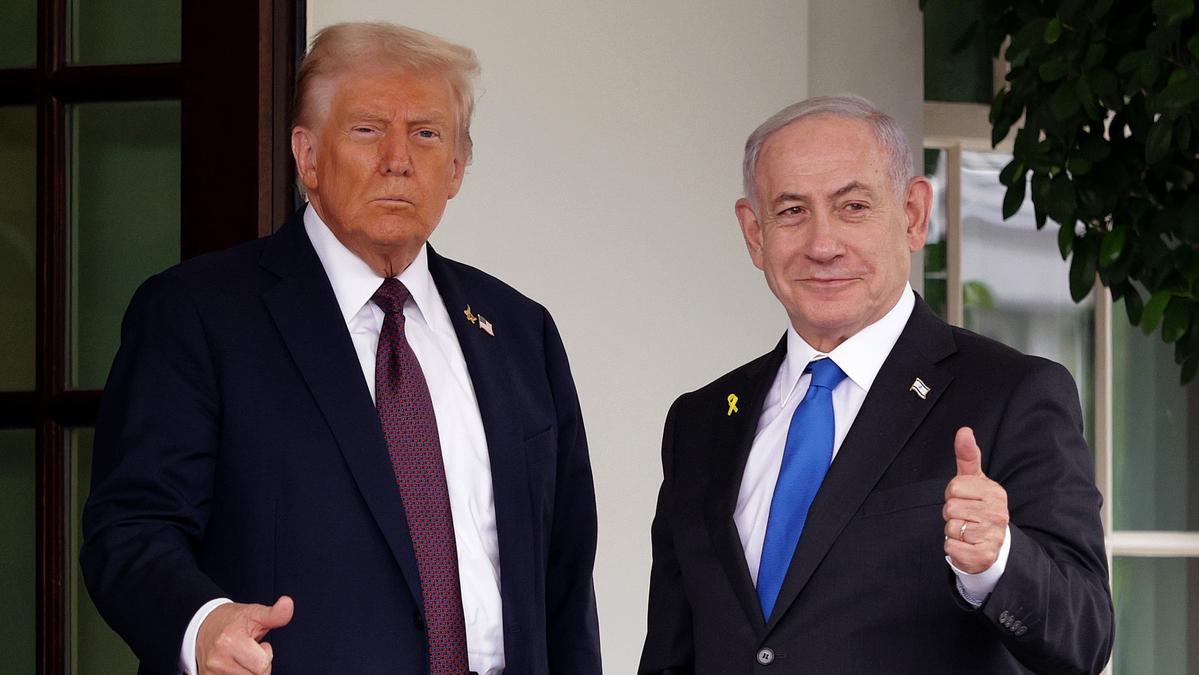
Donald Trump has declared the US-Iran agreement signed and the Strait of Hormuz on its way to fully reopening, hailing the deal as a major victory that he claims will send oil prices tumbling and bring stability back to the Middle East.
Speaking alongside French President Emmanuel Macron at the G7 summit in Evian-les-Bains, the US President said the critical shipping route was already partially open and should be fully operational by Friday as efforts continue to clear mines from the waterway.
Mr Trump said the memorandum of understanding, which was signed digitally on Sunday local time, would guarantee Iran never acquires a nuclear weapon while paving the way for the restoration of global energy flows.
“Very importantly, the oil is plummeting down, and the stock market is shooting up like a rocket,” he said.
“The main thing is that Iran will not have a nuclear weapon.”
“They fully agreed to that with strong policing powers.
“They won’t have a nuclear weapon which is what it was all about.”
Mr Trump said the Strait of Hormuz would remain toll-free and suggested any future sanctions relief for Iran would depend on the regime’s conduct over time rather than being granted immediately under the agreement.
The President also claimed that senior figures within Iran’s leadership had been removed during the conflict, saying he was now dealing with what he described as a “very smart” and “strong” third tier of leadership.
The agreement marks the most significant diplomatic breakthrough since fighting between Iran, Israel and the United States pushed the region towards a broader conflict and threatened global oil supplies.
While Mr Trump has framed the deal as a decisive step towards peace, Israeli Prime Minister Benjamin Netanyahu signalled that some differences remain between Jerusalem and Washington.
Breaking his silence on the agreement, Mr Netanyahu dismissed suggestions either leader controlled the other and acknowledged the pair do not always share the same view.
“In the US, they say that President Trump does everything I ask, and in Israel, they say the opposite, that I do everything he asks,” he told reporters.
“Neither is true.”
“We have a relationship of partners who know each other.
“Many times, we agree; sometimes we don’t agree. That happens in the best families.”
“President Trump and I do not always see eye to eye,” he added.
“He is the president of the United States, and I am the prime minister of Israel. I am responsible for Israel’s security interests, and it needs to be done wisely.”
Mr Netanyahu used his remarks to emphasise Israel’s determination to prevent Iran from developing nuclear weapons regardless of any diplomatic outcome.
“With or without an agreement, Iran will not have nuclear weapons — not today and not tomorrow. As long as I am prime minister of Israel, it will not happen,” he said.
“The struggle is not over.
“We will need to remain vigilant, strong and determined to defend ourselves, as required.”
The agreement is expected to be formally signed in Switzerland later this week, with mediators hoping it will lock in a ceasefire, reopen vital trade routes and prevent a return to hostilities across the region.

