


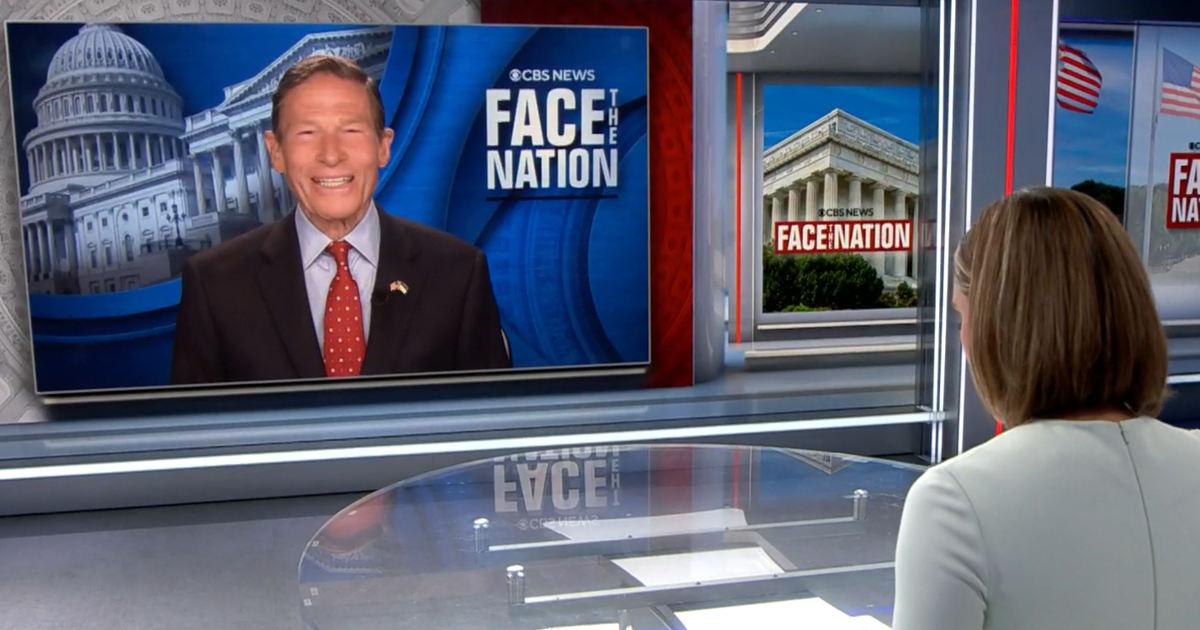
On this “Face the Nation with Margaret Brennan” broadcast, moderated by Margaret Brennan:
- Sen. Richard Blumenthal, Democrat of Connecticut
- Rep. John James, Republican of Michigan
- David Becker, CBS News election security analyst
- Afghan General Haibatullah Alizai
Click here to browse full transcripts from 2026 of “Face the Nation with Margaret Brennan.”
MARGARET BRENNAN: I’m Margaret Brennan in Washington.
And this week on Face the Nation: an update from Nepal following last week’s devastating flooding, and a look back at the chaotic withdrawal from the longest war in U.S. history.
Four days after a glacier collapsed and triggered a cataclysmic flash flood in Nepal, we will have the latest on the search for its missing victims, including nearly 100 Americans.
And with the attacks on Ukraine and concerns about Russian aggression intensifying, we will talk to Connecticut Democratic Senator Richard Blumenthal, who is just back from the region.
Then: The president hits the campaign trail and begs voters to make the elections a referendum on him.
(Begin VT)
DONALD TRUMP (President of the United States): What I really want you to do is pretend, please, that I’m on the ballot. Just come and vote. It’s so important.
(End VT)
MARGARET BRENNAN: Will that strategy help or hurt his party? We will talk with Congressman John James, the Republican nominee for governor in Michigan.
We will also try to clear up the confusion over mail-in ballots and look at how those court cases could impact the midterm elections.
Finally, five years after the catastrophic U.S. withdrawal from Afghanistan, we will share the story of a former Afghan general’s dramatic flight from his country following the 20-year war.
It’s all just ahead on Face the Nation.
Good morning, and welcome to Face the Nation.
Search-and-rescue operations are under way for a fifth day in Nepal, where catastrophic floods from a massive glacier collapse wiped out entire neighborhoods, killing 788 people, with thousands still missing.
Foreign correspondent Ramy Inocencio is in Kathmandu.
Rami, what’s the latest in the search-and-rescue?
RAMY INOCENCIO: Margaret, yes.
Well, so far, the Nepali army has rescued more than 7,500 people, but there is another number out there. Nearly 3,000 people are still missing someplace in the disaster zone.
Earlier, we were at a Nepali army base, and that was a staging ground for operations for aerial search-and-rescue, for helicopters taking off. An army official said that they’re trying to get out 15 sorties, back-and- forth flights, every single hour for a total of about 500 every single day.
But they said that, because of the weather, they have had to suspend that at least twice.
MARGARET BRENNAN: There were nearly 100 Americans. What are their status?
RAMY INOCENCIO: Yes, this is something that no family wants to hear, Margaret. They are all still missing, 90 in total, according to the latest State Department estimate.
Now, the reason for this is because most of them were on the Tibetan side of the border, and they were either going to or coming from this sacred pilgrimage route up to the higher elevations in the high Himalayas to a mountain called Mount Kailash.
The concern, the anxiety, the focus here is the immigration checkpoints on the Tibetan side of the border called Gyirong immigration checkpoint. We have seen already that that immigration checkpoint building had been obliterated in a matter of seconds when that avalanche of ice, glacial meltwater and debris just covered and buried that whole entire building.
I have also been in touch with several American families in the United States, and they’re all telling me the same thing, that they all lost touch with their loved ones, with their families, with their friends, at about the same time, and that they are wondering out loud whether any of them could have survived.
MARGARET BRENNAN: How significant is the risk of continued flooding?
RAMY INOCENCIO: The risk absolutely is there.
When we look at the cause of this catastrophe, looking back on Wednesday morning, that was because of a glacier collapse. Now, scientists, officials aren’t talking about that, but they are talking about the flooding risk of the river, the Trishuli River, that surged in the north of Nepal.
Right now, in fact, this morning, that river surged again because of these monsoon rains. And this is a race against time with all those thousands of people still missing.
MARGARET BRENNAN: Ramy Inocencio, thank you for being there in Kathmandu.
And we turn now to Democratic Senator Richard Blumenthal, who joins us from Westport, Connecticut.
Good morning to you, Senator.
SENATOR RICHARD BLUMENTHAL (D-Connecticut): Good morning. Thanks for having me, Margaret.
MARGARET BRENNAN: Well, I understand that there was the deadly attack, deadliest attack that we have seen so far this year in Ukraine.
There, officials say, Saturday, a Russian drone attack west of Kyiv killed at least 38 people. You were just in Ukraine. I understand you went out east to Dnipro, close to the front lines. What can you tell us about the situation there?
SENATOR RICHARD BLUMENTHAL: This trip was exhilarating, because Ukraine is clearly making progress. It’s turning the tide.
But it was also heartbreaking to see the toll that this war is taking. The latest attack is only one of every night’s bombardment of hospitals, homes, schools. Putin is killing Ukrainians in cold blood with his missiles and bombs.
And I went to Dnipro, where I visited a military hospital where the most seriously wounded from the front were brought. I went back to Bucha, where, at the very beginning of the war, Putin’s army murdered hundreds of civilians and buried them in mass graves. And I visited with some of the children who have been abducted.
But President Zelenskyy had some priorities. I called it a homework assignment that he gave me, number one, the Russian sanctions bill, number two, air defense to protect against exactly the kind of bombing that you…
MARGARET BRENNAN: Yes.
SENATOR RICHARD BLUMENTHAL: … just mentioned, and, third, Starlink so that he can hit targets within Russia before they launch those deadly missiles and drones.
MARGARET BRENNAN: And we will see if the White House helps deliver on any of that.
This past week, the president sent John Ratcliffe, the director of the CIA, to Moscow. And CBS has learned he told Russia not to attack NATO member states. Meanwhile, the – the prime minister of Poland is out there saying that NATO assesses Russia is about to escalate and he cannot rule out provocations from Russia against a NATO member state.
Have you been briefed on this? What should we expect in the coming months?
SENATOR RICHARD BLUMENTHAL: Without going into any classified information, I think the Ratcliffe mission could well be empty and ephemeral unless it is backed with a real show of strength.
Putin is a mob thug. He understands only force and strength. And so to send the CIA director, as President Biden did, Director Burns, to warn or try to persuade Putin with words – actions speak louder than words – largely going to be ineffective.
And the Europeans understand that, right now, what’s needed is more air defense, the PAC-3 interceptors, more long-range artillery in the HIMARS, and the kinds of aid that Ukraine needs to hit those launch sites and drone and missile manufacturing…
MARGARET BRENNAN: Yes.
SENATOR RICHARD BLUMENTHAL: … sites with Starlink that will really send a message to Putin that the United States and Europe means business.
But they sense a danger of escalation that can’t be met by just words, and, in fact…
MARGARET BRENNAN: Yes.
SENATOR RICHARD BLUMENTHAL: … is contradicted by Elbridge Colby’s mission – he’s the chief undersecretary for policy in the Department of Defense, or War – when he went just last week and said, we’re reducing our troop strength.
MARGARET BRENNAN: Right.
Well, he hasn’t revealed any details of what that reduction in presence could be. I understand there’s a floor set, about 76,000 troops, right? Otherwise, they have to get congressional permission. Is there – is that happening?
SENATOR RICHARD BLUMENTHAL: I doubt that Congress will approve, at this critical moment, reduction in force structure in…
MARGARET BRENNAN: OK.
SENATOR RICHARD BLUMENTHAL: … Europe, when Putin is more dangerous and threatening than ever.
MARGARET BRENNAN: You mentioned Russia sanctions. You were a part of that team alongside the late Senator Lindsey Graham pushing for that punishing package of financial measures against those who buy Russian oil.
It passed through the Senate, but there are reservations, as you know, in the House, including from some of your fellow Democrats. Greg Meeks, the top Democrat on the House Foreign Affairs Committee, said it’s a Trojan horse for tariff authorities he has repeatedly abused.
He’s concerned about giving President Trump more power here. What’s your message to these skeptics?
SENATOR RICHARD BLUMENTHAL: First and foremost, this bill was the result of painstaking, sometimes painful negotiations with the U.S. trade representative, the White House, my colleagues in the House and Senate on both sides of the aisle.
It passed the Senate 86 to 11, not many measures doing that kind of successful passage these days. And it has increased authority for the president to impose scorching sanctions on the oligarchs, the financial institutions. It has measures to crack down on the shadow fleet.
And it has tariff authority, but narrowly constrained to the five largest purchasers of Russian oil and gas.
MARGARET BRENNAN: Yes.
SENATOR RICHARD BLUMENTHAL: None of our European allies would be tariffed.
And here’s the main point. It is a moment of extreme urgency, for the reason that Putin may try to escalate, but also because Putin is on his heels economically. His economy is on the verge of major crisis. He has a deficit looming of $125 billion, 5 percent of his GDP, an interest rate of 14 percent on his national debt.
And this kind of sanctions bill, throttling the flow of revenue to his war machine, could undercut completely his ability to wage this…
MARGARET BRENNAN: So, you think…
SENATOR RICHARD BLUMENTHAL: … brutal, murderous war.
MARGARET BRENNAN: You think you can get enough Dems in the House to move this through?
SENATOR RICHARD BLUMENTHAL: I’m very hopeful.
MARGARET BRENNAN: OK.
SENATOR RICHARD BLUMENTHAL: And I urged President Zelenskyy when we met to come to talk to members of Congress, just as he did in the Senate.
MARGARET BRENNAN: Yes.
SENATOR RICHARD BLUMENTHAL: And I’m very hopeful that he will, because he’s Ukraine’s strongest advocate.
MARGARET BRENNAN: I want to ask you about what’s happening in the state of Connecticut.
Nationwide, ICE arrests have increased significantly in June and in July. This past week, the governor of Connecticut said, despite President Trump saying to governors he would not send in ICE to cities that did not ask for help, they detained dozens of people in Danbury, Connecticut, in Bridgeport, and Stamford. ICE did not inform those cities in advance.
You’re seeing footage of some of those arrests. What have you learned? Has this operation concluded? How many people were arrested? And was it timed to back to school, as your colleague Senator Chris Murphy alleges?
SENATOR RICHARD BLUMENTHAL: We’ve learned nothing from ICE.
But we know that probably about 100 were detained and arrested. Very few of them, only a fraction, maybe six or seven, have any kind of criminal history. So, the administration saying that it’s detaining the worst of the worst or deporting people with serious criminal history is absolutely belied by the facts. That’s not what’s happening.
In fact, they are seizing people. Many of them have legal status…
MARGARET BRENNAN: Yes.
SENATOR RICHARD BLUMENTHAL: … in this country. They may have come here seeking asylum. And they are doing it in a way that is repugnant and inhumane.
The point is cruelty. They are trying to spread terror and sow fear in a way that is destructive of those communities.
MARGARET BRENNAN: Yes.
SENATOR RICHARD BLUMENTHAL: I’m going to be walking through Danbury tomorrow with the mayor. And I hope to have a forum. The Permanent Subcommittee on Investigations has been doing spotlight forums on these abuses by ICE. I hope to have one in Danbury or in Connecticut later in the week.
MARGARET BRENNAN: OK. And – and Homeland Security hasn’t provided detailed information to us about that.
I want to quickly ask you about, you have made this push for more online safety for kids. This past week, we saw Meta, the parent company of Facebook and Instagram and WhatsApp, they agreed to pay $17 billion to the states that sued them to try to institute child safety measures.
They want YouTube and TikTok to put the same measures in place, and they’re being asked to, you know, turn off access at night. They said they’ll have a two-hour daily time limit, notifications during school hours.
Do these measures do enough to, you know, sort of obviate the need for legislation? What do you make of this settlement?
SENATOR RICHARD BLUMENTHAL: This settlement is a very commendable and welcome step forward, but it is incomplete, first because it covers only Meta.
And Meta, understandably, wants YouTube and TikTok and all of social media to be covered by it. It limits only some of the addictive, harmful features that are driving toxic content at kids. It lasts for only 10 years. And it relates only to some of the addictive product design features that are so terrible.
And it will not keep pace with an evolving technology. So, we still need the Kids Online Safety Act, in fact, more than ever.
MARGARET BRENNAN: OK.
SENATOR RICHARD BLUMENTHAL: I’m going to be pushing with my partner Senator Marsha Blackburn of Tennessee, who has been a staunch advocate with me.
MARGARET BRENNAN: OK.
SENATOR RICHARD BLUMENTHAL: And we’re hopeful that we’ll get our bill through the Senate and the House.
MARGARET BRENNAN: We’ll watch for that.
Senator, thank you for your time this morning.
Face the Nation will be back in a minute. Stay with us.
(ANNOUNCEMENTS)
MARGARET BRENNAN: And we’re back with Michigan Congressman John James, who is also the Republican nominee for governor in his state. He joins us from Rockford, Michigan.
Good morning to you, Congressman.
REPRESENTATIVE JOHN JAMES (R-Michigan) (Gubernatorial Candidate): Hey, Margaret. Good morning. Thank you so much for having me on.
I’m really excited, because, in a state like Michigan…
MARGARET BRENNAN: Yes.
REPRESENTATIVE JOHN JAMES: … we have the most extreme ticket running with Abdul El-Sayed and Jocelyn Benson campaigning with people who said that we deserve 9/11. I say, never forget.
MARGARET BRENNAN: OK. Wow.
I want to ask you about some issues with your platform and the like, but never forget. Of course, I’m sorry.
REPRESENTATIVE JOHN JAMES: That’s right.
MARGARET BRENNAN: Did you just accuse Senate candidates of something to do with terrorism? I’m not clear on what you just said.
REPRESENTATIVE JOHN JAMES: Yes, they’re – they’re campaigning with extremists who say that America deserved 9/11.
And I think that coming up on the 25th anniversary of 9/11, these are statements that are way out of bounds and should definitely be clarified. Michigan is ground zero for this republic in this next election.
MARGARET BRENNAN: Yes.
REPRESENTATIVE JOHN JAMES: And we need to make sure that we stop socialism and that we save the state of Michigan, because, if we don’t do it here, it’s going to go to the rest of the country.
MARGARET BRENNAN: OK. OK. I think you’re talking about a supporter of a Senate candidate that that Senate candidate has started to distance himself from, and that influencer, Hasan Piker, has disavowed those past comments he made.
But let’s put that aside, because I don’t want to get into that. I want to talk about you.
You are an Iraq War vet.
REPRESENTATIVE JOHN JAMES: Yes.
MARGARET BRENNAN: And we are now – given your time in uniform and your service to this country, I wonder what you think that we’re now at the six- month mark of the war with Iran. We were told it was going to be four to six weeks.
As you know, it’s unpopular; 61 percent of Americans, according to our polling, disapprove of it. It’s driven up gas prices. It’s affecting America’s role in the world. I wonder if you agree with what appears to be a switch away from military force towards economic sanctions. And do you think your constituents deserve more of an explanation from the administration as to what they’re doing?
REPRESENTATIVE JOHN JAMES: I believe very strongly, when people say “Death to America,” we should take them at their word.
I graduated West Point in the class of 2004, and we took our oath of affirmation knowing that we would go to war. And, as a result, the class of 2004 suffered the most casualties of any service academy since Vietnam. We understand the cost of war. We hate war. And we want to use every method, diplomatic or economic, to make sure that we keep Americans safe and we keep our young military members out of war.
I applaud the administration’s effort to make sure that Iran has no nukes, so they cannot threaten America and our allies. I applaud the administration’s efforts to use every resource at their disposal to pursue peace. And these are the types of things that – that – that our people want.
But we also have a number of things in the state of Michigan that we can do to lower the cost of living, to increase affordability. And these are the types of things that I’m running to do as governor, to reduce harmful regulations that will lower gas prices…
MARGARET BRENNAN: Yes.
REPRESENTATIVE JOHN JAMES: … and will lower the cost of groceries. These are the types of things that Michiganders are talking about, increasing affordability, particularly with energy and housing and health care. And I’m excited to be able to do that here at home.
MARGARET BRENNAN: OK.
Well, Michigan, in particular, has a major reliance on trade with Canada, your neighbor to the north.
REPRESENTATIVE JOHN JAMES: Yes.
MARGARET BRENNAN: Their prime minister said he’s going to match the U.S. tariffs on Canada dollar for dollar starting September 8. Do you have any idea what this trade war is going to cost Michigan?
REPRESENTATIVE JOHN JAMES: Absolutely.
I am somebody who actually understands the automotive industry. I’m an automotive supplier. I have actually created jobs in the state of Michigan, and I recognize how important and crucial our partnership with our friends and family in Canada is.
But I also recognize how crucial it is that the status quo not continue. Michigan has lost over 300,000 manufacturing jobs since the ’90s, and that cannot continue. But, at the same time, we need the negotiators to go back to the table, stop acting like children, and negotiate a fair, mutually beneficial, reciprocal deal that will benefit the United States of America and the state of Michigan.
MARGARET BRENNAN: Yes.
REPRESENTATIVE JOHN JAMES: As a governor, I will be able to work with the president, be able to work with the prime minister to make sure that we can do this. Hopefully, it doesn’t take that long, but I stand ready and willing to assist to make sure that we have an economy that works for Michiganders and one that will continue to create prosperity in the state of Michigan.
MARGARET BRENNAN: So, if you win, you would be Michigan’s chief executive here.
So, January 1, when you would be sworn in, is the very same date President Trump says he’ll hit Canada with a 50 percent tariff on cars, trucks, auto parts, and steel. Canada’s prime minister said workers in your state rely on Canadian demand, since they are the largest customer for autos.
This is going to be a big blow on the first day of your administration. Would you ask the White House not to do this?
REPRESENTATIVE JOHN JAMES: Well, we’re already talking with – with members of the trade team. And we’re going to be continuing to engage with them so that we can avoid those things.
Look, tariffs are not the objective. The objective is to protect Michigan jobs. The objective is to make sure that we deepen and continue our relationship with Canada. But it cannot be borne on the backs of Michiganders.
Michigan is a state that relies on free and fair trade, but it cannot come at the expense of Michiganders. So, again, as somebody who’s been in the automotive industry, who understands this…
MARGARET BRENNAN: Yes.
REPRESENTATIVE JOHN JAMES: … the prime minister has also said that he’s targeting politically sensitive states. He should not be bullying Michigan because the – the negotiators can’t come to a deal.
We need to stop the bickering.
MARGARET BRENNAN: Well, President Trump said he was going to do tariffs first.
REPRESENTATIVE JOHN JAMES: The negotiators need to sit in a room.
And they should probably – well – well, you know what? I have kids, and I recognize that, when you have people who are fighting, you just want people to fix it.
MARGARET BRENNAN: Yes.
REPRESENTATIVE JOHN JAMES: And these are adults. The negotiators need to get back in the room and negotiate, and not leave until they have a deal.
As the governor of the state of Michigan, I will be uniquely situated to make sure that these – these things don’t happen and we continue to grow jobs, because the fact of the matter is, Michigan is 42nd in the nation in infrastructure. We’re 43rd in the nation in economy. We’re 45th in the nation in education. We’re 46th overall.
MARGARET BRENNAN: Yes.
REPRESENTATIVE JOHN JAMES: Outside people want to make this about the president. Democrats want to make this about the president.
But there are 45 states doing better than Michigan.
MARGARET BRENNAN: Yes.
REPRESENTATIVE JOHN JAMES: And we all have the same president.
MARGARET BRENNAN: Yes.
REPRESENTATIVE JOHN JAMES: By having a governor who will work with everybody on both sides, and including Canada, to make sure that we grow our economy…
MARGARET BRENNAN: OK.
REPRESENTATIVE JOHN JAMES: … because the status quo isn’t working, Michigan has been hurt, we will continue forward to have a more prosperous future and affordable future for Michigan.
MARGARET BRENNAN: OK, on that point, I want to ask you about your position on data centers. This is such a hot topic.
REPRESENTATIVE JOHN JAMES: Yes.
MARGARET BRENNAN: You’ve said both that the decision to allow data centers should be left to local communities. And then the John James campaign said you support a moratorium on new data centers until there’s a plan to protect local communities. Which is it?
REPRESENTATIVE JOHN JAMES: Yes, they’re not – they’re not mutually exclusive. They are the same.
My position is that we need to have a plan to protect our communities. Until we do, then we have to make sure that we have local control. Our electricity bills can’t go up. We must protect our water. We have to prevent pollution.
MARGARET BRENNAN: So, hold off for now, until there is a vote?
REPRESENTATIVE JOHN JAMES: That includes land, air, noise pollution.
And then we need to make sure that we prioritize blighted and brown fields over productive green farmland. And then, of course, we all need to make sure that we have diverse growth in our economy. But Michigan is open for business, but we are not for sale.
We need to make sure that we are repealing Public Act 233 and Public Act 235 that give Lansing all the control and pursues these Green New Deal initiatives that are making everything more expensive from our gas to our groceries.
MARGARET BRENNAN: OK. Got it.
REPRESENTATIVE JOHN JAMES: You look at our prices, from our taxes to our energy costs, we are the highest amongst other Midwestern states.
MARGARET BRENNAN: Yes.
REPRESENTATIVE JOHN JAMES: So, again, we need to have local control.
MARGARET BRENNAN: OK.
REPRESENTATIVE JOHN JAMES: And we need to make sure we prevent pollution, make sure our electricity bills don’t go up…
MARGARET BRENNAN: Yes.
REPRESENTATIVE JOHN JAMES: … we prioritize blighted and brown fields over productive green farmland.
MARGARET BRENNAN: OK.
All right, John James, Congressman, thank you for your time today.
We’ll be right back.
(ANNOUNCEMENTS)
MARGARET BRENNAN: Yesterday, three journalists from NBC and a Palestinian woman they were interviewing were attacked by Israeli settlers in the Israeli-occupied West Bank.
As you can see in this brief video released by NBC, a gray car drove in reverse toward the journalists. A masked man with a stick leaned out of the window of the vehicle, and other masked men hit the TV crew with sticks and rocks.
Israeli Prime Minister Netanyahu’s government has often been accused of turning a blind eye to settler violence against Palestinians. But Netanyahu swiftly condemned yesterday’s attackers, referring to them as rioters, and he called for an investigation.
Earlier this year, crews from CNN and the AFP had similar incidents in the region. Worldwide, according to the Committee to Protect Journalists, 31 journalists and media workers have been killed thus far in 2026.
(ANNOUNCEMENTS)
MARGARET BRENNAN: Welcome back to “FACE THE NATION.”
We are 65 days away from the midterm elections and the first mail-in ballots for the midterms will start going out Friday. But President Trump has issued an executive order attempting to restrict voting by mail that is now being challenged by a number of states.
CBS News election security analyst David Becker joins us now.
Good morning.
DAVID BECKER: Good morning, Margaret.
MARGARET BRENNAN: David, I always like you helping us to break things down and make sense of it because I think the question here is, what the administration is doing is now trying to fight this ruling from a federal judge who said, time out for two weeks as we look at this new rule that would allow the Postal Service to refuse to deliver ballots from states that do not submit lists of eligible voters and follow a uniform envelope style for mail-in voting. Are voters going to be able to vote by mail?
DAVID BECKER: The short answer is, yes, there’s just simply no time for this executive order to go into effect. The court in Boston realized that this week. That same court had enjoined this order before and the Supreme Court said earlier this week that it was too early for them to rule on it, but they did not endorse the executive order. They said they were not ruling on the merits at all.
MARGARET BRENNAN: Right.
DAVID BECKER: So, the short answer is, right now, 65 days before, ballots are already being printed, they mostly have been printed, valid envelopes have long since been printed. The election officials all across the country are already doing the work to prepare for the November election. Every single state will be sending mail ballots out by mid-September. So, it is at least to military and overseas voters.
MARGARET BRENNAN: Right.
DAVID BECKER: So, it’s simply too late for these changes. I think the courts have recognized that. There’s going to be a preliminary injunction hearing this coming week that will formalize that injunction in Boston. It will probably be appealed, but I think the courts are going to rule that it’s just too late for this to be implemented. Putting aside the fact that the president simply doesn’t have the power to do this on his own.
MARGARET BRENNAN: So, you’re saying, practically speaking, this doesn’t look feasible. But in terms of this two-week pause in – the Boston judge put in place, we are still also looking at the Supreme Court. As you just said, they have not ruled on the constitutionality question.
DAVID BECKER: Right. Right.
MARGARET BRENNAN: They likely may need to take that issue up. So, then what? Does this mean there will be changes made after November or is it still possible that something changes?
DAVID BECKER: So, I think there’s a couple of big questions that the Supreme Court would have to look at going into this November election. One, is it legal for the president to unilaterally change election policy in the 50 states with the swipe of a pen? The answer to that should be very simply, no, the Constitution’s very clear that if the president wants to change election policy at all, he has to go through Congress. And he has not done that.
But the second question with regard to November is, is it’s too – is it too late? The president didn’t sign this executive order until after primaries had already started. And then the Postal Service took two more months to issue just proposed rules that would be reviewed, and two more months after that until those rules were finalized. They did this too late, and there’s no way to change this, even if this were a good idea, and it’s not.
So, I think for 2026, this is almost certainly not going to be implemented. There may be a fight after 2026 on the constitutionality of this, but I think the answer to that is also very clear.
MARGARET BRENNAN: OK. Because when you – you look at the why or what the impact could be of all of this. Statistically, it appears Democrats vote by mail in higher numbers than Republicans. Voters in rural areas and older voters often use mail-in voting. There is one very prominent Republican who does vote by mail, and that is the president himself.
DAVID BECKER: Yes.
MARGARET BRENNAN: Even though he has said a number of things casting doubt on it.
Take a listen.
(BEGIN VC)
DONALD TRUMP, PRESIDENT OF THE UNITED STATES: Mail-in ballots – you can never have a real democracy with mail-in ballots. And we, as a Republican Party, are going to do everything possible that we get rid of mail-in ballots.
Mail-in ballots are inherently corrupt.
Mail-in ballots, we’re going to make them so secure, you have no idea. If you want to stay home, you can do it, but we’ve got to make them secure because they are crooked as hell.
(END VC)
MARGARET BRENNAN: Again, the president votes by mail, but this is how he describes it for everyone else.
DAVID BECKER: Right.
MARGARET BRENNAN: Do you expect that his rhetoric is going to impact voters’ behavior?
DAVID BECKER: So, what we’ve seen is it has impacted voters’ behavior on his side, on voter who support him. As you mentioned, he voted already twice at least this year, and presumably a third time coming up in November by mail in Florida.
What we’re seeing is, his voters are buying some of the rhetoric and are voting by mail or choosing an option to vote, a very safe and secure option that we’ve had, since at least the civil war, for, you know, over 150 years now. They’re bypassing that option. And that’s the only reason that we’re seeing more Democrats vote by mail now than Republicans since 2020. Prior to that, it was pretty much even.
MARGARET BRENNAN: OK.
DAVID BECKER: And so, I think Republican campaign operatives might say this is a real concern. We often saw this in the 2024 campaign, where the Republican campaigns were really encouraging their voters to vote by mail so they could cross them off the list and they could out – conduct outreach to other voters.
MARGARET BRENNAN: Right. You want everyone out there.
DAVID BECKER: Exactly. And especially as here, the voters who really need vote by mail, who don’t have other options that are convenient or easy, are those voters that might find it difficult to get to a polling place, older voters, rural voters, military voters. And I think a lot of Republicans would say, those are voters that they really think might be inclined to vote Republican.
MARGARET BRENNAN: Right, advantageous to them.
DAVID BECKER: Right.
MARGARET BRENNAN: So, another thing I’d like for you to clarify for us. Last month, the Homeland Security secretary said that the federal government identified more than 200,000 citizens – non-citizens, I should say, registered to vote in four states, California, Pennsylvania, New Jersey and Nevada. He gave those states two weeks to respond. It’s a month later. And those states, including the Republican secretary of state in Pennsylvania, say they don’t have any information on how the federal government came up with these numbers and these allegations.
DAVID BECKER: That’s right.
MARGARET BRENNAN: What is going on?
DAVID BECKER: So, we’re – been seeing over and over again the administration try to inflate numbers around a potential for non-citizens voting in the country.
MARGARET BRENNAN: The president had an Oval Office – or he spoke to the nation.
DAVID BECKER: Exactly.
MARGARET BRENNAN: In primetime.
DAVID BECKER: And the numbers just don’t track. I mean they – in that letter they cited 250,000 non-citizens in California, Nevada, New Jersey, and Pennsylvania. Every single one of those states got back to the DHS within days and said, tell us what your methodology is for this and give us the lists.
And at least two of those states have heard from DHS, although kind of confidentially, DHS apparently didn’t want to go on the record with this. They had a meeting in Nevada, where they had claimed nearly 16,000 were non-citizens. And in that meeting, apparently, DHS representatives said, at best we have 185.
In Pennsylvania, they apparently told the secretary of state, they couldn’t stand by any of the numbers at all. And if you look at – actually track the number of non-citizens, the numbers are much, much smaller than what we’ve seen.
MARGARET BRENNAN: And to that point in Pennsylvania, it was “The Philadelphia Enquirer” who has an article and that communication that the secretary of state from Pennsylvania, Al Schmidt, had, if you want to read more about the state questioning the feds on that one.
Thank you, David.
DAVID BECKER: Great. Thanks, Margaret.
MARGARET BRENNAN: The FBI has revised its hiring standards and no longer disqualifies applicants who admitted to hiring prostitutes or stealing from an employer. This past June, the bureau quietly changed how its screens applicants, including would-be agents. Employee theft and solicitation of prostitution are among a group of acts that are no longer considered deal breakers in the FBI hiring process. The new guidelines, first reported by CBS’ Sarah Lynch and Daniel Klaidman, come following the retirement, resignation and termination of scores of FBI agents during the second Trump administration.
CBS has learned that candidates may receive a pass on prostitution if their last encounter was more than ten years ago, and if they haven’t hired sex workers three or more times. Among the other changes, if you admit you stole from your employer, but it happened more than three years ago, you are no longer automatically disqualified from a job.
As you can see on this archived web page from 2023, the FBI listed, quote,” engagement in prostitution” among its automatic disqualifiers for employment. But a similar version of that document is available today on general eligibility rules, but it contains no reference to prostitution.
Former FBI agent James Davidson, who now leads the nonprofit FBI Integrity Project, told CBS, “if they are lowering standards, it means the pool of candidates has sufficiently shrunk.” FBI Director Kash Patel has not publicly weighed in.
We’ll be right back.
(ANNOUNCEMENTS)
MARGARET BRENNAN: Five years ago today, the last U.S. soldier left Afghanistan, ending America’s longest war and leaving that country under the control of the hardline Taliban. We spoke last week with Afghan General Haibatullah Alizai. He was made commander of the entire Afghan army in those final chaotic days of the U.S. withdrawal. We found General Alizai in the Washington suburbs, living an immigrant’s life like some of the Afghan allies who were evacuated by U.S. forces. He tells us about the bond between the Afghan soldiers he served with and the U.S., despite the politics.
(BEGIN VT)
MARGARET BRENNAN (voice over): The images of Afghans trying to escape the Taliban takeover of their country gripped the world. So desperate, they clung to American planes as U.S. forces withdrew. Some plunged to their deaths.
GENERAL HAIBATULLAH ALIZAI (Former Chief of General Staff, Afghan Armed Forces): Shouting of people, screaming and everything we could hear at that part of the airport. And that was the most unfortunate part of my life.
MARGARET BRENNAN: Did you feel like you were the last line of defense against the Taliban?
GENERAL HAIBATULLAH ALIZAI: I think, yes.
MARGARET BRENNAN: Today, Alizai makes ends meet as an Uber driver in America’s capital.
GENERAL HAIBATULLAH ALIZAI: It’s a whole 12-hour shift with Uber and Lyft both. Sometimes I even work 14 hours, 15 hours.
MARGARET BRENNAN: You had seen the worst of combat, but you felt like those last moments in the airport were the hardest things?
GENERAL HAIBATULLAH ALIZAI: Absolutely. Absolutely.
MARGARET BRENNAN: Why?
GENERAL HAIBATULLAH ALIZAI: Because I was thinking about my friends who were killed on the battlefield to defend the country, to fight the global war on terrorism. I didn’t have any answers for their families at that point, if they would call me, say like, why did we lose our sons? And you were the commander. That was the main point that was eating me from inside.
MARGARET BRENNAN: Yes.
GENERAL HAIBATULLAH ALIZAI: Like, I don’t have any answer for those families. And how will I face them?
MARGARET BRENNAN (voice over): For nearly 20 years, the U.S. fought a war in Afghanistan, sparked by al Qaeda’s terrorist attacks on 9/11. The timeline for America’s exit from Afghanistan on August 30, 2021, was set in motion by President Trump’s agreement with the Taliban in 2020, signed in Doha. But in the end, the Taliban’s sweep across the country happened faster than anyone predicted.
MARGARET BRENNAN: You knew America and NATO forces were leaving Afghanistan after 20 years. Did you think that in those final weeks you could stop the Taliban from taking over the country?
GENERAL HAIBATULLAH ALIZAI: Yes. If not the whole country, but at least some specific locations around the country. And that’s why I just came up with a plan in mid-July and sent my attention to the ministry of defense. And since the process was very slow in those days in our government side making a decision of that kind was, I guess, not easy for the leadership. But, yes, we had options. But time was not in our favor.
MARGARET BRENNAN: No.
GENERAL HAIBATULLAH ALIZAI: Everything was just running so quick and so fast.
MARGARET BRENNAN (voice over): The Taliban was seizing more territory by the day. As they advanced, Afghanistan’s president promoted Alizai. And after just four days on the job, ordered him to craft a plan to defend Kabul. Alizai told us he was shocked one didn’t already exist. It was August 14th.
GENERAL HAIBATULLAH ALIZAI: I expected to have a plan already been placed at the ministry of defense level to secure Kabul or to defend Kabul.
MARGARET BRENNAN (voice over): By dawn, the Taliban were in the city. As fear took hold, crowds started to build at the airport, looking for an escape. Their home recently bombed by the Taliban, Alizai’s wife and three sons fled on the last commercial flight out to India.
MARGARET BRENNAN: And then, you hear that President Ashraf Ghani and his top aides have gotten onboard helicopters and fled.
GENERAL HAIBATULLAH ALIZAI: Unfortunately, yes. And –
MARGARET BRENNAN: What did you think?
GENERAL HAIBATULLAH ALIZAI: I just had to smile and say, like, OK, it made it easy. Now we can announce the martial law. And it’s our right, because we still have our troops fighting in different parts of Afghanistan. (INAUDIBLE).
MARGARET BRENNAN: You still thought there was something worth fighting for after the president fled?
GENERAL HAIBATULLAH ALIZAI: Yes, absolutely. Our soldiers were fighting in different parts of around Kabul City, and we still had troops in Helmand. We still had troops in provinces around Kabul.
MARGARET BRENNAN (voice over): The next day, President Biden acknowledged there were some very brave and capable Afghan special units and soldiers, but he told the American people –
JOE BIDEN, FORMER U.S. PRESIDENT (August 16, 2021): The truth is, this did unfold more quickly than we had anticipated. So, what’s happened? Afghanistan political leaders gave up and fled the country. The Afghan military collapsed sometimes without trying to fight.
GENERAL HAIBATULLAH ALIZAI: We did fight. As I’ve been saying, we lost a hundred thousand soldiers defending the country and the world from terrorists. The collapse did not come from soldiers not fighting. The collapse came from the local politicians negotiating with Taliban. And then even the national level politicians also get involved constantly. And in recent days of collapse, to just like, OK, Taliban, Doha deal is happening, but they did not defeat us in the battlefield. We did try our best. And we did use all the capabilities we had.
MARGARET BRENNAN (voice over): Alizai spent the next ten days working with the Americans at Kabul’s airport, now the base of operations as they continued their scrambled evacuation. The Americans took with them some of the Afghans who had worked for the U.S. and now risked being killed by a vengeful Taliban. Some who couldn’t get out begged soldiers to take their children.
On August 26th, it got worse. While the Taliban had claimed the task of securing the perimeter, an ISIS suicide bomber detonated himself in the crowd, killing 170 Afghans and 13 U.S. service members.
MARGARET BRENNAN: How did that happen? Did you have any idea that it was that risky during the evacuation?
GENERAL HAIBATULLAH ALIZAI: I had a couple of my generals with me, like the director of intelligence, and he was sitting just right behind – beside me. And we were still getting calls from provinces, from villages. We had, of course, 20 years (ph). And he got a call that the ISKP (ph) wanted to attack the American troops –
MARGARET BRENNAN: That ISIS was planning an attack.
GENERAL HAIBATULLAH ALIZAI: (INAUDIBLE). Yes, they were planning. And it was around 22nd or 23rd of August. And, yes, I did share my concern and that report was a legitimate report.
MARGARET BRENNAN (voice over): But Alizai himself was gone the day before the attack. As the clock ticked down to the Biden administration’s deadline for withdrawal, Alizai told us he couldn’t muster support for an attack on the Taliban leaders.
MARGARET BRENNAN: You left on a U.S. military plane, along with other Afghans. How did that happen? How did you make that choice?
GENERAL HAIBATULLAH ALIZAI: Well, on the 25th, I was still trying to form a resistance and be part of the air resistance in Ponchair (ph). I did try my best. And then it was around evening, like sunset, that some American folks showed up and said, like, we are going to close this base and everybody is going to leave in 15 minutes from here.
MARGARET BRENNAN: Wow.
GENERAL HAIBATULLAH ALIZAI: And that’s how I left. And I just put on my civilian clothes that I had from my brother-in-law, and then I put a scarf around my face and there were some Marines, took the fingerprints, and they just boarded us on a C-17. I didn’t know where we are going.
MARGARET BRENNAN: You didn’t know which country you were headed to?
GENERAL HAIBATULLAH ALIZAI: Yes, no, I – no. When we landed, I didn’t know which part of the world we are. And then they said – it’s Kuwait. I was at the end of the tail of the C-17. And I was sitting in a corner with my brother and with my sister and brother-in-law. So, we were together, but I chose to sit in a corner. I didn’t want people to recognize me.
MARGARET BRENNAN: Why?
GENERAL HAIBATULLAH ALIZAI: I thought they may ask me very tough questions at that point. And I didn’t have any answers for them. My mental health was not helping me at that time to engage with people.
In four days, I lost everything. And I have been suffering with that – those allegations for the last five years. And – however, as I said, I never saw any defeat in my entire life. Every single mission I did was 100 percent success. A hundred percent success.
MARGARET BRENNAN (voice over): Alizai now has asylum in the U.S. He describes his new life as that of an immigrant.
GENERAL HAIBATULLAH ALIZAI: This is what I have accepted right now. When you accept it, you can do it. I have no other option than this.
Employment is not easy to find in U.S. when – especially you are coming from a war zone as an immigrant. It needs a lot of background check. It needs a lot of processes that you have to pass. Hopefully we will find some good employments in the future.
MARGARET BRENNAN (voice over): And like thousands of other Afghans, he is separated from his family. Video calls are the closest he gets to his wife and three sons, who have asylum in India. For their own protection, we are not showing their faces.
MARGARET BRENNAN: So, right now, Afghans are heavily restricted from entering the U.S. Some people would refer to it as a ban.
GENERAL HAIBATULLAH ALIZAI: That’s true.
MARGARET BRENNAN: This must be hard for you since you worked so close with the United States to hear that.
GENERAL HAIBATULLAH ALIZAI: That’s very hard. Hopefully some time it will change, not only for me, but for all other Afghans, too.
MARGARET BRENNAN: When will you see your wife and your boys again?
GENERAL HAIBATULLAH ALIZAI: I don’t have idea, to be honest.
MARGARET BRENNAN: You don’t know.
GENERAL HAIBATULLAH ALIZAI: I don’t really know, because I cannot travel outside U.S.
MARGARET BRENNAN (voice over): Alizai also told us he visits with fellow former soldiers. And like many vets, some are still traumatized from combat and the collapse.
GENERAL HAIBATULLAH ALIZAI: We chose this way. We chose the friendship even after the collapse, to stay with U.S. And we thought that we are not dealing with an administration, we are dealing with American people. It’s a more deeper relationship than just an administration comes and goes. We have shared (ph) blood together for 20 years. This is the right side. Our – – whatever happened, still, this is the right side. I have some hope.
MARGARET BRENNAN: Everything that you did and your family members and the men who served under you did, everything American military members did, what was it for?
GENERAL HAIBATULLAH ALIZAI: I think we, as soldiers, we thought that we are defending our countries. And we did. Only securing Afghanistan for 20 years from terrorists was not an easy deal. It’s worth it. In the meantime, for 20 years, there was no terrorist attacks in U.S. soil or in America. And that was because of that blood we were sharing. And we were donating to the security of the world.
(END VT)
MARGARET BRENNAN: We’ll be back in a moment.
(ANNOUNCEMENTS)
MARGARET BRENNAN: That’s it for us today. Thank you for watching. Until next week. For “FACE THE NATION,” I’m Margaret Brennan.
(ANNOUNCEMENTS)

