


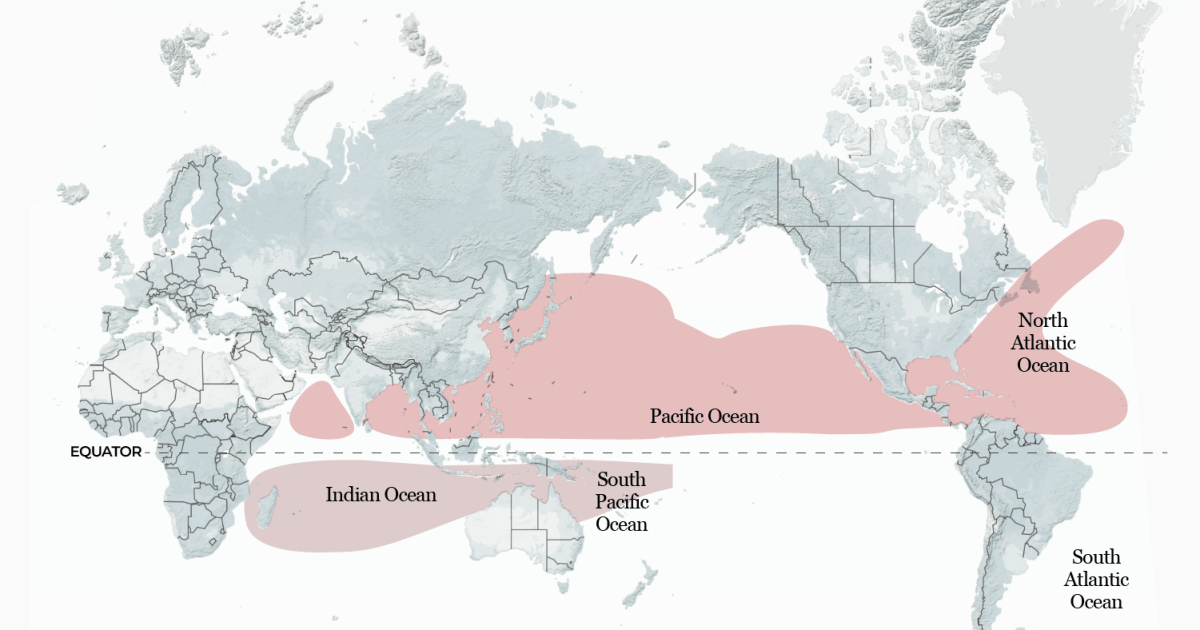
The Atlantic hurricane season has just begun and runs from Monday to November 30 with storm activity peaking in mid-September.
During this period, warm ocean waters and atmospheric shifts feed and accelerate tropical storms and hurricanes that mainly threaten the Caribbean and the East and Gulf coasts of the United States.
This year, forecasters at the US National Oceanic and Atmospheric Administration (NOAA) predicted a quieter‑than‑usual Atlantic hurricane season, largely due to a phenomenon called El Nino. They see a 55 percent chance of below‑normal activity, a 35 percent chance of near‑normal and a 10 percent chance of above‑normal.
What is El Nino, and how does it influence storms?
El Nino is the periodic warming of surface sea temperatures in the central and eastern tropical Pacific Ocean.
The resulting disruptions to global wind and rainfall systems can intensify floods, droughts and heatwaves across parts of the world. The weather phenomenon also tends to push global average temperatures slightly higher during its active phase.
El Nino events typically occur every two to seven years and usually last nine to 12 months although some persist longer.
Its counterpart, La Nina, is the opposite, meaning cooler-than-normal Pacific temperatures.
Both are part of a larger climate pattern called ENSO (El Nino-Southern Oscillation), which has three phases, summarised in the graphic below:

Neutral phase
Trade winds are steady, equatorial winds that blow from east to west across the Pacific Ocean. Under normal conditions, these winds push warm surface water away from the Americas towards Asia. As that warm water moves west, cold water rises from the ocean depths along the American coast to replace it.
The cool phase: La Nina
La Nina is the opposite extreme of El Nino. Trade winds blow even stronger than usual, pushing more warm water towards Asia and dropping eastern Pacific surface sea temperatures below average.
The warm phase: El Nino
During El Nino, these trade winds weaken or reverse, allowing the warm water in the Pacific to surge back east towards the Americas.
El Nino suppresses Atlantic hurricane activity while increasing Pacific storm activity whereas La Nina does the opposite, producing more and stronger Atlantic hurricanes.
Why and how do tropical storms form?
Tropical storms form over warm ocean waters near the equator. Simply put, as this warm air rises, an area of lower air pressure is formed.
As the air cools down again, it is pushed aside by more warm air rising below it. This cycle causes strong winds and rain.
As this cycle gains momentum and strengthens, it creates a tropical storm.
As the storm system rotates faster, the centre of it, called an eye, forms.
The eye of the storm is very calm and clear and has very low air pressure as the intense rotation flings air outwards.
When winds reach speeds of 63 kilometres per hour (39 miles per hour), the storm is called a tropical storm. When the wind speeds reach 119km/h (74mph), the storm becomes a tropical cyclone, typhoon or hurricane.

Are hurricanes, cyclones and typhoons the same thing?
When broken down to basics, yes, hurricanes, cyclones and typhoons are all essentially the same thing. The only thing that differs is where they originate. All three are storm systems with winds exceeding 119km/h (74mph).
Hurricanes: These storms occur in the North Atlantic Ocean and Northeast Pacific, often affecting the US East Coast, the Gulf of Mexico and the Caribbean. The strength of a hurricane is measured on a wind scale from 1 to 5. A Category 1 hurricane will bring with it sustained winds of 119-153km/h (74-95mph) whereas a Category 5 storm can generate winds of more than 252km/h (157mph).
Cyclones: These storms occur in the South Pacific and the Indian Ocean, often impacting countries from Australia all the way to Mozambique. Cyclone season typically runs from November to April.
Typhoons: These storms occur in the northwestern Pacific Ocean and frequently hit the Philippines and Japan. Typhoon season is most common from May to October, but they can form year-round. The strength of a typhoon has various classification scales with the most severe storms named “super typhoons”.

How will El Nino affect storms around the world?
El Nino affects weather differently depending on where in the world you are.
North Atlantic
During El Nino, hurricane activity drops in the Atlantic. An average season has 14 named storms and seven hurricanes, including three major hurricanes.
Historically, there has been a 60 percent reduction in the number of hurricane days and an overall reduction in system intensity during an El Nino phase.
“Although El Nino’s impact in the Atlantic Basin can often suppress hurricane development, there is still uncertainty in how each season will unfold,” NOAA’s National Weather Service Director Ken Graham said in a news release.
“It only takes one storm to make for a very bad season,” he warned, encouraging everyone in areas where hurricanes can strike to prepare for the storms.
Tropical storms in the Atlantic are some of the world’s deadliest and costliest natural disasters. In the US alone, hurricanes have caused 7,211 deaths, or an average of 160 per year, from 1980 to 2024, and caused about $1.55 trillion in economic losses. These numbers include Hurricane Katrina (2005), Maria (2017) and Helene (2024).

Northeast Pacific (near Hawaii)
More storms form around Hawaii during an El Nino phase. In the year right after an El Nino, more storms tend to drift into this area.
Australia and the South Pacific
During El Nino, fewer storms form across Australia’s coastline.
However, the storms don’t disappear entirely. The area where they form simply shifts east into the South Pacific near and just east of the international dateline.
These shifts are linked to shifts in surface sea temperatures and atmospheric conditions, which move and strengthen depending on the climate phase.
Asia and the Northwest Pacific
The Northwest Pacific behaves similarly to the south. During El Nino, the overall number of typhoons stays about the same, but where they form changes. Fewer typhoons form in the western part of the ocean near Asia, and more form farther east towards the international dateline.
Regions with little to no change
The southwestern and northern Indian Oceans do not seem to show any major changes in storm numbers.
How do storms get their names?
The practice of naming tropical storms began to help people quickly identify storms in warnings and media reports. Early storms were named arbitrarily, such as “Antje’s hurricane”, named after a damaged boat.
In the mid-1900s, storms began receiving female names. Meteorologists later adopted alphabetical name lists with storms named in order each year. Male names were introduced for hurricanes in 1979 and now alternate with female names.
Hurricanes are named using lists managed by the World Meteorological Organization. Six lists rotate every six years unless a storm is so deadly or destructive that its name is retired. Retired names include Katrina (2005), Sandy (2012), Irma and Maria (2017).
Naming procedures in other regions are broadly similar to those used in the Atlantic. Tropical cyclones are generally named according to rules set at the regional level with lists tailored to local languages and cultures.
The names chosen are familiar to people in each region, helping make warnings clearer and easier to communicate during storms.
The graphic below shows the 2026 Atlantic storm name list:


