


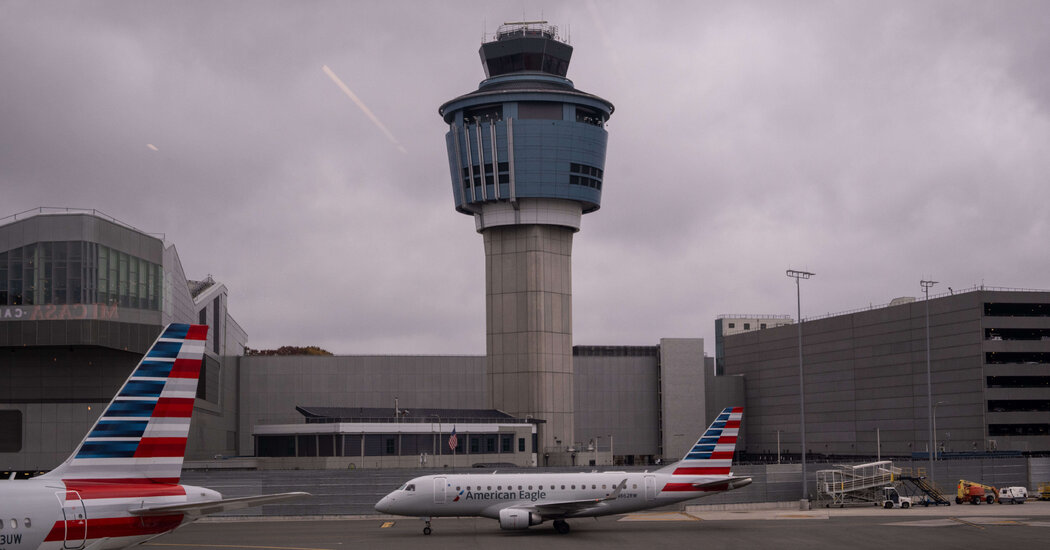
The fatal crash at LaGuardia Airport last weekend has opened a new front in the debate over staffing the nation’s air traffic control facilities: Investigators are questioning whether the minimum standard of two controllers in the airport tower is sufficient.
Only two workers were in the tower last Sunday at 11:37 p.m. when a landing Air Canada jet ran into a fire truck that was crossing the runway, killing the two pilots, investigators have found. It was not clear whether other controllers were on duty elsewhere in the facility.
At midsize airports such as LaGuardia, two controllers typically staff the overnight shift, working from around 10:30 p.m. to around 6:30 a.m. That ensures that the tower is never empty, even if one becomes ill or needs a bathroom break.
During the day, when air traffic is much heavier, there are usually at least eight controllers on duty, according to former investigators and air traffic officials, though specific levels vary by facility and shift.
But as accident investigators try to piece together what led to the crash, the country’s top transportation safety watchdog is signaling that the longtime two-person standard may have to change.
“Our air traffic control team has stated that this is a problem, that this is a concern for them, for years,” Jennifer Homendy, the chair of the National Transportation Safety Board, the watchdog agency that is investigating the accident, told reporters this week.
“It’s a concern, especially if there is a heavy workload,” she added.
The government has struggled for years to fill vacancies in national controller work force as the number of flights has increased at the nation’s airport, and to prevent burnout. The issue took on new urgency in the wake of last year’s fatal midair collision near Ronald Reagan National Airport in the Washington area, after which Transportation Secretary Sean Duffy promised to “supercharge” the hiring of new controllers.
While Mr. Duffy has indicated that vacancies are being filled, and said this week that LaGuardia had filled 33 of 37 controller positions, the Federal Aviation Administration has not published national data showing its overall progress. When a New York Times reporter asked an F.A.A. spokeswoman for updated numbers on vacancies across the country, she pointed to an August 2025 report citing staffing levels from September 2024.
But the needs of the work force may be even greater than what the F.A.A. has outlined, according to some aviation experts, because they are based on an assumption that the LaGuardia accident is now throwing into doubt.
“They are starting at a false premise that two is the number for the midnight shift,” said David Riley, a former controller at the Denver International Airport tower. “It should be a minimum of three.”
The National Air Traffic Controllers Association, the union that represents controllers, declined to comment, citing its proximity to the N.T.S.B. investigation. When asked about concerns regarding minimum overnight controller staffing, the F.A.A. said in a statement that it supported the safety board’s inquiry and would take any necessary safety actions based on evidence.
The controller managing flights in and out of LaGuardia late last Sunday had been on duty for less than an hour when he gave the lead fire truck in a group of emergency vehicles permission to cross Runway 4, just as Air Canada Flight 8646 was in the final seconds of its descent. According to the N.T.S.B.’s recounting of audio from the cockpit voice recorder, 11 seconds later, he appeared to realize his mistake as he yelled for the fire truck to stop; nine seconds after that, the tape stopped, seemingly marking the moment where the truck and the plane made impact.
By that point, the controller, who has not been identified, had already been juggling a heavier workload than would be considered ideal for the shift.
LaGuardia operates under a noise-abatement curfew from midnight to 6 a.m., which discourages airlines from scheduling flights during that window, keeping overall workload low.
But a review of last Sunday’s flights into and out of LaGuardia compiled by the tracking website FlightRadar24 indicated that the airport tower was managing takeoffs and landings after 11 p.m. at a pace of one every 69.6 seconds. That was roughly the same pace as what controllers on the previous, more robustly staffed earlier shift had been handling.
Rain and thunderstorms in New York contributed significantly to the rush: Almost all of the departures and about half of the arrivals the control tower handled after 11 p.m. had been significantly delayed.
“It would be the responsibility for the supervisor for the evening shift to evaluate if there are aircraft backed up to the midnight shift for inclement weather,” said Michael McCormick, who previously ran the Federal Aviation Administration’s air traffic office and now teaches air traffic management at Embry-Riddle Aeronautical University.
“There is a natural reluctance if you’re working evening shift to stay for additional overtime; you want to go home,” he added. “But that doesn’t mean that supervisor shouldn’t do his or her job.”
Of the two air-traffic workers who were in the tower that night, one was a local controller, responsible for managing runway traffic, and the other was the controller in charge, Ms. Homendy said. The N.T.S.B. is looking into whether the local controller was also managing vehicles on the taxiways, she said. Audio recordings of air traffic control feeds posted to LiveATC.net depict one controller spending several minutes before the accident helping the pilots of a United Airlines flight connect with airport operations and emergency personnel after the pilots smelled a strange odor on board.
It is common for duties to be combined on the overnight shift, according to former investigators and former controllers, some of whom said that is usually sufficient as long as a second person is in the tower, ready to help. “Normally, if everything runs the way it’s supposed to run, at 10:30, 11 o’clock, 12 o’clock, things really die off. You don’t need a lot of controllers in the tower,” said Scott Dunham, a former air traffic controller and senior N.T.S.B. investigator.
But, he added, standard operating procedures can need to be amended swiftly if traffic spikes, or if something goes wrong.
“It really just depends on what’s going on,” he said.
The minimum of two controllers in the tower was established after a series of high-profile incidents about 15 years ago, in which controllers working alone were found to have fallen asleep on the job.
Controllers usually rotate shifts, meaning they work a mixture of day and night shifts, according to former controllers and accident investigators. That can lead to fatigue on the overnight shift, which is anathema to the natural body clock — despite recent changes requiring that controllers have a minimum of 12 hours off before starting such a shift.
It is not yet clear what schedule the controllers on duty at LaGuardia last Sunday night had worked in the days prior.
But former investigators and controllers said that one of the most concerning things about the accident was its immediate aftermath, when the local controller involved had to keep managing airport traffic for several minutes after the collision — because there were not enough other controllers around to relieve him.
“He kept doing his job. I got to give him a lot of credit for that, for not losing it,” said Harvey Scolnick, a retired controller who previously worked in the tower at John F. Kennedy International Airport. On any other shift, Mr. Scolnick noted, the controller would have been relieved immediately.
Mr. Riley compared the situation to a police-involved shooting. “If there’s an officer-involved shooting where somebody’s a fatality, they usually take them off of duty for a while, not only for the paperwork, but you’ve got to process it mentally too,” Mr. Riley said. “Controllers need to be treated the same way.”
Jeremy Singer-Vine contributed to this report.

