


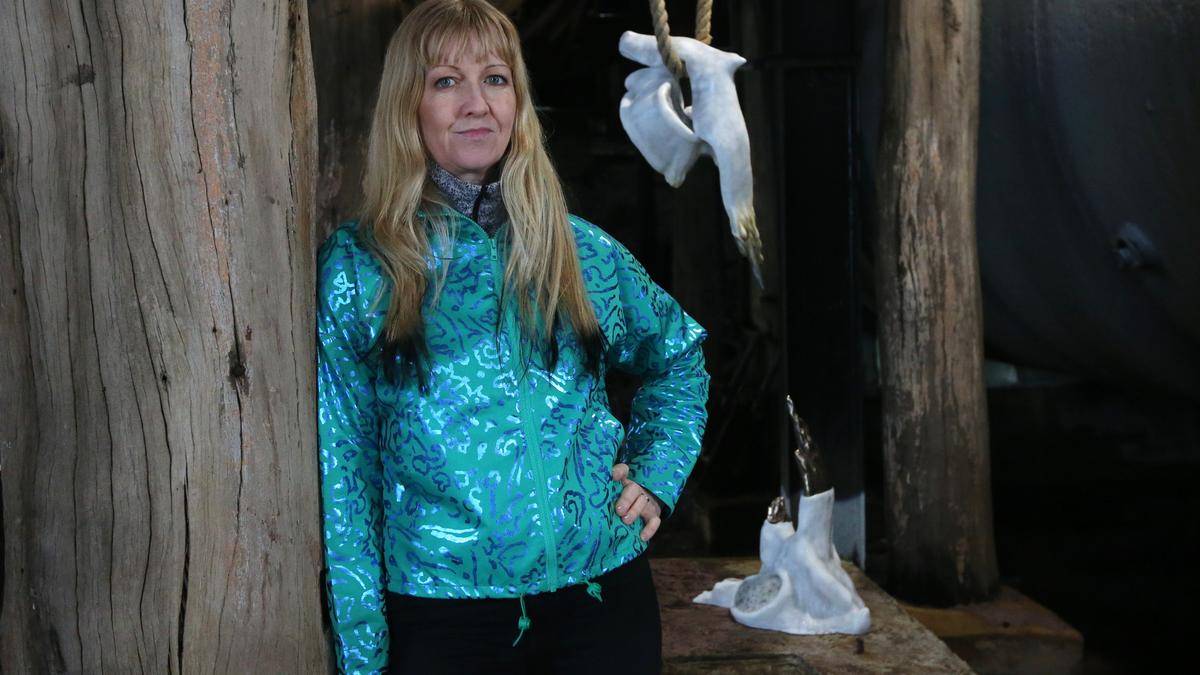
The ocean and its inhabitants hold many mysteries, and Erin Coates is captivated by them.
The Albany-born artist opened her most recent exhibition The Boneyard at Albany’s Historic Whaling Station last week, offering a thought-provoking perspective on humans’ impact on the natural environment, particularly the impact of Albany’s whaling industry.
The daughter of a shell diver, Coates weaves her personal history and connection with the ocean with history, ecology and biology, drawing on many threads to create a many-faceted exhibition that tells the story of the coast and how people changed it.
The Boneyard was inspired by a little-known site in King George Sound, just off the coast from the last shore-based whaling station in Australia: a graveyard of decades-old whale bones, deposited there during the years of commercial whaling.
Coates learned about the site during an artist residency at the Museum of the Great Southern in 2024, and convinced a local dive shop operator to take her out to the site, which lies in water about 18 metres deep and covers an area of about 30 square metres.
“I knew that the bones were very old and that they had dispersed, partially sunk into the sand and broken apart, but I did not expect what this huge pile of bones had become,” she said.

“Massive plate corals grown over the whole area, alive with fish, sponges and marine invertebrates.
“It is possible to glimpse the broken, abstracted forms of whale bones between the living growths, and although there is still a strange darkness to it, it is now a site of regeneration and life.”
Part of the work on show at the whaling station depicts large silicone vertebrae suspended into the engine room below the cutting-up deck, hanging from the wooden ceiling on ropes that were used to haul whale carcasses up out of the water for processing while the station was still operational.

Coates said this eerie work represented the process of cutting down whales’ bodies for human use, the transformation from their natural state to the chaos of the processing decks, and broken down to a new order of saleable materials.
Inside the whaling station’s gallery, Coates broadens her horizons with graphite drawings, sculptures, and collage wallpaper.
One wall is covered in wallpaper that at first glance looks like biological diagrams of creatures, but upon closer inspection joins skeletons sketched in graphite with mismatched animal parts: a femur bone with a snake’s tail, a nautilus shell with the bones of a human hand.

A hanging line of polished sperm whale teeth reflect on to nine inverted black resin forms, a work inspired by a dream to imagine the hidden lives and memories of whales in the deep, black ocean.
Stark black and white graphite drawings adorn two walls, including pieces spanning seven years of work, and a series of sculptures memorialising her family’s maritime history.
Perhaps the most striking work in the gallery is a line of bronze statuettes, silhouetted in front of a sheet of linen dripping black and red paint, representing the 48 whales taken in the final week of commercial whaling.

“While I was exploring the whaling station, I came across an image taken from the spotter plane used to find the pods of whales,” Coates said of her inspiration for the vivid piece.
“It was as the plane was flying above the whaling station on a day when a large number of whales had been caught.
“Some were on the flensing deck, others on the cutting-up deck.

“Several still floated in the water, tied by cables waiting to be processed, the shoreline a tide of red.
“Shortly after seeing that image, I came across the logbooks in the archives that recorded the total catches on every day in meticulous detail.
“In the very final seven days of whaling, 48 sperm whales were taken.”
Reflecting on the whaling station’s past has been an integral part of constructing the exhibition, Coates said.

“Whaling stopped the year before I was born, so it’s within my lifetime that the whales have come back, and I really wanted to draw on that cyclical nature of life and how things regenerate,” she said.
“My work examines human and environmental frailties, and weaves into this the possibilities of transformation and resilience.
“While my work contains optimism about human adaptation and a deep fascination in nature, there are also darker references to the scope of human impact on the animal kingdom and our own peril at this transformation.“
The Boneyard will be on display at Albany’s Historic Whaling Station until August 30.

