


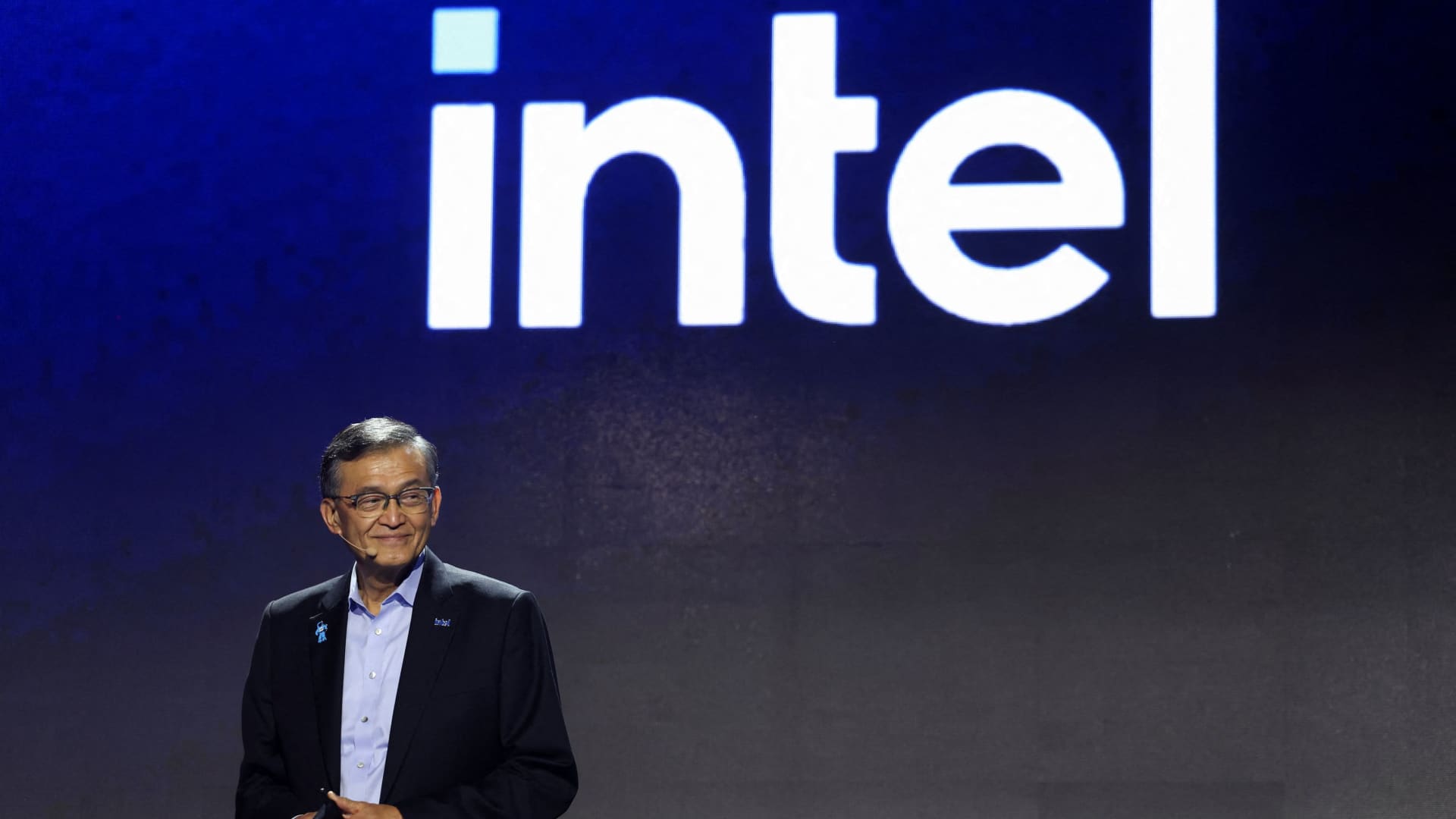
Intel CEO Lip-Bu Tan attends the annual Computex trade show in Taipei, Taiwan, June 2, 2026.
Tsai Hsin-han | Reuters
Intel reported better-than-expected second-quarter results on Thursday, notching its fastest revenue growth rate for any quarter since 2011 and issuing guidance that topped expectations. The stock jumped 11% in extended trading.
Here’s how the chipmaker did versus LSEG consensus estimates
- Earnings per share: 42 cents, adjusted, versus 21 cents expected
- Revenue: $16.1 billion, versus $14.42 billion expected
Intel shares are up over 170% so far in 2026 as of Thursday’s close after soaring 84% last year, when the U.S. government took a 10% stake in the company as part of an effort to support U.S. chip manufacturing. However, the stock has been in a slump more recently, dropping 28% in July.
Despite the recent downturn, the company is getting a boost from the artificial intelligence infrastructure boom, which is helping sales of its server processors. Intel’s 25% revenue growth was the fastest for any quarter since the third quarter of 2011.
“AI is driving unprecedented demand for compute,” CEO Lip-Bu Tan said in the statement. “As we continue to execute, Intel is well-positioned to capture sustainable growth across our CPU franchise.”
For the current quarter, Intel said it expects adjusted earnings per share of 38 cents on revenue between $15.8 billion and $16.8 billion. Analysts were expecting revenue of $15.1 billion and EPS of 27 cents, according to LSEG.
Intel also said it is starting to craft long-term agreements with customers for its server CPUs, some with pricing locked in and others focused on chip volume.
It’s a move that’s becoming common, particularly in memory, as vendors try to preserve current high pricing and market power in case the AI market turns. Intel said it had reached 10 long-term agreements, and Zinsner said the company is supply constrained, with data center customers demanding more than it can produce.
Revenue in the company’s client computing group, which makes chips for PCs, rose 13% to $8.9 billion. It’s still Intel’s biggest unit, but the robust growth is coming from its data center business, where revenue rose 59% to $6.3 billion. Intel said it expects flat PC sales in the third quarter because of the memory shortage.
Intel is boosting its capital expenditures, targeting a “meaningful increase” next year, as it aggressively tries to morph into a manufacturer of chips for other companies. CFO David Zinsner told CNBC’s Kristina Partsinevelos that the company’s latest manufacturing process, called 14A, is ahead of where older technologies were at the same point in the cycle. Intel said its foundry reported $5.8 billion in sales, up 31% on an annual basis.
Still, Intel did not reveal a major customer for its foundry, as investors and potential customers keep waiting. It primarily manufactures its own chips. Intel’s foundry landed Fortinet as its first named customer under Tan earlier this week, but it’s using an older manufacturing technology to make security chips.
Intel’s gross margin also recovered to 42%, up from 2.5% in the year-ago period, which the company attributed to benefits of scale with more revenue, as well as selling chips with higher margins and pricing.
WATCH: Bernstein’s Stacy Rasgon on Intel


