


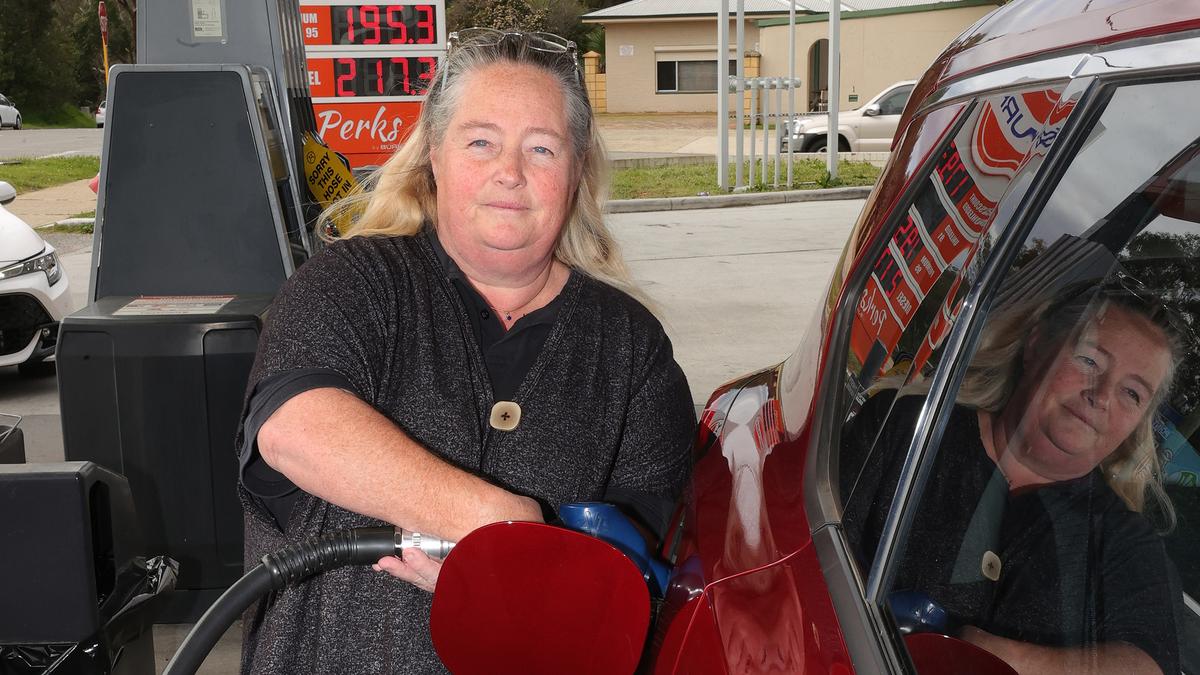
Pain at the bowser is set to return after the Federal Government’s fuel excise cut ends at midnight, with one Perth retailer bumping prices to more than $2 per litre on Monday.
The metropolitan average for unleaded will jump from 192.1 cents per litre to 194.9 cents, however Premier Roger Cook said it should be some time before consumers are hit with a “significant” increase as a result of the return to full excise.
Excise was slashed from 52.6 cents per litre to 20.6 cent a litre in April, resulting in a 32-cent discount to cushion the impact of the Iran war on fuel supplies.
The reduction was halved in July, and is now being axed entirely.
Drivers flocked to the pump on Sunday to fill up before the price rise, with Raji Nair from Nollamara saying she’d been driving around to find the cheapest option.
“The Government really need to do something more for people, I would like the excise (cut) to continue,” Ms Nair said.
“I had to take a job change after the increase because I was required to drive from Armadale to Yanchep, I’ve had colleagues transfer to sites closer to home.”

The Albanese Government relented to pressure to act, when the closure of the Strait of Hormuz sent prices to record highs of more than $2 a litre for unleaded and $3 for diesel.
ULP fell as low as $136.5 a litre after the excise discount, but higher prices are now expected for the rest of 2026 – depending on what happens in the Middle East.
The heavy vehicle road-user charge discount applied to diesel for truck drives also ends.
United’s ULP will be the cheapest in Perth at 191.9 cents per litre, while Vibe increased their prices from 186.6 per litre to 202.9 cents per litre.
In regional WA, Kalgoorlie’s average will increase to 197.7 cents per litre from 195.6, while Port Hedland’s average is set to rise from 229.2 to 231.7.
Mr Cook urged West Australian’s not to over-react.
“There’s no reason to panic. We want people to buy what they need, no more, no less,” he said.
“It will be some period of time before you start seeing any significant impact as a result of the damping down of the fuel excise.”
Chris King from Wembley was filling up with premium unleaded which was already more than $2 a litre and the highest he’d paid for fuel in his life.
Mr King said he’d been happy with the government until it came to their handling of the fuel crisis.
Patricia Barros from Innaloo said the change was “terrible, terrible!”.
“Normally I would drive my dog to different parks but I’ll stay around closer to home and minimise my usage of the car,” she said.
“My salary hasn’t increased but costs keep going up. I don’t think the government can do much to control this because what are they going to control when Trump targets other countries?”
Mr Cook said the temporary excise discount had shielded people from the “harshest impacts” of the conflict overseas, and that supplies have stabilised.
“There’s more fuel in WA today than there was on (February 28) when the conflict broke out,” Mr Cook said.
“So, there’s no reason for people to fear that there will be impacts in relation to supply.”

Federal Treasurer Jim Chalmers has asked the ACCC to closely monitor fuel prices, to ensure the rise is gradual.
“Any price increase that can’t be explained will face serious scrutiny from the ACCC,” Mr Chalmers said.
“Servos and suppliers are on notice. The regulator will be watching them like a hawk.
“We’ve jacked up the penalties for petrol stations that rip off Australians.
“They face multi-million-dollar fines if they break the law.”
Dr Chalmers said the Government’s recent tax cuts and higher wages to help with the cost of living.
But the Opposition has warned the full weight of excise will only add to cost-of-living pressures already weighing on households.
“While fuel is one of the great drivers of the cost-of-living crisis there are others as well,” Deputy Liberal leader Jane Hume said.
“It’s been more than four and a half years now that the government has failed to get inflation under control and that’s left our country far less resilient to shocks.
“If the government would get inflation under control by doing its fair share of the heavy lifting using fiscal levers to manage inflation — not just relying on monetary policy — we’d be in much better shape when these international shocks occur.”
Filling up in Subiaco on Sunday, Khidir Azhar was disappointed the excise relief was ending.
“I’m definitely a bit more fuel conscious and take more public transport instead of driving if I’m going up to the city,” the Padbury resident added.
“Months ago when prices increased the first time I burned through more fuel than I’d like.”
The price of crude oil jumped to its highest price ($91 USD) since March as the month came to a close as conflict began ramping up again between the US and Iran.
Metropolitan ULP average prices
- United 191.9 ↓
- 7-Eleven 192.2 ↓
- EG Ampol 192.7 ↑
- Ampol 193.2 ↑
- Caltex 193.4 ↓
- BP 197.4 ↑
- Reddy Express 197.9 ↑
- Vibe 202.9 ↑
Average price by product
- LPG 156.4
- ULP 194.9 ↑
- PULP 210.7 ↑
- RON 220.0 ↑
- Diesel 237.9 ↑
- Brand Diesel 242.9 ↑
- E85 269.9

