


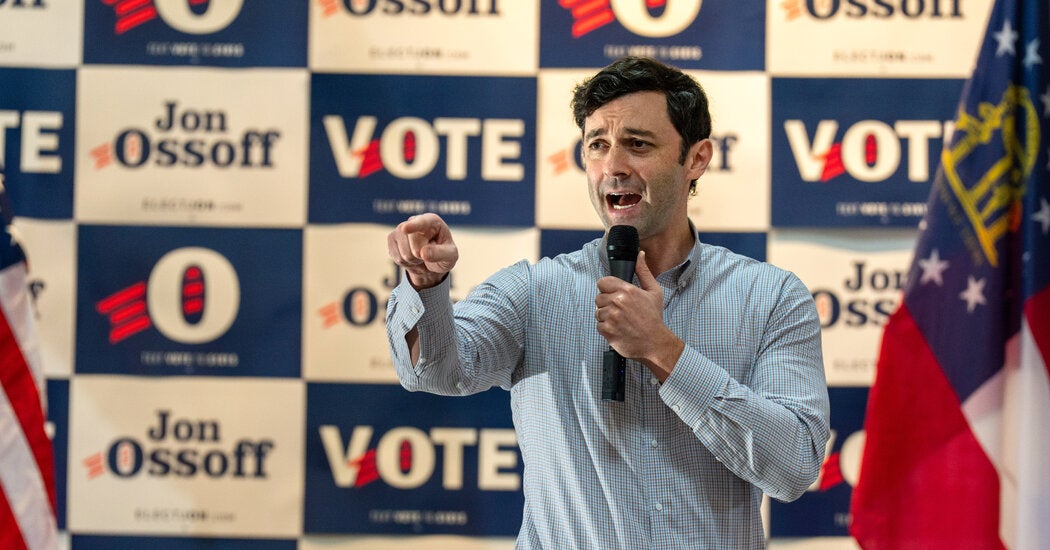
Senator Jon Ossoff of Georgia, whose race was a must-win for Democrats, easily won re-election on Tuesday, according to The Associated Press. His commanding victory is sure to catapult his name into more conversations about potential 2028 presidential contenders.
Mr. Ossoff, a first-term incumbent, defeated Representative Mike Collins, the Republican nominee, who faced accusations of bigotry and trailed throughout the campaign.
Mr. Ossoff’s feat was by no means a given. He entered the midterms as the only Democrat trying to hold on to a Senate seat in a state that President Trump won in 2024. That made Mr. Ossoff, at least on paper, the most vulnerable Senate Democrat seeking re-election this year. Democrats needed to hold on to the seat to have any realistic chance of winning Senate control.
But Mr. Ossoff proved an exceptional fund-raiser and an aggressive anti-Trump campaigner, giving fiery speeches that yielded viral video clips in which he accused the president and his family of corruption and the Trump administration of threatening American democracy. He denounced Mr. Trump and his allies as the “Epstein class” and the “Mar-a-Lago mafia”; both phrases were a hit with Democrats and gave Mr. Ossoff the air of a liberal populist.
His ability to tie corruption to the high cost of living, weaving a broader criticism of money in politics rigging the system against regular voters, fueled speculation about possible White House ambitions. Mr. Ossoff, 39, has disavowed any interest in seeking the presidency and has said that he will serve a full six-year Senate term.
At his election night party in Atlanta, Mr. Ossoff delivered a speech lofty in rhetoric and heavy on unity before hundreds of supporters.
“In sweeping and decisive victories,” he said, “the American people have rebuked the depravity, corruption, and incompetence of the failed lame duck president Donald J. Trump.”
“In these last two years together, we’ve reaffirmed that our task is not just to contain one president’s wickedness but to heal the brokenness beneath,” he continued. “That this moment is a moment not for restoration but for reformation.”
Mr. Collins, a two-term congressman from Jackson, Ga., won the Republican primary by campaigning as a Trump loyalist, defeating a more moderate candidate backed by Gov. Brian Kemp, who polling suggests is the state’s most popular Republican by far. Mr. Kemp would have quite likely given Mr. Ossoff a tougher challenge, but he passed on a Senate run, leaving some Georgia Republicans anxious that they might be poorly positioned to defeat Mr. Ossoff in a tough year for their party.
From the start, Mr. Ossoff went after Mr. Collins, 59, hard. He attacked him for reposting a video in 2024 of white male students taunting and jeering at a female Black student with racist and profane remarks — and for his history of having aides who espoused white nationalist and antisemitic views. Mr. Collins said in a debate last month that he had “condemned racism, antisemitism, hate.”
But Mr. Collins struggled to make a case that Mr. Ossoff was elitist and out of touch, or that his own experience as the owner of a trucking company made him better suited to represent regular Georgians.
By the fall, Mr. Collins’s polling numbers looked so dismal that Republicans began to shift resources away from the race, making Georgia the first big state to all but fall off the competitive Senate map.

