


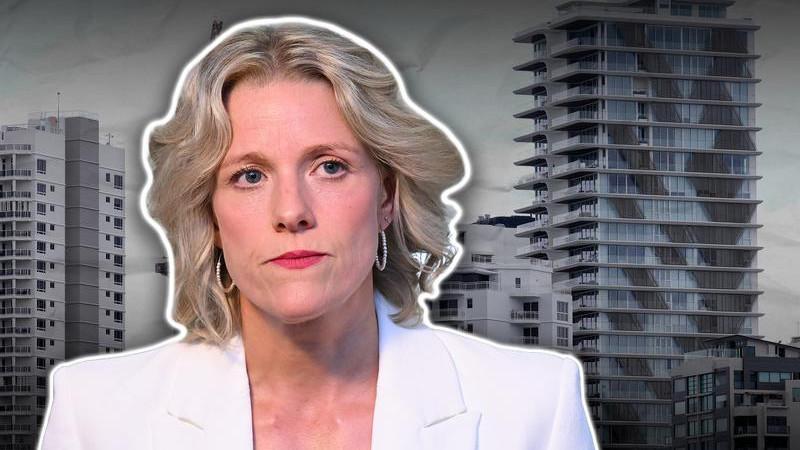
Call it a correction, a downturn or simply “softening”, but Housing Minister Clare O’Neil is refusing to put a label on predictions Sydney and Melbourne home prices could tumble by more than 10 per cent.
Commonwealth Bank is forecasting Australia’s property downturn will continue well into next year and accelerate, with double-digit falls expected in the nation’s two biggest housing markets.
The bank does not expect prices to begin recovering until the second half of 2027 and even that relies on the Reserve Bank eventually cutting interest rates.
Pressed on Sunrise over whether falls of 10, 12 or 13 per cent would constitute a housing correction, Ms O’Neil left the terminology to the experts.
“Well, Nat, I’m going to leave that to CBA and to the economists and forecasters,” she said.
Instead, the Housing Minister urged Australians to zoom out from the increasingly ugly month-to-month numbers and consider the longer-term picture.
“We’ve seen house prices in our country grow by 300 per cent since the year 2000. If that happens for another generation in our country, our nation’s going to be unrecognisable to us in terms of equality and aspiration.”
The Government has faced intense scrutiny over its housing tax changes, with Treasury previously forecasting they would result in prices growing more slowly than they otherwise would have.
There is just one rather significant problem with that argument right now…prices aren’t growing.
Sunrise host Natalie Barr put that discrepancy directly to the Minister, “But it’s not growing at a slower rate. It’s falling.”
Ms O’Neil was forced to defend the Treasury modelling, saying it examined the impact of the Government’s tax changes rather than attempting to predict movements across the entire property market.
“The big picture is that house prices in Australia will continue to grow, but a bit more slowly because of those big tax changes that we’ve made in the budget,” she said.
“And I just remind you, the reason we did that is, as you say, something had to give here. We’ve got a broken housing market in this country that’s hurting millions of people, and our government is standing up and doing something about it.”
But Nationals Senate Leader Bridget McKenzie was having none of the suggestion that the downturn could simply be chalked up to another turn of the property cycle.
“That’s not cyclical, Clare. That’s not cyclical,” she said.
Ms McKenzie claimed some homes had already lost as much as $90,000 in value and pointed to 1.7 million mortgage holders she said were experiencing mortgage stress.
She also seized on the dramatically different forecasts now emerging for the housing market.
“And it was only three months ago we heard the treasurer and the government say that housing price growth would only decrease by 2 per cent, and now we’re seeing banks calling out that this is going to be the largest price correction in the housing market in 40 years.”
For Labor, falling prices present an awkward balancing act.
Cheaper homes could offer some relief to younger Australians struggling to crack into the market, with Barr noting polling from July found 61 per cent of Australians wanted house prices to fall.
But for millions of existing homeowners, their property is also likely to be their biggest asset.
Ms McKenzie argued Australians would not take kindly to watching that wealth disappear, declaring the downturn was either “a massive failure of economic management by the Labor Party” or, based on Ms O’Neil’s defence of making housing more affordable, “a deliberate design feature”.
“And I think Australians are going to take a very dim view of their largest asset’s value falling through the floor over coming months.”

