


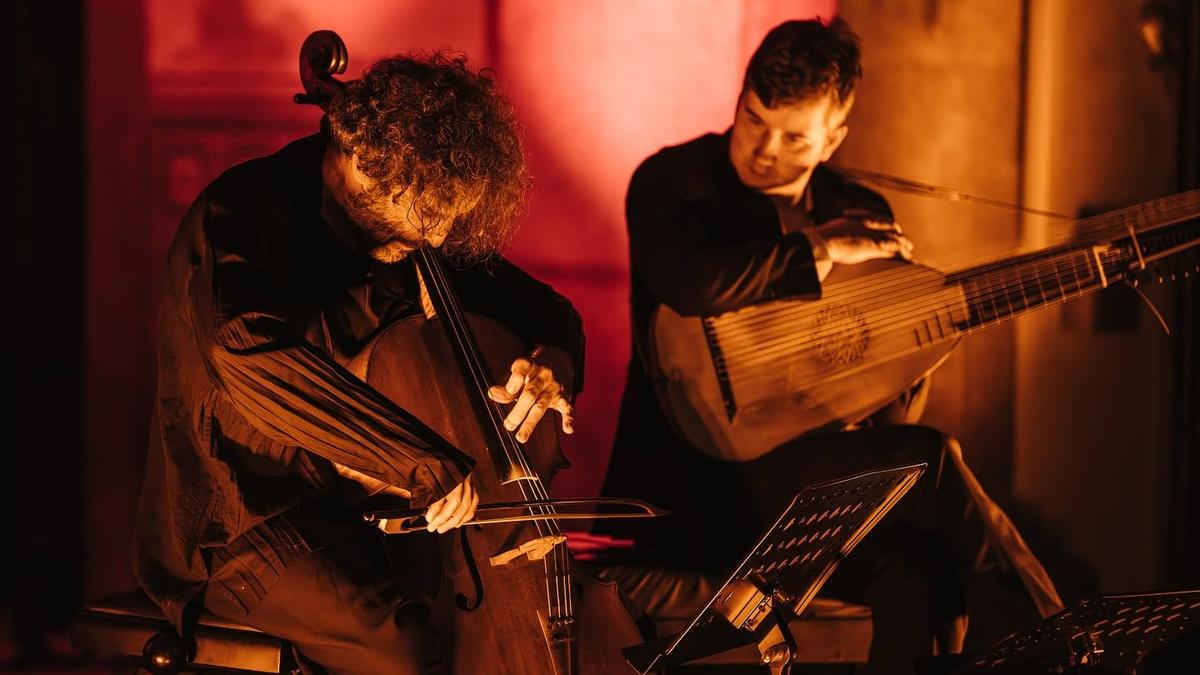
Friendship and affinity run through the collaboration of lutenist Thomas Dunford and cellist Nicolas Altstaedt, who launch their Musica Viva national tour at UWA Winthrop Hall on Wednesday.
It’s an Australian debut for Dunford and a welcome return for Altstaedt, who graced Perth Concert Hall two years ago with the Australian Chamber Orchestra.
Both share French heritage, reflected in a program heavy on the music of Marin Marais and Antoine Forqueray — court musicians to Louis XIV — plus Baroque contemporary JS Bach, late-Romantic composer Henri Duparc and 20th century maestro Arvo Part.
Dunford’s choice of the lute is tied to his heritage.
“I was with my parents who are viol players and were giving a workshop in the middle of France when I was nine,” he says.
“My mother said I looked bored and proposed that I take a lute lesson. I tried and instantly fell in love with the instrument.”
Dunford is a rising star, described by BBC Music Magazine as the “Eric Clapton of the lute”, while Altstaedt is an established international soloist and conductor.

The cellist plays a Guadagnini instrument crafted in the second half of 18th century, following the tradition of the Stradivari but smaller and more agile
“When I was looking for an instrument seven years ago, I kept looking for a large instrument and played an uncut Rugieri, until I came across the Guadagnini, that is 10cm smaller than the Rugieri. It did not only have a much deeper and powerful bass, but also larger upper tessitura (range) despite its small size,” he says.
“A violin maker called it once a small Ferrari, as it provides everything you need, while being very flexible.”
The Ferrari and the lute — a more ancient instrument — have an interesting resonance.
“These instruments have a halo and a huge dynamic and colour range that work well together,” Dunford says.
Altstaedt digs deeper.
“A violoncello that is built nowadays is a model varying on influences from 1712-45,” he says.
“A grand piano is a model that dates from a hundred years ago. When you play with modern piano a lot of attention goes to the ability of the pianist creating the right balance between these uneven instruments.
“Playing with the lute, this problem doesn’t appear. You rather have the feeling playing with your sister.”

The duo met in 2010, at a festival in the Hungarian city of Kaposvár.
“In those few days we had less time to rehearse than usual, but it felt very easy and inspiring as we were riding the same wave,” Altstaedt says.
“Thomas is a musician, that I respect a lot. Respect leads to being open and letting things happen, trusting and reacting until you create something together. That’s why music is the most magical thing to create bonds between human beings.”
Their collaboration is more recent, grounded in the repertoire they have chosen.
For Dunford, it’s about “poetry, emotions, and a wide range of colours”.
“We hope the audience enjoys this music that we love,” he says.
Altstaedt seconds that emotion.
“I believe the music proves that both instruments are not restricted to a certain period in time, but can speak to an audience with music from Bach to Arvo Part,” he says.
Thomas Dunford and Nicolas Altstaedt open their Australian tour with Musica Viva at Winthrop Hall on Wednesday, August 5.

