



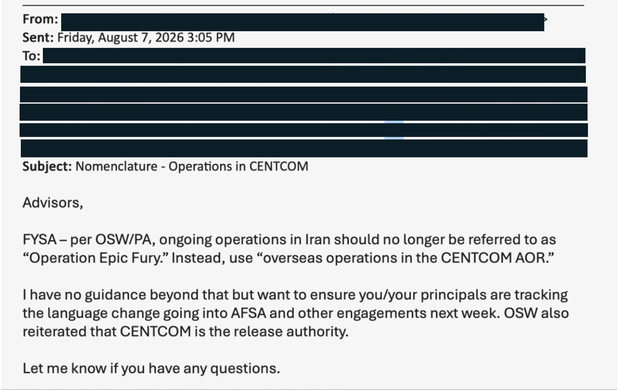
Washington — An Air Force email from August and obtained by CBS News shows the Pentagon was instructing personnel to stop referring to ongoing U.S. military operations in Iran as “Operation Epic Fury” — three months after the Trump administration declared it had ended.
In response to questions from CBS News, the Pentagon said Wednesday that Operation Epic Fury officially ended May 5, the same day Secretary of State Marco Rubio declared to reporters at the White House: “The operation is over. Epic Fury is — the president notified Congress — we’re done with that stage of it. We’re now on to this Project Freedom.” Four days earlier, Mr. Trump told Congress the “hostilities” had “terminated.”
Previously, the Pentagon and U.S. Central Command had declined to disclose the operation’s formal end date for months. The U.S. and Iran have continued to exchange on-and-off fire since Operation Epic Fury’s official end date, though there have been lengthy pauses in fighting, including during a ceasefire that began in early April.
But the date also raises questions about how the Pentagon categorizes service members who were killed and wounded after “Operation Epic Fury” formally ended, or why guidance over what to call ongoing U.S. military operations against Iran came months after the May end date.
Last month, as senior U.S. Air Force leaders flew to Orlando, Florida, to attend the 2026 Air Force Sergeants Association, high-level public affairs officers were instructed to inform military leaders not to use “Operation Epic Fury.” They were told to instead use broader language to refer to the conflict: “overseas operations in the [U.S. Central Command Area of Responsibility],” according to an email containing the guidance that was obtained by CBS News and dated Aug. 7.
The Air Force email shows that the guidance was issued by Defense Secretary Pete Hegseth’s central public affairs office led by Sean Parnell, the chief Pentagon spokesman. It reiterated that U.S. Central Command had to approve information publicly released about the Iran conflict.
U.S. military officials who spoke to CBS News under condition of anonymity said the guidance was not exclusive to the U.S. Air Force and was disseminated across the entire Defense Department. Military officials, who spoke to CBS News under condition of anonymity because they were not authorized to speak publicly, said the guidance was also disseminated within their services in August and September.
Contacted by CBS News, a Defense Department official said: “Following the April ceasefire, the administration stated Operation Epic Fury had concluded on May 5. Subsequent activities have included Freedom of Navigation operations and strikes to further diminish threats posed by the IRGC [Islamic Revolutionary Guard Corps] to commercial shipping, Gulf countries, and American forces.”
The U.S. military has historically published start and end dates for named military operations, creating a public record of when one mission ends and another begins. Operation Enduring Freedom in Afghanistan, for example, began Oct. 7, 2001, and ended on Dec. 31, 2014, before moving into Operation Freedom’s Sentinel
The Pentagon used those dates to establish campaign phases and eligibility for military awards, but they also provide Congress, service members and the public with a clear way to track the scope and duration of American military involvement in operations abroad.
Rubio appears to be the only Trump administration official to publicly and explicitly say that Operation Epic Fury had officially concluded. He did not, however, say that the date it ended was May 5.
On the same day as Rubio’s statement, Hegseth also separately briefed reporters at the Pentagon, differentiating Epic Fury from the new Project Freedom, which he described as a defensive maritime mission to protect commercial shipping through the Strait of Hormuz. He referred to Epic Fury in the past tense but did not explicitly state that the operation had ended. In a Pentagon press briefing a month earlier in April, after the U.S. and Iran entered into a temporary ceasefire, Hegseth said Epic Fury had achieved a “decisive military victory.”
May 5 was also the last time the Pentagon briefed the press on the war with Iran. Mr. Trump announced on May 5 that Project Freedom would be put on hold for a “short period of time” so the U.S. and Iran could negotiate. Its current status is not clear.
The May 5 date did not mark the end of the broader conflict with Iran. American forces continue to conduct missions tied to the conflict that began six months ago when the U.S. and Israel attacked Iran.
President Trump formally notified Congress that “military action” against Iran had restarted on July 7, in a message addressed to Republican Sen. Chuck Grassley of Iowa, the Senate’s president pro tempore. At around that time, talks between the U.S. and Iran collapsed, and Mr. Trump declared the April ceasefire “over.”
Iranian forces have continued attacks on U.S. troops and commercial vessels following the collapse of the April ceasefire. The U.S. has also periodically struck Iran, including in two different rounds of strikes this week that drew Iranian counterattacks.
The Pentagon’s acknowledgment of the May 5 date raises questions about why its public affairs office found it necessary in early August to explicitly instruct senior leaders not to use the Operation Epic Fury banner when talking about ongoing military operations against Iran, an operation the military now says had ended months earlier. The Pentagon did not comment on why the guidance was sent out.
Separately, the significance of the May 5 date also extends beyond the named operation, providing a benchmark for understanding how the military has counted the Americans killed and wounded in the fighting since the war with Iran started.
In July, the Defense Department website that informs the public about the dead and wounded in military conflicts originally categorized four service members who died in July in the Mideast as being killed in action during Operation Epic Fury — two months after it had officially ended.
On July 18, 1st Lt. Tyler James Feehan, Staff Sgt. Angel Rampersad and Pfc. Isabella Gonzales were killed when an Iranian missile hit their sleeping barracks at Muwaffaq Salti Air Base in Jordan. The fourth service member, Staff Sgt. Michael Emmanuel Swinton, was killed in a separate incident on July 19, in Iraq, during a controlled detonation of an Iranian attack drone.
Within a few days, the four were moved on the Defense Department’s website into a new category, “overseas operations,” which was created over the weekend of July 25. The move technically decreased the number killed in Epic Fury hostilities from 18 to 14.
When the four deceased service members were moved to the overseas operations category, multiple news outlets, including CBS News, requested to know why. Chief Pentagon spokesman Sean Parnell on July 23 chalked up the errors to a “temporary data disruption” and said the “site anomalies” were being resolved. The Pentagon also declined to say in July when Epic Fury had ended.
Contacted for this story, a Pentagon official said: “Since Operation Epic Fury has concluded, the Department classifies casualties as overseas operations in the CENTCOM area of responsibility.”
As of publication, the Pentagon’s Defense Casualty Analysis System currently shows five service members were wounded in June, and one was killed in July in Operation Epic Fury. It’s not clear why these service members are categorized under the operation that the Pentagon says ended in May or why no end date for Epic Fury is listed.

