


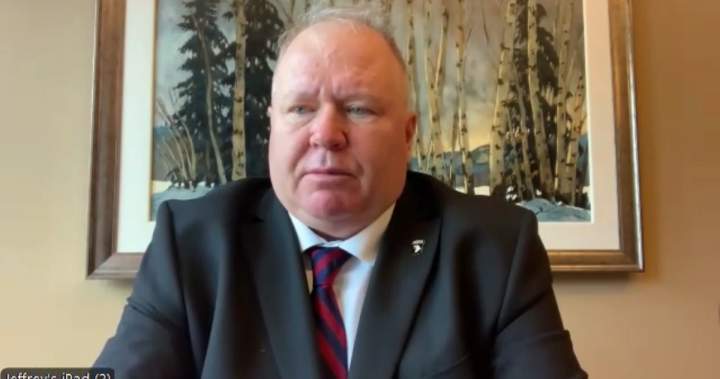
Another First Nation is questioning millions in alleged withdrawals from a trust overseen by Alberta separatist lawyer Jeffrey Rath and his professional corporation, court documents obtained by Global News reveal.

The allegations from Sturgeon Lake Cree Nation emerged from material disclosed in a separate court battle between Rath and Tallcree First Nation. That case led a provincial judge on Friday to grant an interim Mareva order against Rath and Jeffrey R.W. Rath Professional Corporation, which operates as Rath & Company. The judge found reasonable grounds to believe assets could be moved or dissipated before judgment.
A Mareva order, also known as a freezing order, is an extraordinary pre-judgment remedy that prevents a defendant from transferring, hiding, or liquidating assets before a case is decided, allowing the collection of any eventual financial award.
During a hearing on the matter on Wednesday, Justice John Gill extended the Mareva order until Aug. 11 and granted a receivership order, putting an independent court officer in control of assets and records so the “missing” trust money can be traced and protected.
Referring to the Tallcree and Sturgeon Lake cases, Gill said, “This raises a concern about a pattern of behaviour by the respondents and the potential intermingling of trust assets.”
A co-founder of the Alberta Prosperity Project, Rath is a leading voice in the separatist movement and has long represented First Nations in landmark treaty settlements.

Rath now faces escalating, simultaneous legal challenges from two First Nations, each alleging that his firm charged trust fees they were never told about and withheld financial records that should have been disclosed earlier.
Those cases come on top of eight other First Nations that have been involved in court or Law Society proceedings against Rath, a Global News investigation found.
Sturgeon Lake Cree Nation has now raised concerns about $12 million in withdrawals from the Sturgeon Lake Cree Nation Trust, including more than $11 million paid to Rath & Company as administrative fees and another $575,000 tied to legal expenses, according to an affidavit filed on Tuesday by Chief Sheldon Sunshine. The trust distributed the settlement funds to beneficiaries and held the minors’ shares until they reached adulthood. Rath’s firm was the fund’s sole trustee.
Rath has not responded to the allegations.
The latest fight is tied to a long-running legal battle between Sturgeon Lake and Rath, and follows a February 2025 Alberta Court of Appeal ruling that upheld an order that Rath could not enforce the 20 per cent contract behind his $28.6-million fee from the nation’s Treaty 8 settlement.
The Nation has also been fighting to remove Rath as the sole trustee of the trust, alleging incorrect payouts, difficulty obtaining information, rude treatment by Rath & Company staff, and incomplete financial statements.

Get breaking National news
Get breaking Canada news delivered to your inbox as it happens so you won’t miss a trending story.
The allegations from Tallcree and Sturgeon Lake have not been proven in court.
Like Tallcree, Sturgeon Lake alleges it has been unable to obtain financial statements for its trust. The last financial statement it received covered 2021. Subsequent years produced only “financial summaries” for 2022 and 2023, despite multiple requests, court documents allege.
It was through material filed in the Tallcree court case on Monday that Sturgeon Lake learned auditors were questioning $12 million in withdrawals from its own trust paid to Rath & Company, according to Chief Sunshine’s affidavit.
Sturgeon Lake’s lawyers received the Mareva injunction order as well as four letters from Tallcree’s lawyers, revealing questions from financial auditors Doane Grant Thornton to Rath about the trust withdrawals.

They zeroed in on four withdrawals: two from Jan. 23, 2024, for $9.8 million and $1.67 million paid to Rath & Company as administrative fees, and two 2023 withdrawals for almost $500,000 and $75,000 described by Rath as legal expenses for trust management.
According to correspondence with auditors in the court documents, Rath states that the $11.47 million was a retroactive administrative fee charge for 2017 to 2024 — based on a review of administrative fees charged by similar trusts, which he says were “well within the range” of those fees — and permitted by the trust agreement.
Sunshine argues Rath’s corporation drafted the trust agreement.
In a December 2024 email to Grant Thornton, Rath says external legal expenses were necessary to pay law firms such as Parlee McLaws and Reynolds Mirth.
But when Rath provided invoices, the auditors noted, both firms described their services as reviewing the retainer agreement between Sturgeon Lake and Rath & Company — the same lawsuit that Sturgeon Lake had brought against him.
Separate court documents obtained by Global News indicate that Parlee McLaws sued Rath in 2024 for around $140,000, claiming that Rath and his company had failed to respond to repeated requests to pay invoices for legal services they had carried out for him, dating back to November 2021. Three months later, the case was dropped. Global News was unable to determine why.
When Grant Thornton asked for an arm’s-length legal opinion on whether the withdrawals qualified as administration costs and other reasonable expenses under the terms of the trust agreement, Rath refused, saying his own reading was sufficient, according to letters from Rath to the auditors included in Sunshine’s affidavit.

When the auditors pushed back, saying this was insufficient audit evidence, Rath continued to disagree. He labelled the request out of scope and unnecessary and threatened to terminate them if they did not complete the audit without it, according to correspondence included in Chief Sunshine’s affidavit.
“At this stage, we feel it is incumbent on you to meet your responsibilities and complete the Audit without any further delay and without the need for an outside legal opinion,” Rath allegedly wrote.
“[…] If you do not agree to complete the Audit on the terms we have outlined – consider this letter as our Notice of your Termination as Auditor of the Trust and our expectation of your confidentiality under the Audit Engagement Agreement.”
Sturgeon Lake says it is still awaiting news about the $28.5 million fee. Rath is allowed to seek a fair and reasonable fee, but Chief Sunshine says no review date has been set. In May, the Nation filed an application to have the money paid into court.
Rath, however, had previously indicated that he no longer has most of the money. Court records from 2022 indicated that litigation funders had advanced Rath $10 million for the Sturgeon Lake case and he repaid them $23.3 million after settlement funds were received. Sturgeon Lake has no records of that payment or funding agreement, documents indicate.
In his affidavit, Sunshine — whose council met urgently on Monday evening to discuss the audit letters —is “deeply concerned” about the revelations.
“[Rath] claims to be a treaty expert and helping all these First Nations, yet … looking back on our court cases and our dealings with him, it was more [him] taking advantage of the situation,” he told Global News in June.
In his affidavit, he said he worries “many children will never see that money from the settlement and that our Nation will never see any return of the disallowed contingency fee following the eventual review.”
The Sturgeon Lake case parallels the dispute between Rath and Tallcree First Nation.
After courts cut his 20-per cent fee on Tallcree’s $57.6 million settlement, Rath’s corporation was ordered to refund $8.5 million to the trust. Court filings later alleged Rath PC charged more than $6 million to the same trust in 2024, and bank records showed an $8.5 million cheque from a trust account payable to “Jeffrey R.W. Rath Professional.”
In his defence against Tallcree’s latest claims, Rath denies wrongdoing and says audited financial statements identify all fees and costs charged to the trust and that all money coming in and out was disclosed in accordance with the trust agreement. The trust agreement provision gives the trustee broad powers, including moving trust property within Canada and “charg[ing] for services performed by them, including the services of acting as Trustee.”
Rath did not oppose the extension of the Mareva order on Wednesday.
In his reasons for granting the extension of the order, Gill said there was a strong prima facie case that Rath had made “improper payments out of the trust” and that he personally had assisted “in a breach of fiduciary duty.”
Referring specifically to the $8.5 million cheque taken from the Tallcree trust, he said it was “made in direct contravention of the orders of Justice Lee and the Court of Appeal.”
“There is also a real risk that the respondents have been actively taking steps, and will continue to take steps, to frustrate the process of locating the missing money,” Gill said.
With files from Adam MacVicar and Ken MacGillivray.

