


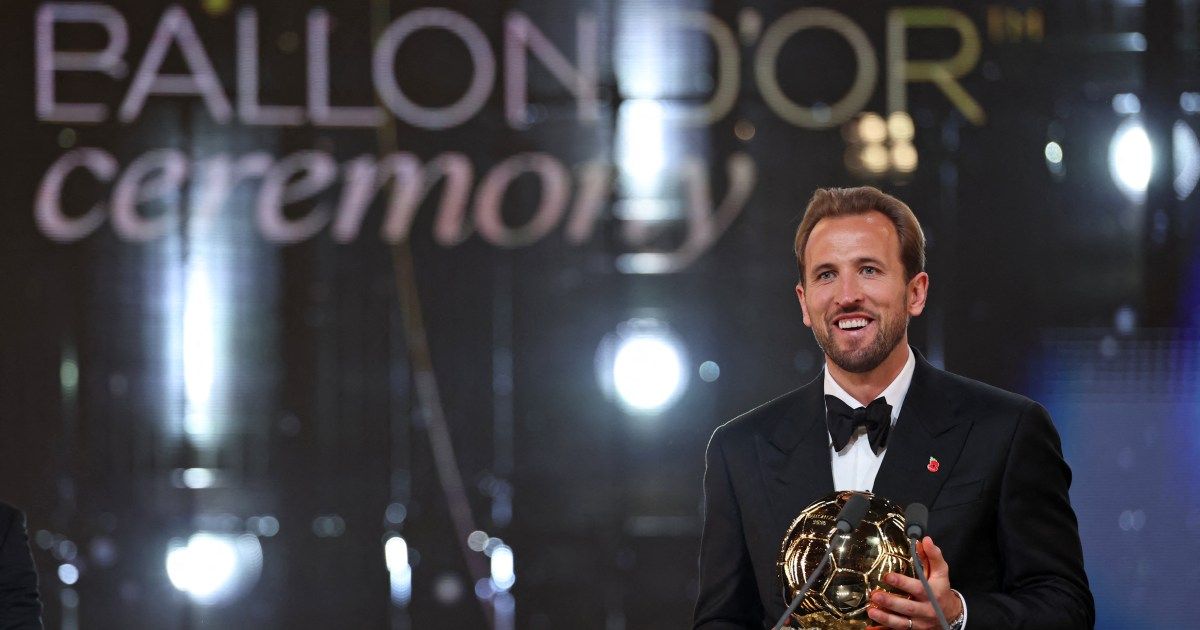
The Ballon d’Or is football’s most prestigious individual honour. On Monday, Bayern Munich striker Harry Kane became the first Englishman to win it since Michael Owen in 2001. But his victory also raises a fundamental question about the award: How can individual excellence be fairly assessed in a team sport?
For much of the past two decades, that question has been overshadowed by the extraordinary rivalry between Lionel Messi and Cristiano Ronaldo. From 2008 to 2017, one or the other won the Ballon d’Or every year, turning the annual award into a contest between the two superstars. Messi eventually accumulated a record eight trophies and Ronaldo five, together accounting for 13 of the 17 awards presented between 2008 and 2025.
Their rivalry generated unprecedented excitement around an award first presented in 1956, when England’s “wizard of the dribble”, Sir Stanley Matthews, became its inaugural winner. But it also pushed several important questions into the background. Has the growing commercialisation of the Ballon d’Or distracted from its purpose? Why does it overwhelmingly reward attacking players? And why does a supposedly global award remain so heavily focused on European football?
The commercialisation of the Ballon d’Or reflects the transformation of football into a global entertainment industry, in which individual players have become brands in their own right.
“The whole dynamic of the Ballon d’Or has changed because the dynamic of the sports and entertainment industry has changed with the way individual athletes are marketed,” Steve Martin, founding partner of MSQ Sport + Entertainment, formerly of M&C Saatchi, told The Athletic.
“They’ve found a way as an individual athlete or player to build their own profile and their own fanbase, as opposed to relying on their clubs. They control their own destiny, and they market themselves.”
Former Switzerland defender Ramon Vega has been more critical of this development. “The commercialisation and monetisation of this award is not taking it in the right direction,” he told the writer.
The Ballon d’Or has undoubtedly become a bigger spectacle, but the attention surrounding the award should not obscure the question of what constitutes individual excellence. And commercialisation is not its only problem. The award has also long favoured players in attack over those in other positions.
A goalkeeper’s or defender’s performance is as important as that of midfielders and strikers, in a sport where a team is supposed to be as great as the sum of its parts. Yet Russia’s Lev Yashin remains the only goalkeeper to have won the award, in 1963, while Italy’s Fabio Cannavaro was the last defender to do so, in 2006, after captaining his country to World Cup victory. Germany’s Franz Beckenbauer and Matthias Sammer were among the few other defenders to have received the honour.
“Goalkeepers and defenders are also part of the spectacle. Attackers don’t just play amongst themselves,” Cannavaro told France Football after winning the award in 2006. “If a goalkeeper has saved 15 or so matches in a year, it’s only fair to highlight him.”
But the Italian’s observations have done little to change the pervasive bias of voters for the award, as strikers and midfielders on the European club and national team stage remain the yardstick for measuring global excellence.
That focus on European football points to another longstanding weakness of the Ballon d’Or: Its failure to adequately recognise outstanding players from elsewhere in the world.
For nearly four decades after the award was established, only European players were eligible to win it. This was a great injustice to exceptional footballers from other continents, even those competing in Europe’s leading leagues. The late Diego Maradona was perhaps the most notable victim of this exclusion.
The restriction was finally lifted in 1995, allowing players of any nationality at European clubs to compete for the prize. It took another 12 years, until 2007, for the award to be opened to players competing anywhere in the world.
It could be argued that when the award began, the club and national team game outside Europe was beyond the close observation and expert knowledge of the Ballon d’Or selectors. But that argument no longer holds water. Knowledge of the global game has grown exponentially, yet recognition of excellence beyond Europe’s leading competitions remains limited.
When Liberia’s George Weah became the first non-European player to win the Ballon d’Or in 1995, following outstanding performances for Paris Saint-Germain and AC Milan, his victory was expected to open the door for exceptional players from parts of the footballing world that had long been denied recognition.
But 31 years on, the former president of Liberia remains the only person outside Europe and South America to have won it.
“When I started playing football, I never thought I would ever win the Ballon d’Or and emerge as the best player in the world. I just had a passion for the game and I worked hard. Every day. I would rather train than eat or sleep,” Weah told the writer in Monrovia.
“I am surprised that no other African player has won the award since I did so. I think there have been others that deserve to win. But it is down to those who select the winners.”
Cameroon’s Samuel Eto’o, the former Barcelona and Inter striker, now president of his country’s football federation, is one person with a right to feel aggrieved that he didn’t win the award before retiring in 2019.
“It’s difficult to understand how Samuel Eto’o never won the Ballon d’Or with the impressive career he had,” Jose Mourinho, who managed Eto’o at Inter, said in a 2019 interview with Cameroon Radio.
“He played in three Champions League finals, winning two with Barcelona and scoring in both finals. He also won one Champions League at Inter and won many league titles. He was the best striker in the world for several years, and I think he deserved a Ballon d’Or, but these are things out of our control.”
Eto’o’s omission, like Weah’s continued status as the only African winner, raises questions about how the award’s selectors and voters assess the achievements of players from outside football’s traditional European and South American powerhouses.
The Ballon d’Or already has an international voting panel, with journalists from 100 countries selecting the winner from a shortlist of 30 players. But geographical representation among voters does not necessarily translate into recognition of the world’s footballing talent.
France Football, the award’s organisers, should ensure that the process of selecting nominees and winners draws on a genuinely global understanding of the game and gives due recognition to exceptional players, regardless of nationality or where they compete.
The award must also address its other shortcomings. Football is a team sport in which goalkeepers, defenders, midfielders and strikers all contribute to success, and individual recognition should reflect that. Nor should the growing commercial appeal of the Ballon d’Or distract from the footballing achievements it was created to honour.
The Ballon d’Or should be a celebration of individual excellence across all positions and all continents, not an award dominated by football’s biggest stars and Europe’s leading competitions. Only then can it truly claim to recognise the best footballer in the world.
The views expressed in this article are the author’s own and do not necessarily reflect Al Jazeera’s editorial stance.

