


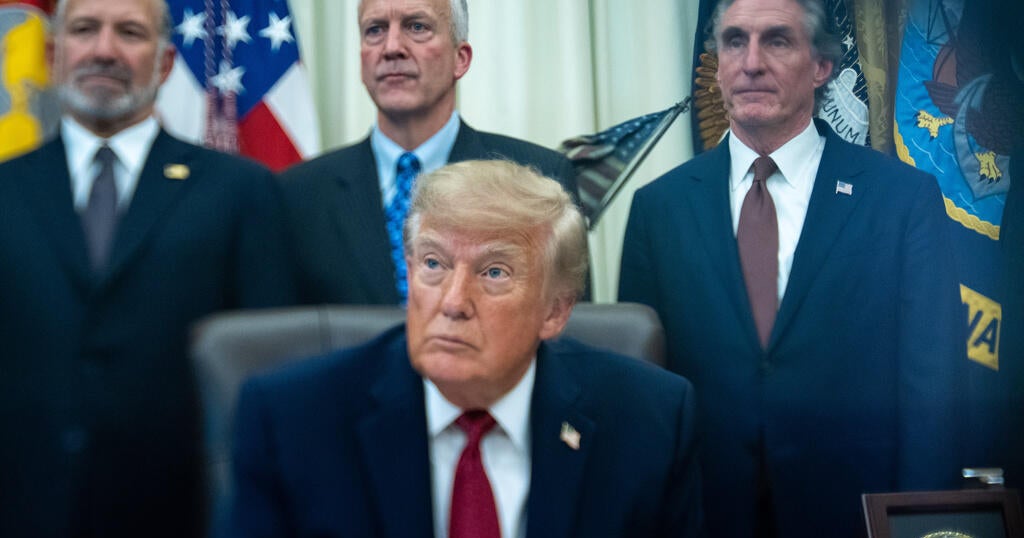
President Trump announced plans Wednesday for South Korea to invest in exporting natural gas from Alaska, a project long backed by Republican Sen. Dan Sullivan, who is in a competitive reelection contest there.
It marks the second time in three days that the president has sought to highlight planned foreign investments in states where Republican Senate candidates are in tight election campaigns. Mr. Trump made a similar Oval Office announcement on Monday for a massive steel plant in Iowa, another state where Republicans are defending a Senate seat.
The project consists of an 807-mile natural gas pipeline connecting Alaska’s petroleum-rich North Slope to a liquefied natural gas export terminal in southern Alaska. It will eventually reduce energy costs for the state’s residents by providing a reliable and secure supply, the White House said. Commerce Secretary Howard Lutnick said liquefied natural gas could also be exported to Asia.
Officials said during the Oval Office event that building the pipeline will take three years and that exports of liquefied natural gas would begin two years after that — but that was dependent on financing coming through fully.
It was not clear how quickly South Korea’s government would approve the project and how much it planned to spend.
The pipeline is part of a series of projects that Mr. Trump said would get nearly $200 billion in South Korean funds, including a power plant in Texas and eight “large-scale” nuclear power plants. Further details on those investments are not clear.
The investment comes from pledges made as part of a 2025 trade deal with South Korea, which included promises of $350 billion in investments in the United States in exchange for lower U.S. tariffs on South Korean cars, auto parts and other products.
Mr. Trump credited his controversial tariff strategy for making the announcement possible, saying, “Our trade agreement with South Korea, they have to invest hundreds of billions of dollars.”
The president credited Sullivan during the Oval Office event.
“He’s got my ear, and he’s had my ear for a long time on Alaska,” Mr. Trump said. The president added that “all these energy projects are all mine, and I got ’em done working with Dan Sullivan.”
Sullivan said, “the sky is the limit when we get this project done.”
“Mr. President, this one is huge for Alaska,” Sullivan said, adding that he’d been working on it “relentlessly.”
The push to deliver big projects in areas where GOP candidates could use a boost comes as Mr. Trump’s approval ratings have sunk to nearly historic lows ahead of midterm elections. Republicans are also contending with voters’ historical tendency to reject whichever party controls the White House during the midterms.
Even Mr. Trump himself has begun acknowledging that Republicans could face an uphill climb in their push to retain control of both chambers of Congress after November, but suggests it is because his administration hasn’t done enough to promote its accomplishments.
“I’ve done a very bad job of explaining,” the president said during an event in the White House’s East Room, which came before the subsequent announcement on the Alaska investment.
He’s promised to help rectify that by spending much of the next 30 days on the road, campaigning ahead of the midterms — though he is beginning that swing with trips to Texas, Alabama, Ohio and Nebraska, which are all normally solidly red states.
Sullivan, who has been a persistent advocate for the Alaska natural gas project and has encouraged South Korean investment, is a two-term senator facing a competitive challenge from Democratic former Rep. Mary Peltola.
Wednesday’s Alaska event came two days after Mr. Trump announced plans for a $15 billion steel plant to be built in Iowa by a Minnesota company owned by an Indian industrial conglomerate.
In Iowa, Republican Rep. Ashley Hinson is in a close U.S. Senate contest with Democratic state Rep. Josh Turek for the seat being vacated by retiring two-term Republican Sen. Joni Ernst. Hinson spoke in the Oval Office during the announcement.
Alaska and Iowa — where Mr. Trump won comfortably each time he has run for president — are among the states where Democrats are targeting Republican-held Senate seats in the 2026 midterm elections, less than five weeks away.
Democrats need to gain a net of four seats in the 100-member Senate to overtake Republicans in the majority.

